Burson Audio Timekeeper Voyager V-400 MAX power amplifier
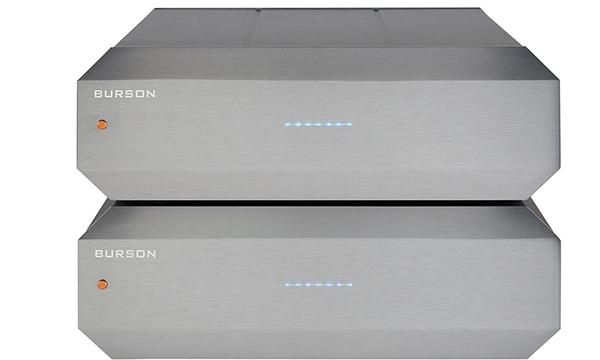

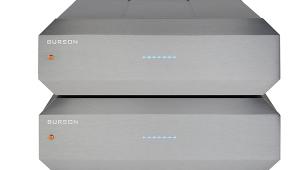
Designed as a partner for the likes of Burson’s Conductor Voyager DAC/preamp/headphone amp [HFN Mar ’26], the Timekeeper Voyager V-400 power amps, at £6200 – yes, for the pair in the MAX version we have here – defy convention in a number of ways. For a start, despite their diminutive size – they’re around 27cm square and 8.5cm tall – the amps don’t take what may seem like the obvious route of a Class D topology, with its advantages of size, efficiency and cool running.
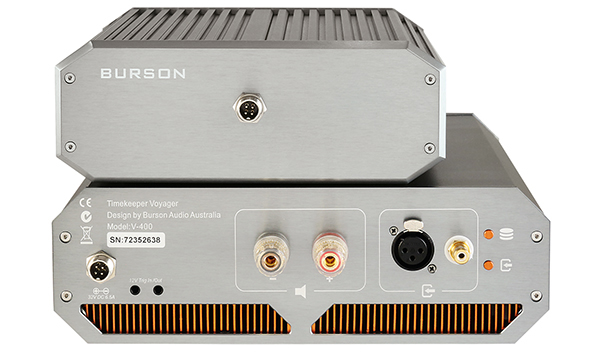
Instead, these are Class AB amplifiers, rated at 100W/8ohm and 200W/4ohm [see PM's Lab Report] and heavily biased into Class A. They necessarily run hot, so for all their compactness, we’d avoid using them in an enclosed space, such as a cupboard. That’s despite a couple of Burson strategies to disperse heat, the first of which is the ribbed aluminium alloy ‘Cool Case’ supported by copper internals, with fan assistance venting through grilles in the rear panel. The fans are quiet enough to be inaudible at normal listening distances, and only just apparent when close to the amps with nothing playing.
Clocking in
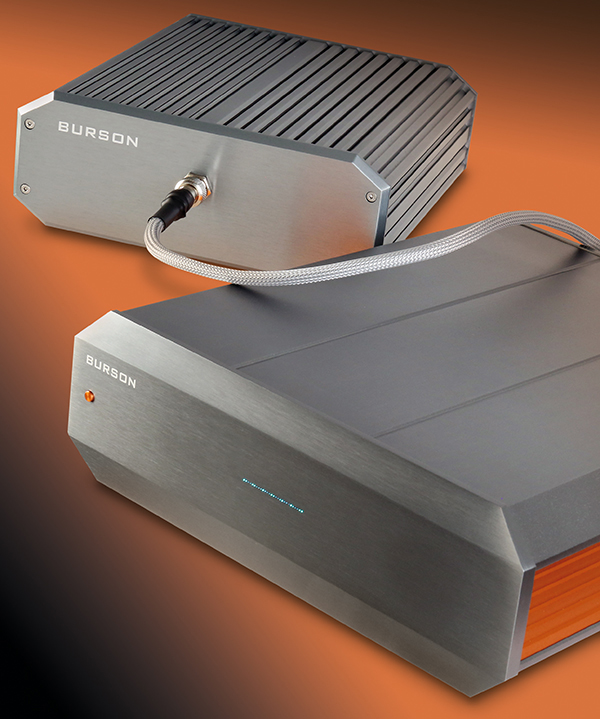
The Timekeeper Voyager amps here come with Burson’s more substantial Fusion Core 32V GaN-transistor switchmode power supplies, operating at a claimed 1MHz, and connecting via a screened 4-pin umbilical. There is PSU regulation and filtering within the Voyager amp itself, its ‘Silent Power’ (SP2) modules claiming an ultra-low 0.8μV residual noise floor.
The rest of the amp’s rear is pretty simple, with a choice of unbalanced RCA or balanced XLR ins, selected using a small copper-coloured button [see p61]. Another button allows a gain boost of +3dB for the RCA input, or +6dB for the XLR – an LED bar on the front of the amp indicates which medley of input/gain mode is selected.
The amps have a single set of combination terminals for speaker connection, plus 12V trigger in/out. There’s no AC mains switching on the Fusion Core power supplies – once everything is connected, the outboard PSUs automatically switch on when the amps are fired up. As an aside, PM and I agreed that the design of the Fusion Core is a little awkward, with the mains input to the rear and the multicore output on the front. It would surely look neater, and rack more logically, were the DC out connector relocated to the rear...
Tweaker’s corner
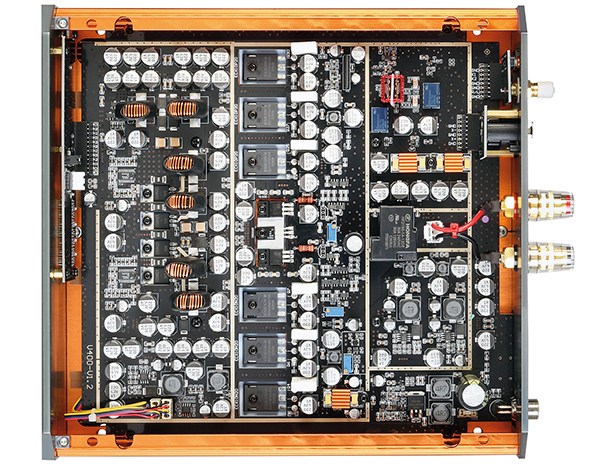
In common with the enthusiast philosophy of Burson, which started in 1996 and grew out of the world of ‘head-fi’ – which is as close to a counterculture as you’re going to find in modern hi-fi – the Timekeeper Voyager amplifiers can be modified with substitute power supply modules and upgraded op-amps [see boxout]. Our samples were already fitted with the aforementioned SP2 Silent Power modules and with V7 discrete op-amps in that Class A input ‘buffer’ stage. The manual is unusual in giving full instructions for stripping down the amplifiers and changing these components should you feel brave or just curious, but then that’s always been the Burson way.
Growing out of a group of enthusiasts who pooled knowledge and expertise to create the kind of products they wanted to hear, early Burson projects were never intended for commercial release. Indeed, it took until 2005 before word had spread to the point where its first product was released onto the market.
To date, awareness of the Burson brand has been gained through word of mouth and various ‘head-fi’ community forums, the company neither advertising nor attending hi-fi shows. The recent appointment of Armour Home in the UK as one of its official distributors is therefore a major move – most of Burson’s sales are typically direct from its Australian HQ.
 Tiny dancers
Long-time Burson enthusiasts may challenge the assumption inherent in this, but on the showing of the recently reviewed Conductor Voyager DAC/headphone amp and the V-400 monoblocks we have here, the product offering is more than up to the task now the company is hitting the big time. Yes, these bijou amplifiers did look faintly ridiculous sitting between the huge Wilson Audio Alexx Vfx floorstanders in the HFN Reference Listening Room [HFN Yearbook ’25], but despite the equally ridiculous price differential, these Australian-developed monoblocks proved rather special indeed.
Playing the understated Untouched Takeaway live set from Nick Lowe [Bandcamp download], the Timekeeper Voyager V-400 MAX amplifiers delivered a fine sense of presence and ‘live-ness’. Lowe’s relaxed voice was as well realised as the minimal instrumentation on tracks such as ‘Shaking On The Hill’ and ‘Indian Queens’, while the mainly acoustic version of ‘(What’s So Funny ’Bout) Peace, Love And Understanding’ had a fabulously close-up quality. The tracks with larger musical forces, meanwhile, showed excellent scale and weight.
Prior engagement
The same goes for the classic Steeleye Span sound, honed over more than 55 years, on the recently released Conflict album [Park Records PRKCD162]. Maddy Prior’s vocals are a little thicker than in the past – after all, she is almost 79 and still gigging with the band – but the Voyager monoblocks still revealed the slam with which the album opens on ‘Over The Hills And Far Away’. The unnerving spookiness of ‘Ghost Ship’ – no, not an old tale of piracy and the like, but a ship ‘loaded with refugees’ – saw Prior’s voice plaintive and well defined against the guitars and rhythm section. By contrast, the nostalgic ‘When All The World Was Young’, almost a look back to the old days of the band, possessed a fine ethereal quality.
Pumping out the power of ‘The Warning’, from Nine Inch Nails’ Nine Inch Noize set [The Null Corporation download], found these Voyager V-400 amps very much ‘up for it’. This recording is all slamming bass and driving rhythms, and the amplifiers gave a suitably aggressive and upfront presentation of what’s not exactly a state-of-the-art recording.
Changing pace to Apollo’s Fire’s take on Bach’s Brandenburgs [Avie Records AV2207], the sprightly playing of the American chamber group was beautifully realised by the fast, tightly defined sound of these Burson amps. I was recently lucky enough to see this ensemble in an instrumental ‘Fencing Match’ of double concertos with members of the English Baroque Soloists at Snape Maltings. Turning to leader Jeanette Sorrell’s arrangement of Vivaldi’s ‘La Folia’, from Vivaldi & Friends [Avie AV2211], with which the concert concluded, the exuberant spirit was again evoked, with an effortless flow to the ‘madness’ as it built.
That sense of ‘live’ is a hallmark of the Timekeeper Voyager’s sound. With an old review favourite, the ‘Carousel’ waltz from the Sinfonia of London/John Wilson’s recreation of the entire Rodgers & Hammerstein score [Chandos CHSA5342(2), 96kHz/24-bit], the units delivered both refinement and ripe instrumental textures. There was also a total confidence in the way they handled the easy swing of the music, then the speed at which Wilson takes the central section, with its feeling of the ride running out of control before settling back into its rich, stately rhythm.
Guitar hero
This assured sound was much to the fore in classical guitarist Sean Shibe’s Vesper recital [Pentatone PTC5187518; 192kHz/24-bit download]. Every note in James Dillon’s ‘12 Caprices’ landed with real impact before fading into the acoustic, resonant and yet with no blurring. And even with the longish silences here there was not a hint of the Voyagers’ fans running – instead, all the focus was on the image of fingers on strings, and the thrilling effect of thoughtful, totally concentrated musicianship.
Wrapping up with some good old-fashioned rock swagger, The Who’s ‘Baba O’Riley’, from Who’s Next: Life House [UMC 96kHz/24-bit download], sounded as dramatic as ever, The Ox’s grumbling subterranean bass and Keith Moon’s thundering drums underpinning Daltrey’s raw vocals and that familiar windmilling guitar. Meanwhile, The Rolling Stones’ skanking, slinking ‘Fingerprint File’ from It’s Only Rock ’N Roll [Polydor download] saw Keef’s guitar cannoning out from the speakers, Charlie Watts’ drumming as restrained and effective as ever, and Bill Wyman’s bass and synths driving it all along. It was a performance so captivating you could even forgive Jagger’s cod vocal theatrics. Burson’s Voyager Timekeeper amplifiers have it sorted – and in some style.
Hi-Fi News Verdict
Small but mighty – yes, it’s a cliché, but one that sums up rather well these compact power amplifiers. Beware of the fact they run hot, so don’t be tempted to box them in: instead, put them on display and enjoy their open, refined and yet hard-hitting sound, full of detail and impact. Beautifully built and finished, they may look daft between a pair of huge floorstanders, but who cares when they sound this good?Sound Quality: 87%
 | |||||||||||

|
|
| |||||||||








 SPONSORED VIDEO






| Equipment Reviews | |
Music Reviews Awards | |
Latest News Features | |
Resources Newsletters | |
Subscriptions |
WHERE TECHNOLOGY BECOMES ENTERTAINMENT
 © 2026 Hi-Fi News
AVTech Media Ltd
All rights reserved