Onkyo P-80/M-80 pre/power amps
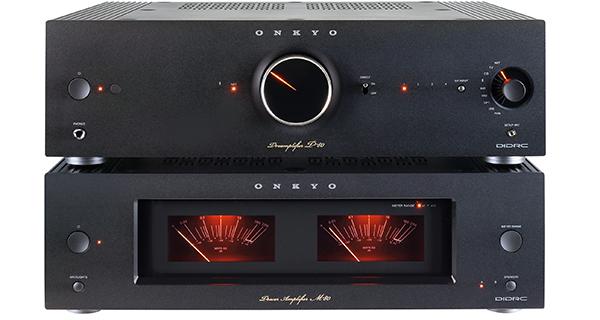

Onkyo has carved a name for itself as a leading maker of AV receivers, but the Japanese company has never lost sight of its two-channel roots, and neither have its fans. Onkyo’s M series power amps, including the M-504 from 1987, still trade for hefty prices on the secondhand market. Aside from its sonic capabilities, that model is valued for its large VU meters, a trend not lost on Onkyo when it came to setting the aesthetic for its new M-80 power amplifier. Paired with the P-80 streaming preamplifier, the system delivers the convenience demanded in 2026.
The launch of this new ‘Icon’ range coincides with the brand’s 80th anniversary although, strictly speaking, the P-80 and M-80 aren’t officially part of the birthday party – there are other celebratory products on their way. But the Icon range, which also includes the A-50 integrated and C-30 CD player, appears to herald the start of a true Onkyo revival. The brand seemed nearly dormant after its sale to a joint venture between Sharp and Premium Audio Company (a subsidiary of Voxx, also responsible for Klipsch) in 2021, but has ambitious plans to introduce a wealth of new products in 2026 and beyond.
Orange juice
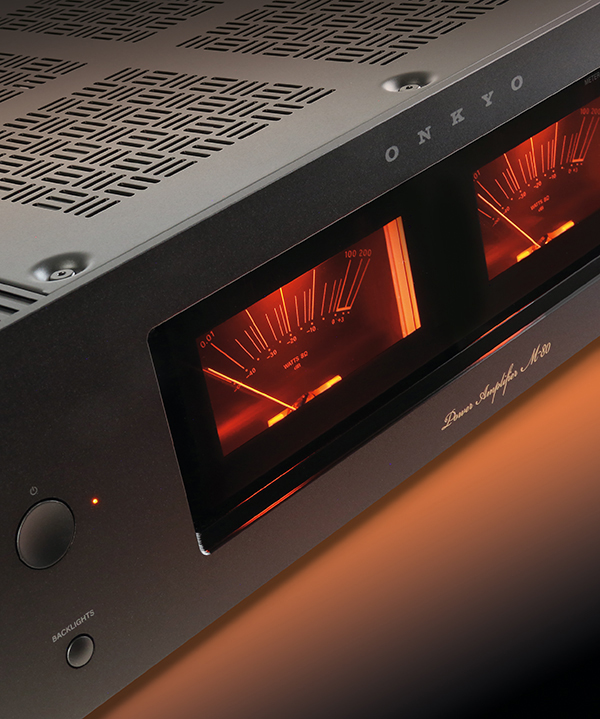
I used to own an Onkyo P-3000R and M-5000R, both of which were substantial, well-built pieces of kit and precursors of the P-80 and M-80, respectively. These new units don’t feel as solid, but the M-5000R was introduced in 2010 at £2500 (£3700 adjusted for inflation), considerably more than the reasonable £1449 now asked for the far lighter but also more powerful M-80. The P-80 and M-80’s steel and aluminium cases sport decent enough build quality with some charming details, such as ventilation holes in a geometric San Kuzushi-style and script font labels. There’s a lot of orange illumination too, as a backlight for the VU meters on the M-80 and the indicators and rotaries on the P-80.
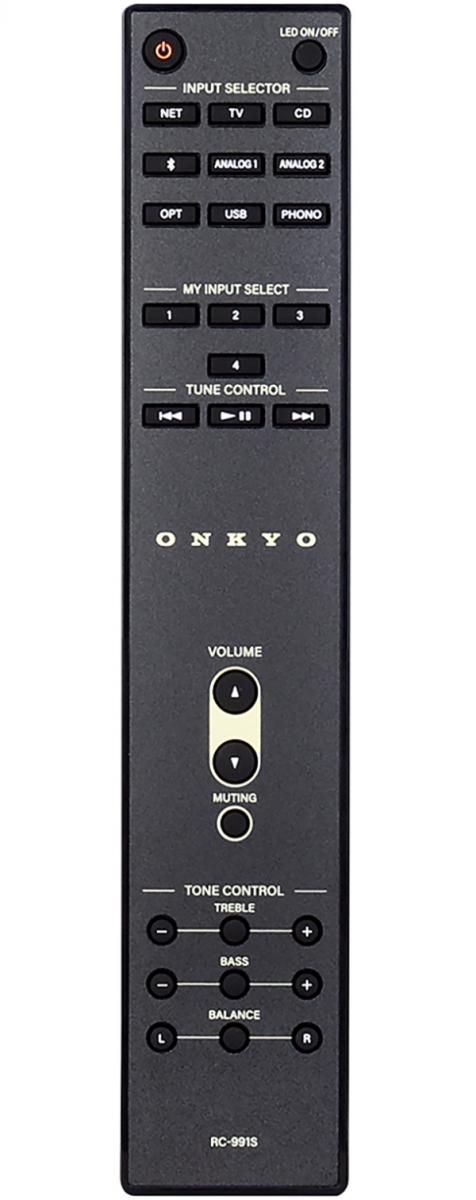
The preamp’s input selector is multifunctional. When you adjust treble or bass, the orange lines around the input knob function as a kind of display, with more lines above or under the zero-position lighting up as you boost or cut. So, even though the VU meters add a touch of nostalgia, the overall design of both devices is quite modern, in both the black or silver colourways. These marry past and present effectively, and I especially like how the P-80 and M-80 (and if you wish, the C-30) visually ‘stack’ to form a system – just like hi-fi used to be!
Tried and trusted
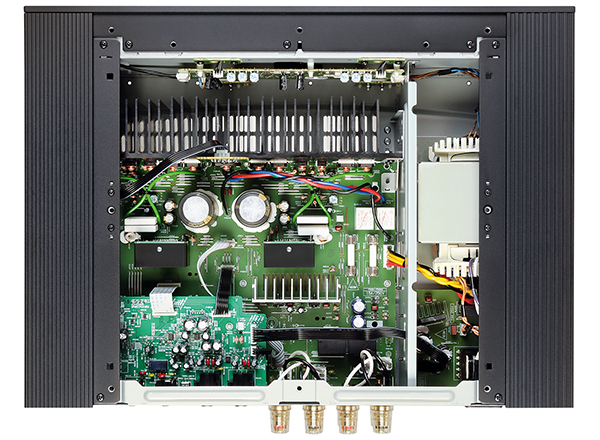
The M-80 is as classic as they come, and more than skin deep – this is not one of those ‘vintage’ products that looks the part but features a not very authentic Class D power module under the hood. On the inside here is a three-stage Class AB Darlington amplifier offering a claimed 150W/8ohm and delivering more [see PM's Lab Report]. It’s not far removed from what you might find in the brand’s products from the ’80s and ’90s.
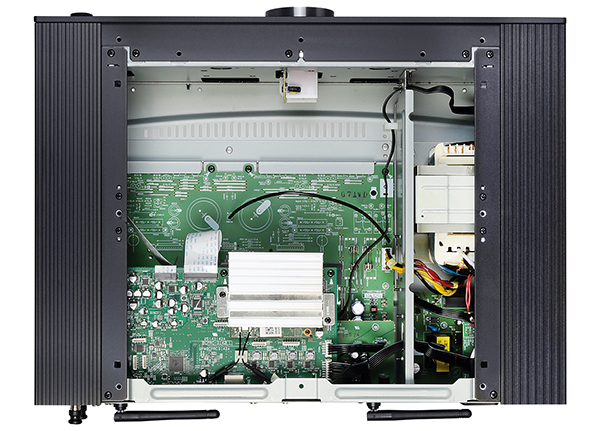
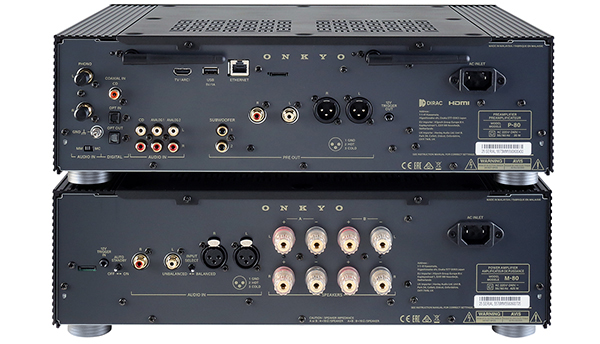
The P-80 on the other hand, is bang up to date. It’s a fully kitted out preamplifier with onboard DAC, an HDMI ARC input, an MM and MC phono stage and a good range of network audio options. Control and streaming are possible via the Onkyo Controller app [see boxout], and there are third-party options galore. This includes Roon Ready, but also AirPlay 2 and Chromecast as ‘universal’ options alongside Qobuz Connect, Spotify Connect and Tidal Connect. If that doesn’t suffice, Onkyo also provides Bluetooth with support for the improved aptX and aptX HD codecs.
Onkyo and sister brand Klipsch seem to be staunch fans of Dirac, the latter even including the ‘professional level’ room calibration software on its soundbars. So, its presence on the P-80 doesn’t come as a total surprise, although it is unusual to find it on a product at this price level. Included is a Limited Bandwidth licence, which normally retails for $159, and is sufficient for dealing with sub-500Hz room issues – getting Dirac to tackle the full frequency range requires an upgraded licence, at a cost of $99.
Dirac Live Room Correction can be very effective but it does require time and knowledge to deploy correctly. Making good measurements is key and tweaking the target curve is often required. Some further investment is also recommended, as while Onkyo provides a puck-shaped microphone, anyone wanting optimal results should invest in a USB measurement microphone with calibration file and stand.
As this might be a bit of a stretch for many two-channel buffs, the P-80 provides a quick and dirty adjustment in the shape of Onkyo’s Fidelity IQ tool, which measures the room’s response to create an automatic Loudness function. I tried this with multiple loudspeakers without ever being convinced by what I heard – the sound tended to become very ‘stuffy’ with boosted lows. Dirac, on the other hand, gave a real improvement in my room, which has minor acoustic treatment. The upshot is that Dirac may require a bit of user effort, but it’s worth it. The P-80 can also run Dirac Live Bass Control for dual subwoofers, although this is another optional upgrade ($299) and not available during testing.
 Made to match
Hooked up to a pair of Monitor Audio Gold 300 6Gs [HFN Oct ’24] and making use of the P-80’s DAC stage via Roon, this Onkyo system’s full character was on display throughout ‘Diablo Rojo’ from the self-titled debut album of Rodrigo y Gabriela [PIAS Recordings; 44.1kHz/24-bit]. As fast as the Mexican duo could pick and strum their guitars, the P-80 and M-80 were on their tail with a commendable sense of speed. Listening to these musicians play live is exhilarating, a sensation that Onkyo’s power amplifier was nimble enough to recreate.
Playing a part was the resolution on offer, which saw the duo’s flurries of notes communicated with insight. I’ve known many Onkyo stereo products in the past to focus on treble clarity, leading to what some describe as a ‘Japanese’ sound. Arguably, that’s the case with the P-80/M-80, although this pairing – while offering a base sound that could never be described as ‘warm’ – is not anaemic either. The P-80’s treble and bass controls are helpful here in allowing the whole system to ‘gel’ that bit better, something you might consider doing if using the amplifiers with a more analytical-sounding set of loudspeakers.
In the mood
It’s a different genre, but there’s similar stringed virtuosity across Farangi (Du Baroque à L’Orient) from jazz/classical bassist Renaud Garcia-Fons and lutist Claire Antonini [E-Motive Records; 48kHz/ 24-bit]. The detail of ‘Reng-é Shotor’ was a highlight, these Onkyo units delivering an airy performance with appreciable depth and width. I could zoom in on both instruments, all the while enjoying the melodies of the theorbo and double bass being woven together, and the occasional scrape of a bow to heighten the ‘live’ mood. Here the P-80/M-80 gave a performance a lot closer to traditional audiophile territory than, again, you might expect at the price.
There was less to admire in terms of detail and subtlety with the relatively lo-fi recording that is Sleater-Kinney’s All Hands On The Bad One [Sub Pop download; 96kHz/24-bit]. Nevertheless, the Onkyo amps proved their mettle with a rendition bursting with energy and drive – the kind of sheer exuberance suited to a Friday evening listening session before heading out to a favoured hostelry.
Admittedly, Monitor Audio’s Gold 300 6G floorstanders aren’t a particularly demanding drive, but it was still impressive how effortlessly the M-80 seemed to exploit their full-range potential. When powering out ‘Knife Prty’ from Californian punk/metal band Deftones [White Pony; Maverick 9362-47667-2] – and the Controller app showing a volume level of just 25 (out of 100) – I wondered how long it could last before a neighbour would come knocking.
Out of the shadows
A very small toggle switch on the back of the P-80 provides selection between MM or MC gain and loading for its phono input. Flipping it to MM for use with a Technics SL-1200GR2 turntable [HFN Sep ’24] and Nagaoka MP-700 cartridge [HFN Aug ’25], and spinning DJ Shadow’s 2023 release Action Adventure [Mass Appeal MSAP154LPBK], the results were genuinely excellent for a £1350 preamplifier. Separation and placement were great on the sci-fi homage ‘Time And Space’, with its soundstage full of discrete effects and retro-tinged synths benefitting from a suitably dark background.
As for the P-80’s MC performance, auditioned via a Pro-Ject X2 B deck [HFN Sep ’22] fitted with the brand’s Pick it MC9 cartridge [HFN Jul ’24], I’d rate this as ‘fine’ rather than ‘excellent’ – the performance sounding a little ‘matter of fact’ with Dominique Fils-Aimé’s soulful Three Little Words LP [Modulor MODLP090]. It’s a good thing that Onkyo provides the option, but critical vinyl listeners advancing into moving-coil territory will surely be tempted to acquire a separate phono stage, by way of upgrade, if they really want to realise the exacting detail a quality MC offers.
There are a lot of features of the P-80 that make Onkyo’s vintage-styled preamplifier utterly contemporary, nothing more so than the HDMI connection, which allows you to pair your two-channel system with a TV. This is becoming more and more commonplace on ‘mass market’ hardware, and why not? Streaming video services are awash with good music content – an example being the Deutsche Grammophon 125th anniversary concert on Disney+, with John Williams conducting the Saito Kinen Orchestra in Tokyo’s Suntory Hall.
Marching band
As expected, it’s a performance packed with rousing orchestral themes to get the M-80’s juices flowing, but the system also impressed with the delicate clarinet and harp of ‘Stargazer’, from Steven Spielberg’s E.T., before the arrival of massed strings. Once again, the P-80 had the resolving ability to uncover little nuances, just as the M-80 had the power reserves to rise to the occasion for the ‘Imperial March’ from Star Wars. Like the best hi-fi stacks of the past, Onkyo’s new pre/power is a thrilling combination.
Hi-Fi News Verdict
Considering the comprehensive functionality and performance on offer, the combination of the P-80 and M-80 is a steal. Onkyo’s vintage/modern design is very appealing, even if the massive build quality of the past is not quite there. The VU meters are lookers though, and the resolving sonics make for exciting listening. Add in Dirac room correction, and this pre/power will form the heart of a great system.Sound Quality: 88%
 | |||||||||||

|
|
| |||||||||











 SPONSORED VIDEO






| Equipment Reviews | |
Music Reviews Awards | |
Latest News Features | |
Resources Newsletters | |
Subscriptions |
WHERE TECHNOLOGY BECOMES ENTERTAINMENT
 © 2026 Hi-Fi News
AVTech Media Ltd
All rights reserved