PrimaLuna EVO 300 hybrid power amplifier
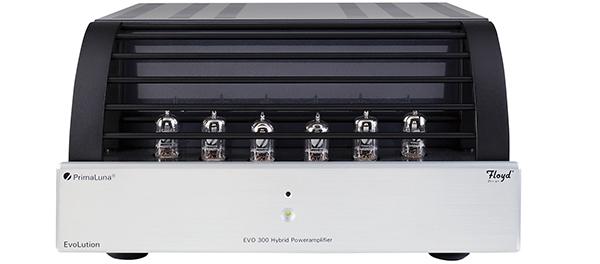

Three questions sprang to mind when discussing the PrimaLuna EVO 300 Hybrid ‘poweramplifier’ with editor PM. The company has been merrily supplying all-valve products for 22 years, so the introduction of hybrid models seemed a non-sequitur, especially given that this particular amp’s £6498 price tag doesn’t preclude an all-tube design on the grounds of costs.
As for the trio of head-scratchers, we mused about 1) why hybrids from a company that paid its dues with valves, 2) why is the power amp dearer than the integrated version [HFN Jan ’22] and 3) why the new XLR input? Addressing the last first, please turn to [PM's Lab Report]
Founder Herman van den Dungen answered our first question unequivocally: ‘Not every loudspeaker can be driven successfully with a pure tube amp, just as not every audiophile is “courageous” enough to make the change to full tube amplification, due to heat or maintenance, including valve replacement costs’.
The concept behind Floyd [PrimaLuna’s name for the hybrid series], envisioned by designer Jan de Groot, is refreshingly straightforward. ‘We want the warmth of tube sound, but with more power, so we begin by shaping the music in a tube environment – the preamp stage,’ says Jan, ‘and the MOSFETs carry it from there’.
Tweaker temptations
The 12AU7 triode tubes, a total of six in this instance, represent a very practical choice – PrimaLuna has always demonstrated a knack for selecting hard-to-criticise valves. With two-decades-plus in China, the company knows how to source the good stuff. That said, I have yet to mess around with one of its amps by replacing the valves with ‘selected’ or ‘matched’ or even NOS classic valves for a worthwhile improvement. This observation might not stop inveterate tweakers from ‘tube rolling’ for the sheer thrill of it, but I suspect it might be a waste of time.
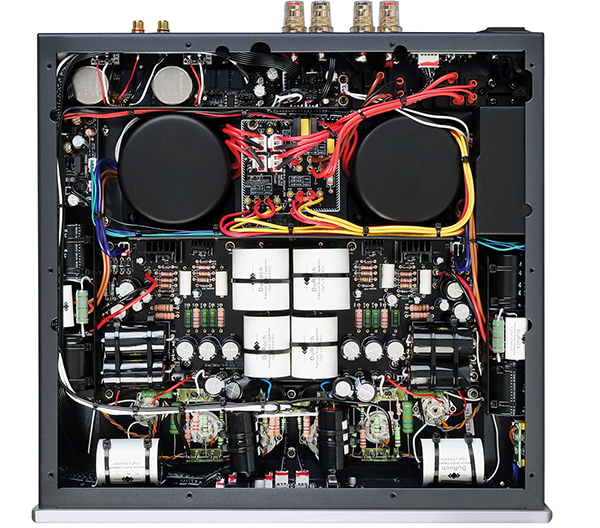
Above: Underneath the EVO 300 Hybrid reveals transformer-coupled XLR inputs [top left], tube bases [bottom] and L/R PSUs [top] for its two input and four 12AU7 driver triodes. The 500VA PSU transformer and Exicon MOSFET-based power amp (on heatsinks) are situated topsides
Herman points out that the MOSFET power amp stage is better suited to driving ‘more demanding loudspeakers’, and it handled Wilson’s The WATT Puppy [HFN Sep ’24], DeVore O/93s [HFN Mar ’23], and BBC LS3/5As with equal disdain: nothing seemed to ruffle it. Also important for some – you should see my electricity bills for the listening room – a hybrid amp costs less to run than an all-valve equivalent.
As for the price being higher than that of the EVO 300 integrated, which shares the same chassis design, the power amplifier offers extra functionality. Switches on the rear enable a mono/bridging circuit for those who need more power as well as ‘High’ and ‘Low’ gain (sensitivity) settings. The power amp also includes the aforementioned transformer-coupled XLR input while the PSU transformer includes multiple secondaries in this model.
Hot stuff
Herman also solved another mystery: why does the cool, slim remote handset only offer mute when most users will pair this power amplifier with a preamp likely to include its own handset (or app…) for volume, input selection, etc? ‘I know a lot of lazy people’, he replied.
As with most power amps, setup is all-but-self-explanatory. The amplifier weighs a hefty 31kg and occupies 385x205x405mm (whd), so take that into consideration if placing on a shelf. Also, the FET power amp runs warm – I measured 38°C on the lid and 46°C on the side-mounted heatsinks after a few hours’ playing time – so adequate ventilation is important.
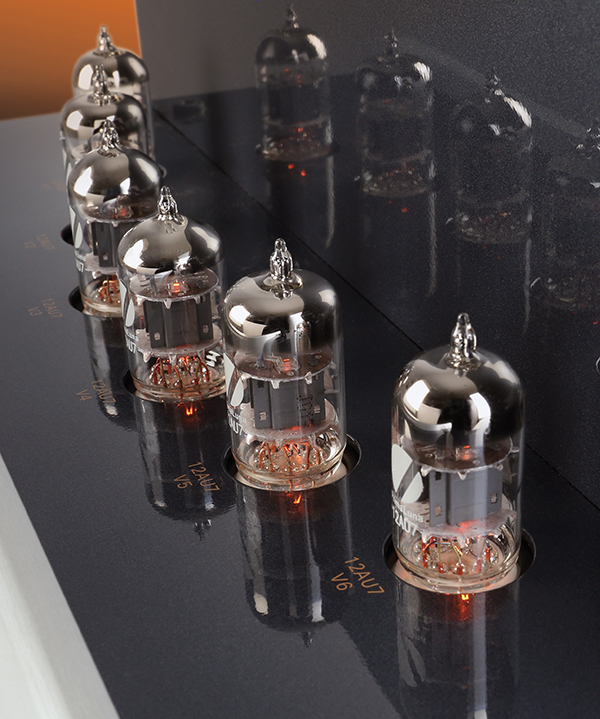
Above: The triode preamp stage offers no overall gain but imparts a 'tube sound', says PrimaLuna
On the left side is the on/off rocker switch, the front panel bearing only the power-on LED which changes from red to green after one minute of a muted warm-up period. The rear panel includes a selector for the XLR or RCA input, ‘high’ or ‘low’ gain and stereo or bridged-mono operation.
 Prima donna?
Listening proved that two of these extra features need specific comment, especially for anyone who plans to have a demonstration of the EVO 300 integrated amplifier. The ‘High’ gain mode, for example, was simply too high for my Audio Research REF 6SE preamp [HFN Jan ’21], or when fed directly by my PS Audio Direct Stream DAC MK2 [HFN Jun ’23] – in both cases I barely had to turn up the volume on the preamp before blasting myself out of the room. Via the PS Audio DAC, I had to reduce its output by 60% from its usual setting.
It wasn’t just about having enough usable scope for precise level setting, as anyone knows if they’ve used a preamp with only a tiny arc of play before it’s too loud. Crucially, the EVO 300 Hybrid sounded much better with the sensitivity selector set to ‘Low’ – now it was quieter, less brash, more valve-like. And this amp does sound deliciously tube-y.
So, too, the XLR-vs-RCA inputs. As explained in [PM's Lab Report], their behaviour is quite different, but not as one expects from an amplifier with actual balanced XLR inputs to compare to RCAs. While single-ended-vs-balanced sound marginally if audibly different, gain variances aside, the overall character is (usually) fundamentally the same. With this amp, the RCA input sounds more transistor-esque and the XLR more valve-like. I’ve no idea if that’s even technically feasible, but that’s how it seemed to me.
Feeding it SACDs, vinyl and open-reel tape, the overall impression was one of balance between its tube and FET technologies. I kicked off with the reel-to-reel of The Beatles’ Sgt. Pepper’s Lonely Hearts Club Band [Capitol L-2653] and it took all of five seconds to appreciate two fundamental aspects of the EVO 300 Hybrid’s behaviour. Overall, it can form and fill a massive soundstage with precise positioning and stage depth. Bass, too, will bring a smile to anyone who craves the extension and snap of transistor amps but with freedom from the overly damped artifice some designs are apt to impart.
Fab finesse
Instead, especially on Macca’s virtuoso bass work on ‘When I’m 64’, the music flowed with a naturalness that was impossible to ignore. It was finely detailed, precise, loping along with the lyrics. Indeed, its presence throughout the entire album was exemplary, but the clincher was not the bass so much as the detail.
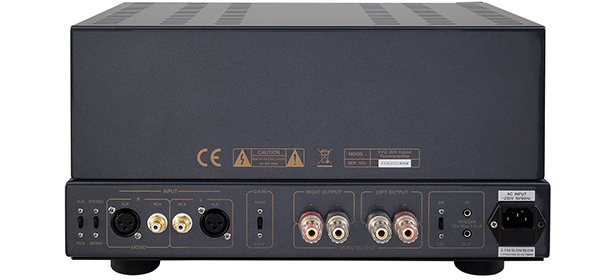
Above: The EVO 300 Hybrid ‘poweramp’ differs from the ‘integrated’ with its bridge (mono) mode and balanced XLR input option. Overall gain is also switchable as are the 12V trigger ports. Speaker outs are on gold-plated 4mm cable binding posts
‘Being For The Benefit Of Mr Kite’ and ‘Lucy In The Sky With Diamonds’ remain exemplars of The Beatles’ studio inventiveness, but they’re tricky to use for reviewing purposes as many of the sounds are studio-generated effects. It makes no difference, however, when your ears tell you that you are hearing what George Martin and the Fab Four intended. Indeed, the most revealing element was the long sustain at the end of ‘A Day In The Life’: smooth, consistent, imposing – nay, majestic.
Wonder wall
At the opposite end of the scale, I played the lean, wholly naturalistic blues of Lonnie Johnson with Elmer Snowden on Blues & Ballads [Bluesville/Craft CR00838]. This offered two trials for the EVO 300 Hybrid, both of which were passed with flying colours. The first was the ultra-wide, extreme left/right stereo of the era while the second was the mainly unplugged instruments.
So lifelike was the recreation of the studio, with vocals so far to the left that I thought a wall had vanished. The guitars had the kind of presence that fools you for those fleeting moments where you swear it’s real. But that was nothing compared to the vocals where the textures are the defining qualities, as distinctive as Joe Cocker’s or Paolo Conte’s growls.
Despite the mildly distracting (to modern ears) far-left location, the voices were so natural-sounding that it actually refocused one’s attention – which is probably the way it should be. The wry, saucy ‘Jelly Roll Blues’ was delivered with an abundance of feeling, all the better to illustrate what audiophiles mean when they claim a system can reproduce emotion. And that’s also as it should be.
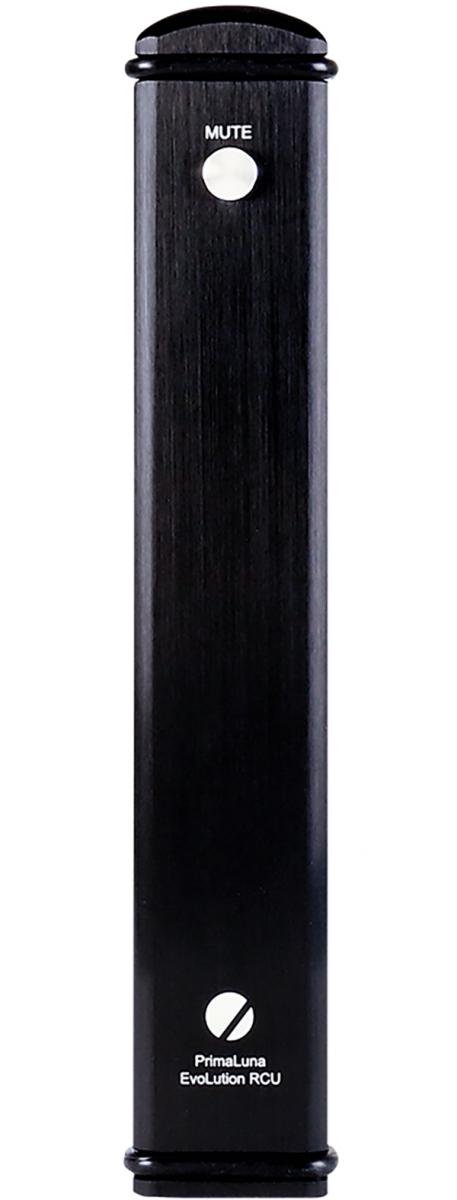
Above: Alloy remote offers control over mute only!
For all the satisfaction the EVO 300 Hybrid provided for this pro-valve listener, I could imagine those diametrically-opposed purist audiophile species – tubes vs trannies – finding grounds for criticism because the two have been weighed equally, exactly as the mission statement required. But perhaps this is an academic debate, for purists of either discipline might not contemplate a hybrid design. For those undecided or who like both, the EVO 300 Hybrid ‘poweramplifier’ is one of the best examples of cross pollination I’ve heard.
If choosing an amp is a matter of tubes-only-vs-solid-state-only-vs-I’m-not-bothered, then your own predisposition will influence your reaction to this remarkable amplifier. Via the RCA input it sounds just like the EVO 300 Hybrid Integrated, but via the XLR – even if you resort to an RCA-to-XLR adapter – the EVO 300 Hybrid ‘poweramplifier’ embraces the hybrid concept, perfectly blending tube colour with solid-state grip. For the undecided, this may well be the best of both worlds.
Hi-Fi News Verdict
What a gentle giant! The EVO 300 Hybrid acts like it has three times its power. As far as PrimaLuna is concerned, it is ‘mission accomplished’ because this amp delivers all its force with the aplomb of a massive transistor amp but with the warmth tube devotees demand. It’s neither as fat nor rich as the all-tube EVO 300 amp, nor hyper-etched à la all-solid-state. Rather, it’s like Goldilocks’ porridge: just right.
Sound Quality: 87%
 | |||||||||||

|
|
| |||||||||












 SPONSORED VIDEO






| Equipment Reviews | |
Music Reviews Awards | |
Latest News Features | |
Resources Newsletters | |
Subscriptions |
WHERE TECHNOLOGY BECOMES ENTERTAINMENT
 © 2026 Hi-Fi News
AVTech Media Ltd
All rights reserved