Aqua La Scala MkIII NOS/Tube USB DAC
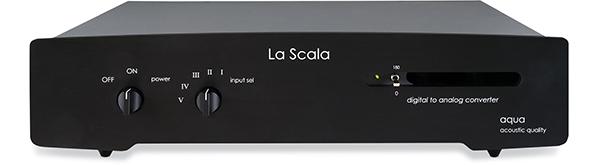

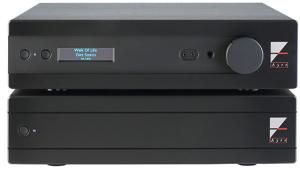
This DAC, to reveal its full name, is the La Scala MkIII Optologic, the third generation of a design from the Milan-based company whose name has nothing to do with water, but instead stands for ‘Acoustic Quality’. Said to be ‘more than a simple upgrade of our La Scala DAC’, this latest version sells for £7850 in grey Nextel powder-coated aluminium casework with either a black or silver finished aluminium fascia. That places it well below the £14,980 Formula xHD flagship DAC [HFN Apr ’20], joining the £8960 La Diva M2 CD transport, and the LinQ network bridge [HFN Sep ’20], which starts from £6350 depending on configuration, in the compact Aqua range.
Like the other models in the portfolio, the latest La Scala is both designed and built by hand in Italy, and distinctive though the La Scala may be, its style shared with the other models in the range, there’s even more to set it apart under the bonnet. Here there’s a raft of in-house technology, right down to the design of the digital-to-analogue conversion itself.
Packed DAC
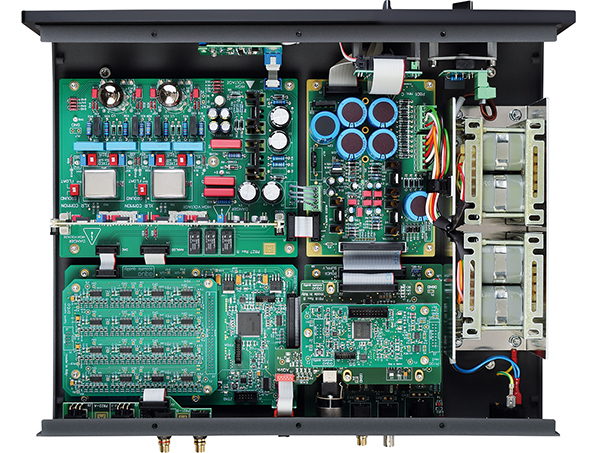
As PM explores in his [see boxout], the company has taken a proprietary route for its choice of DAC, rather than the simpler option of using an off-the-shelf chipset and working around it with various digital filtering options, a custom analogue output stage and so on. This is just one reason why the La Scala MkIII is very busy on the inside [see pic, right] – not for Aqua the kind of ‘fresh air engineering’ seen in many of its digital rivals’ products.
And where does Aqua’s ‘Optologic’ bit come into play? Well, this refers to the use of galvanic and optical isolation between the DAC’s analogue and digital sections, using opto-couplers, notably between the FPGA that handles data formatting, and the NOS (non-oversampling) conversion circuitry. Much of the design here is carried over from the previous generation of the La Scala, including the use of a pair of ECC81 triodes in the tube/FET hybrid output stage, somewhat counter-intuitively mounted just behind the front panel.
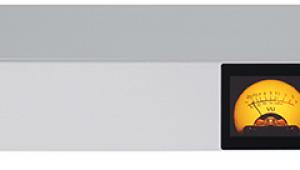
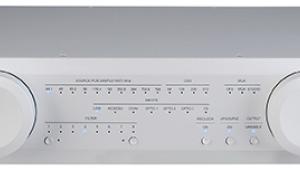
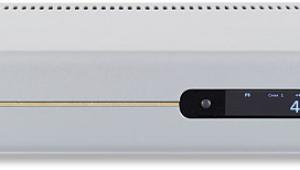
A very faint glow of valves might just be seen behind a slot in the model’s fascia to the right of the two rotary controls – for power on/off and input selection – but you’ll have to stare hard. Beside this window on the La Scala’s internal workings is a small toggle switch to invert the absolute phase of the analogue output, should you so wish.
Board meeting
What is new here is what Aqua calls its PIBU (PIlot BUffer) module in the output stage, allowing the complete removal of any capacitors in the signal path and delivering a claimed higher output current. The digital drivers between the FPGA and ladder DAC have also been enhanced. The beauty of Aqua’s very modular design means existing La Scala models can be easily upgraded to the current specification. A return of the unit is required, though – this is not a simple software/firmware burn and will involve some board-swapping.
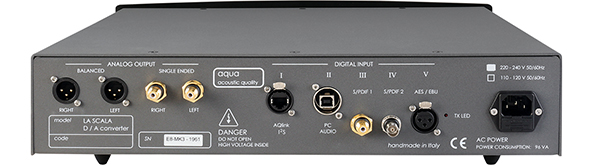
As in the MkII version, separate power supplies are used for the digital and analogue sections, with twin C-core transformers on the right of the interior (when viewed from the rear), while the simplicity of the controls on the front – the power switch being just that, and not an on/standby selector – is reflected in the almost sparse layout of the rear panel.
The DAC’s BNC, RCA and AES/EBU electrical inputs, in addition to AT&T/ST optical fibre, all support 192kHz/24-bit and DSD64. A USB-B input and Aqua’s proprietary AQLink, using I2S and on an RJ45 port, can handle LPCM up to 384kHz/24-bit and DSD128. The La Diva M2 CD transport and the LinQ network bridge offer matching AQLink connections. Output is available on either unbalanced RCAs, or transformer-balanced XLRs, at a fixed level [see PM's Lab Report].
If there’s any criticism of the DAC’s build and functions, it’s that the selector on the front panel is labelled in Roman (not Milanese!) numerals, rather than what the inputs actually are (coax, USB, etc). But I suppose this will soon become intuitive after a period of using the La Scala DAC, and otherwise an immense part of its appeal lies in its simplicity. Aside from the need to download a driver should you want to use its USB input with a Windows computer – none is needed with Mac or Linux machines – Aqua’s DAC is entirely plug and play. There’s no faffing about with digital filter settings (there is no upsampling or digital filtering here, the company relying instead on an analogue filter after the conversion) or any other parameters. All that’s needed is a digital source and a preamp/integrated amp, then switch on and enjoy.
 Organic sounds
And you are going to enjoy! This is a DAC with a smooth, slightly lush and generous presentation, which is not only in contrast with the bright, hyper-detailed and ‘audiophile’ sound of some rival designs, but also superbly easy to relax into. Don’t mistake that broad-brush description for a suggestion that the La Scala MkIII is overly soft or uninteresting, either. Instead, it always sounds natural and organic, bringing out instruments and voices in a wonderfully unforced fashion, without trading away any emotion or involvement.
What’s more, it does all the ‘hi-fi’ stuff deceptively well, with more than enough definition to make clear a large, expansive soundstage or a tight, intimate recording of a solo instrumental recital. The way it handles vocals is a delight, and there’s plenty of space and ambience when required. It’s as adept with the resonance of an upright bass as it is with the gentle tap and sizzle of a cymbal. However, what sets it apart is that it does what it does with the same lack of fuss you find in its operation. There’s nothing flashy or showy here, but rather a confidence and maturity that’s hard not to like.
Midnight mass
Playing Anna Lapwood’s version of Hans Zimmer’s ‘Time’, from the composer’s soundtrack for Inception [Firedove; Sony Classical 19802809272], the La Scala MkIII brought out all the power of the Steinmeyer organ, and the way it shifted and energised the air in the generous space of Trondheim’s Nidaros Cathedral during the musician’s now celebrated midnight sessions. The gentler notes just hung in the air while the dynamics of the piece all but shook the place.
Meanwhile, her arrangement of Bob Dylan’s ‘To Make You Feel My Love’, performed by her choir of Pembroke College, Oxford, swelled from a hushed whisper to the great chords of the organ before giving way to a gentle solo voice in wonderfully dramatic fashion. Here the La Scala MkIII handled both voices and instrument splendidly, with warmth and clarity. Even Lapwood’s arrangement of Robbie Williams and Guy Chambers’ million-selling single ‘Angels’ sounded magnificent, the chords reverberating into a huge wash of sound before subsiding into a flute-like conclusion.
Lovely, too, was the way the La Scala MkIII, fed as throughout my listening with the digital output of a Mac mini computer, delivered the fine focus of Fabio Mittino and Bert Lams’ De Hartmann: A Life In Music album [Pentatone PTC 5187499]. The two performers’ Gibson archtop guitars are both distinctive and wrap around each other in an entirely persuasive acoustic, close-focused yet given plenty of space to breathe. It’s an exemplary recording, and perfectly suited to the warmth and definition the La Scala MkIII delivers.
Swept away
This generosity of sound, backed up by plenty of insight, is also well-suited to orchestral music, as was clear with the recent John Eliot Gardiner set of the complete Brahms Symphonies with the Royal Concertgebouw Orchestra [Deutsche Grammophon 4863519]. With the dramatic opening of the fourth movement of the first symphony, where there are accelerating pizzicato strings and big, powerful chords, the La Scala MkIII relished the growing scope of the music – and the weight of the orchestral sound – while sweeping the listener along to the conclusion of the piece. The technical niceties of what the La Scala MkIII DAC is doing are soon taken for granted as the flow of the music is given the greatest prominence.
It’s not just finely honed classical recordings that show off this product at its best, though this is perhaps not the DAC I’d choose if my listening was dedicated purely to pop and rock music, where a little more sharpness and bite might not go amiss. That said, with the epic drive of Lady Gaga’s ‘Abracadabra’, from her recent Mayhem album [Interscope/Streamline 602475451044], it kept the pounding rhythm section tight yet full of heft, while bringing out all the character of the singer’s voice. In fact, the whole album, with its overtones of muscled-up Europop, sounded pretty sensational here.
Charm school
With other material, there was excellent focus on the title track from The Lumineers’ Automatic album [Dualtone 803020278820], with a beautiful balance between Wesley Schultz’s voice and the piano of Jeremiah Fraites. Meanwhile, given the open, energetic Steven Wilson remix of ‘Roundabout’, from the 2024 reissue of Yes’s Fragile [Atlantic/Rhino R2 726068], the DAC’s combination of warmth and speed was deployed to great effect.
The band’s rhythms were driven smartly while the internal details of the mix remained open for inspection. Aqua’s La Scala MkIII may seem polite and even slightly soft on first acquaintance, but its charms soon become apparent, rewarding you for your patience.
Hi-Fi News Verdict
Idiosyncratic probably sums up the Aqua La Scala MkIII, from the way it does things through to the (blessed) absence of any fiddle-factor. But few allowances need be made for the way it sounds, from that warmth and smoothness to its sweet treble, without any shortage of detail and insight. It may not be the weapon of choice for all-out rockers, but its sound remains both mature and sophisticated.Sound Quality: 85%
 | |||||||||||

|
|
| |||||||||












 SPONSORED VIDEO






| Equipment Reviews | |
Music Reviews Awards | |
Latest News Features | |
Resources Newsletters | |
Subscriptions |
WHERE TECHNOLOGY BECOMES ENTERTAINMENT
 © 2026 Hi-Fi News
AVTech Media Ltd
All rights reserved