Topping D900 desktop USB DAC

Has there been a single defining hi-fi story in the last 20 years? Some might say the rise of streaming services deserves to be the subject of Chapter One when the history books are written. Others may argue for the unexpected resurgence of the vinyl format, or the birth of multiroom audio. And then there’s the arrival of ‘disruptor’ brands that have challenged the status quo with units – typically focused on digital playback – that combine leading-edge functionality with affordable pricing. The likes of Eversolo, FiiO and WiiM all fit this category, and so does Topping, manufacturer of the D900 DAC.
Selling for £1799 and somewhat limited in features, this unit does not quite belong in the same do-it-all bargain bucket as WiiM’s Amp [HFN Nov ’24] or Eversolo’s Play [HFN Jan ’26]. Yet as PM outlines [see boxout], the underlying PSRM (Pure Switching Reference Module) D/A conversion, not based on an off-the-shelf chip, is reminiscent of bespoke technologies used in some decidedly more expensive competitor products. And that will be enough to pique the interest of hi-fi digiphiles.
Range topping
The D900 is the company’s new flagship, and one of 21 standalone D/A converters listed on Topping’s website, of which 14 are on sale in the UK through its official distributor. It also manufactures eight DAC/amp combis, 13 headphone amplifiers, and ten power amps, plus dedicated preamp and streamer options. Much of its catalogue is temptingly priced – ie, just £149 gets you the E30II, a compact DSD-capable USB DAC.
Based in Guangzhou, China, Topping was established in 2008. Its mission statement is to ‘enable more people to experience the splendour of high-quality music’, which explains the myriad models and lowly price points. But its website also stresses its technological credentials, its 30+ team of R&D engineers, and its ‘stringent’ test and measurement processes. On the product page for the D900, alongside the usual marketing blurb, there are graphs for jitter, S/N ratio and THD – but [see PM's Lab Report] for his independent verdict…
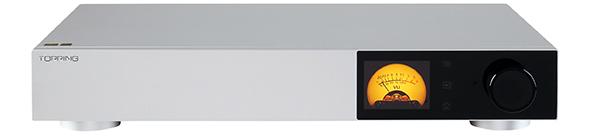
Measuring 330mm wide, 57mm high and just 210mm deep, this unit is considerably less imposing than many a flagship DAC, but solidly built nevertheless. The 3mm-thick aluminium chassis, offered in just a silver finish, is fronted by an 8mm-thick faceplate. Heatsinks adorn each side, and underneath are four circular ‘vibration-absorbing’ aluminium feet.
Twin temptation
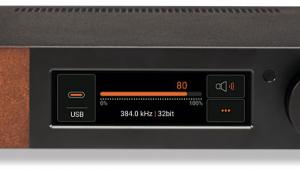
To the righthand side of the D900’s fascia is a small colour touchscreen display and a push/twist controller. The same layout (and chassis size) is a feature of Topping’s A900 headphone amp/preamp, which sells for £1199. Pair the two together, suggests the brand, and you get its ‘Ultra Flagship’. But you would encounter some feature redundancy as the D900 itself includes a variable analogue output.
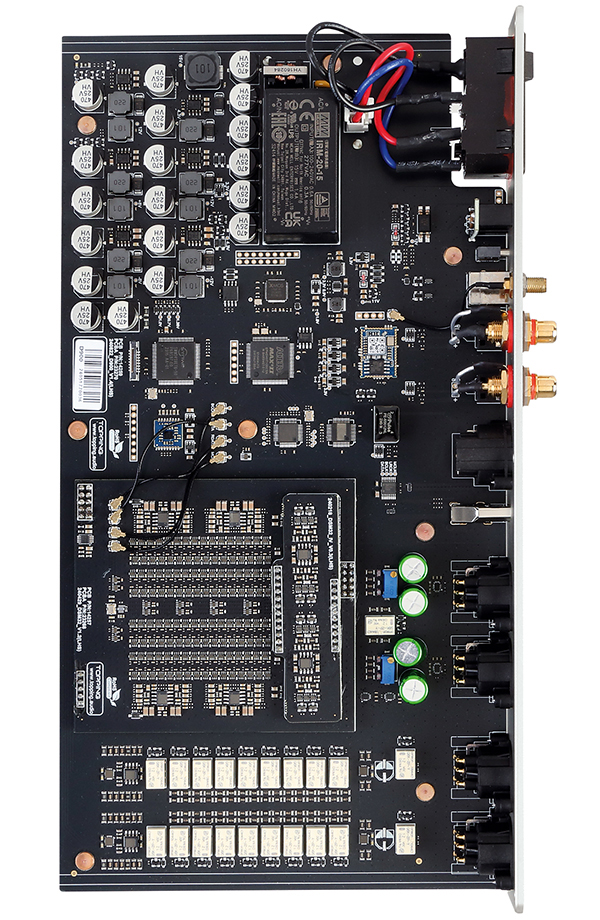
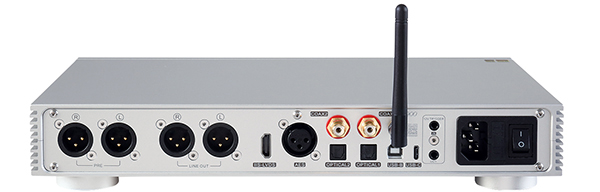
This is available on balanced XLR connections, as is the DAC’s line-level out. There’s no unbalanced RCA option, so adapter cables will be required with amps having just single-ended inputs. Also be aware that the D900 has no network functionality, which means no music streaming or app control. Firmware updates need to be uploaded via its USB-B port.
Music files to 768kHz/32-bit PCM and DSD512 can be fed into Topping’s DAC over this connection, plus USB-C and I2S. The 2x optical, 2x coaxial and one AES input handle DSD64 and PCM to 192kHz/24-bit, while an in-built Bluetooth receiver (with screw-in antenna) supports the aptX Adaptive and LDAC codecs.
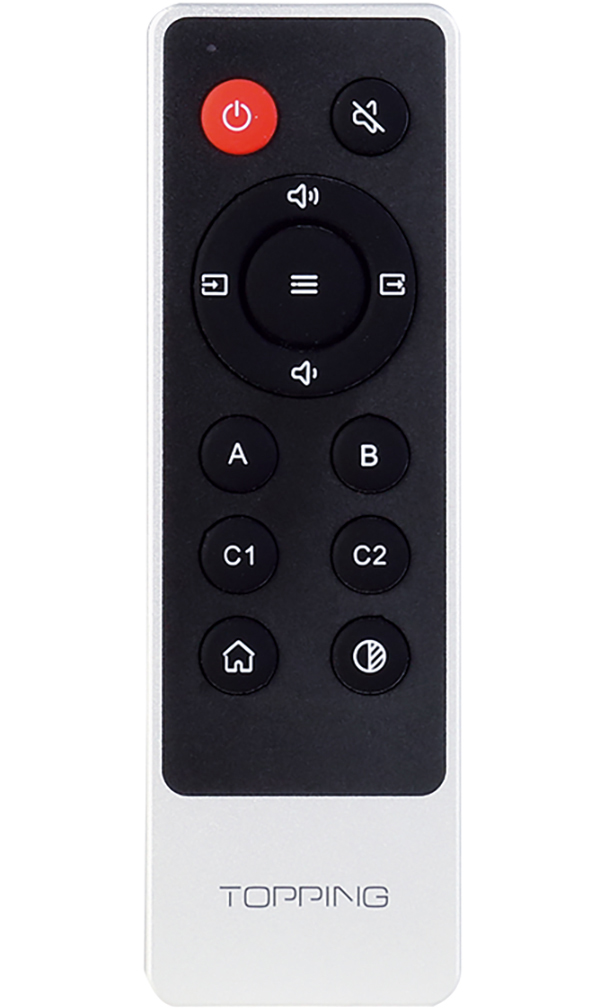
With no app to drive the D900, control and setup must be done via the remote or the display and control knob (which also governs the unit’s high-quality R-2R volume). Despite the screen being small, I preferred this mode as the link between the handset and hardware was unresponsive on occasion.
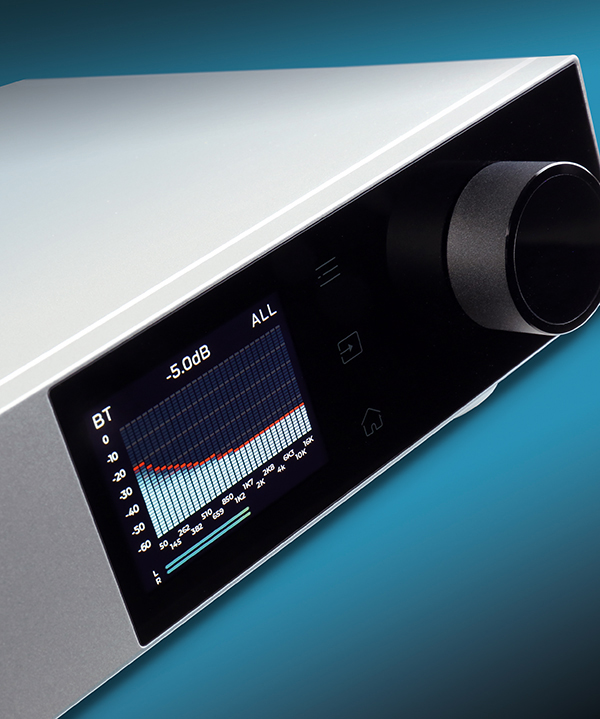
Either way, the settings here are detailed enough to make one wish for an app option. Neither are there multiple digital filters, but there are five parametric EQ (PEQ) settings, named Bass 1, Bass 2, Airy, Warm and Dynamic. None can be fine-tuned by the user, but the free ‘Topping Tune’ software (for Windows/macOS) allows custom PEQ profiles to be created, which can then be added to the D900’s roster via USB. Sample rates with PEQ activated are limited to 192kHz.
Other adjustments include channel balance, a choice of 0.5dB or 1dB volume steps, automatic input selection, and memory of volume and EQ for inputs and outputs. The rotary controller can also be set so a single press accesses a specific function – output selection, input selection, mute, home menu, etc. And during playback, you can choose to have the D900’s screen show a VU meter, spectrum display or info panel with input, sample rate, etc. Just a shame that this screen is barely legible from across a room.
 Search engine
Across its S/PDIF and USB inputs, the former mainly used here with a Hegel Viking CD transport [HFN Sep ’23], the latter fed via a Roon Nucleus Titan [HFN Jun ’25], the D900 gave a consistently clear, detailed sound, brimming with vitality. Such is the impression of fine resolution, particularly in the upper octaves, that perhaps some might consider it a little too searching – even with its analogue preamp circuit in play, there’s no sign of any deliberate ‘mellowing’ of the sound to earn hi-fi brownie points. Yet this is no bad thing as the D900’s clarity encourages you to fine-tune the sound using other elements in your set-up, be it preamp, amp or speakers.
Additionally, there are those five PEQ presets to play with, and the option of getting one’s hands dirty using the Topping Tune software. Okay, the latter is likely a step too far for the hi-fi enthusiast more interested in simply enjoying music, but the differences between, say, the Bass 1 and Airy DSP preset options are far more tangible than the usual digital filter choices. My advice: give them a listen.
Devilish Drive
With PEQ disabled, and the D900 connected over its variable output into a Primare A35.2 power amp [HFN Dec ’19], its performance was extremely rewarding across a wide range of material. CD resolution tracks via USB offered superb insight into not just instrumental detail, but soundstage construction and the space around the players. The attack and decay on ‘Race With Devil On Spanish Highway’, Al Di Meola’s eclectic jazz instrumental from his Elegant Gypsy album [Columbia], was close to astonishing, contributing to the vivid, dynamic feel of the piece.
Tracy Chapman’s ‘Fast Car’, from her eponymous 1988 album [Elektra 960 774-2], was similarly eye-opening. Her vocal sounded effortless, but my focus drifted to all the small, minor details that the D900 coaxed out of the recording. In particular, the DAC’s treble clarity uncovered a wealth of gentle percussive details, while acoustic guitar notes rang out bright but sweet.
Playback of higher-resolution files continued in the same vein. Dire Straits’ ‘Romeo And Juliet’ [Money For Nothing (2022 remaster), UMC; 192kHz/ 24-bit] sounded wide-open, the rimshots and hi-hat shots of the opening verse crystal-clear, the bass guitar notes deep and plump. There was no feeling of congestion, just superb separation and resolution.
Suite TruthsThe unaccompanied performances of Yo-Yo Ma, on Six Evolutions – Bach: Cello Suites [Sony Classical; 96kHz/24-bit], gave the Topping DAC nothing to hide behind, not that this seemed to matter. Through the Prelude and Allemande of No.1 in G major, the D900 crafted a largescale but pin-sharp image of the cello, evoking the resonant nature of the lowest notes and the constant flow of Ma’s playing. The audiophile quality of this recording by Grammy Award winner Richard King was made brilliantly clear.
Less pristine, or simply thin-sounding recordings can be addressed, if desired, by the D900’s EQ presets – ie, Bass 1 added a gentle boost to low-frequencies that I rather enjoyed with The Monkees’ ‘Pleasant Valley Sunday’ [Greatest Hits, Rhino; 192kHz/24-bit]. Bass 2, on the other hand, darkened the overall sound too much. In practical terms, though, the DAC’s small display means it’s only with the unit sat on a desktop that I’d want to make regular changes. Crossing the room to peer at the screen becomes tiresome after a while and serves as a reminder that Topping is chiefly thought of as a head-fi manufacturer.
Using the unit as a line-output DAC into a Rotel Michi P5 S2 preamp [HFN May ’24] introduced a bit more midband colour to the overall sound, without nullifying any of the D900’s insight into the music. Indeed, this set-up proved the mettle of the Topping DAC as a partner to high-quality separates. There was an excellent blend of smoothness and bite to the mix of instruments on ‘Strasbourg/St. Denis’ from Earfood by the Roy Hargrove Quintet [EmArcy; 96kHz/24-bit], plus that open, clear, dynamic flavour to make this performance all sound so alive.
Two other tracks exemplified the D900’s price-tag-smashing talents. Humble Pie’s ‘Rollin’ Stone’ [Rock On; A&M] offered blasts of harmonica and bluesy guitar licks on a soundstage with stunning depth. Meanwhile, a cappella group Pentatonix’s cover of Queen’s ‘Bohemian Rhapsody’ [PTX Vol. IV – Classics, RCA; 44.1kHz/24-bit] spotlit the D900’s ability to resolve close-knit harmonies without detracting from its dense, rich atmosphere.
Hi-Fi News Verdict
Designed for a desktop, but very ready for deployment in a bigger system, Topping’s top-flight USB DAC/preamp may surprise audiophiles with the brilliance of its performance. The slimline D900 pulls plenty from your music, its sound one of clarity, precision and dynamic flair. Some will welcome the selection of its DSP EQ modes, expandable if desired, but others will be happy to just sit back and enjoy.
Sound Quality: 90%
 | |||||||||||

|
|
| |||||||||












 SPONSORED VIDEO






| Equipment Reviews | |
Music Reviews Awards | |
Latest News Features | |
Resources Newsletters | |
Subscriptions |
WHERE TECHNOLOGY BECOMES ENTERTAINMENT
 © 2026 Hi-Fi News
AVTech Media Ltd
All rights reserved