Musical Fidelity M8x DAC

Sentimental audiophiles might think Musical Fidelity’s M8 range is rather left out in the cold, stuck between the brand’s high-end Nu-Vista models [HFN Mar ’23 & Aug ’25] and thought-provoking remakes like the A1 [HFN Jan ’24] and B1xi amplifiers. Since Pro-Ject’s Heinz Lichtenegger took over the wheel of the brand, the series has received only piecemeal updates, starting with the M8xi ‘super’ integrated [HFN Jul ’20], then the M8xTT turntable [HFN Dec ’23] and M8x Vinyl phono stage [HFN Mar ’25], and now the ‘dual-mono’ M8x DAC.
This is a logical addition, but with an unusual twist or two, because besides being a purist DAC intended for speaker-based systems, it’s also a fully fledged headphone amplifier. Yes, some other DACs cater to casual ‘can’ listening, but Musical Fidelity has gone beyond a quick ‘slap it on’ approach and provided a separate Class A amp circuit and fully balanced headphone output. Tantalisingly, the M8x DAC also paves the way for another M8 product...
Blue is the colour
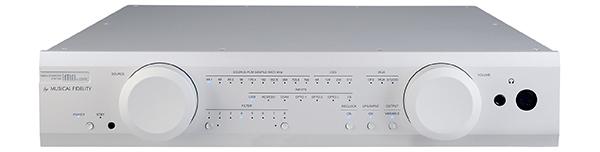
The beautifully finished front panel, with broad chamfers top and bottom, is instantly recognisable – there’s no mistaking the M8x DAC’s pedigree. Park it next to the M8x Vinyl, and you’ll see the same large knobs in exactly the same position, and a collection of blue LEDs arranged in long rows. A lot of blue LEDs, it should be said, but they are tiny and at any given time only about six are lit. Still, the limited legibility of the labels next to these blue pinpricks might annoy.
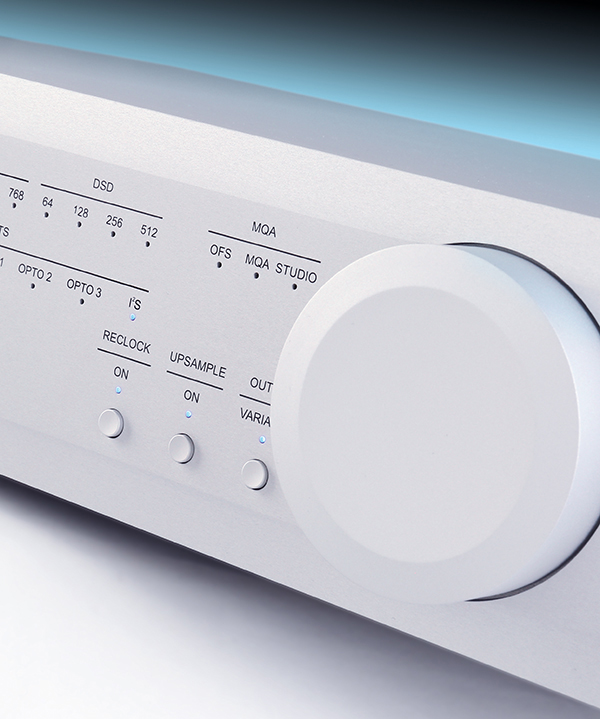
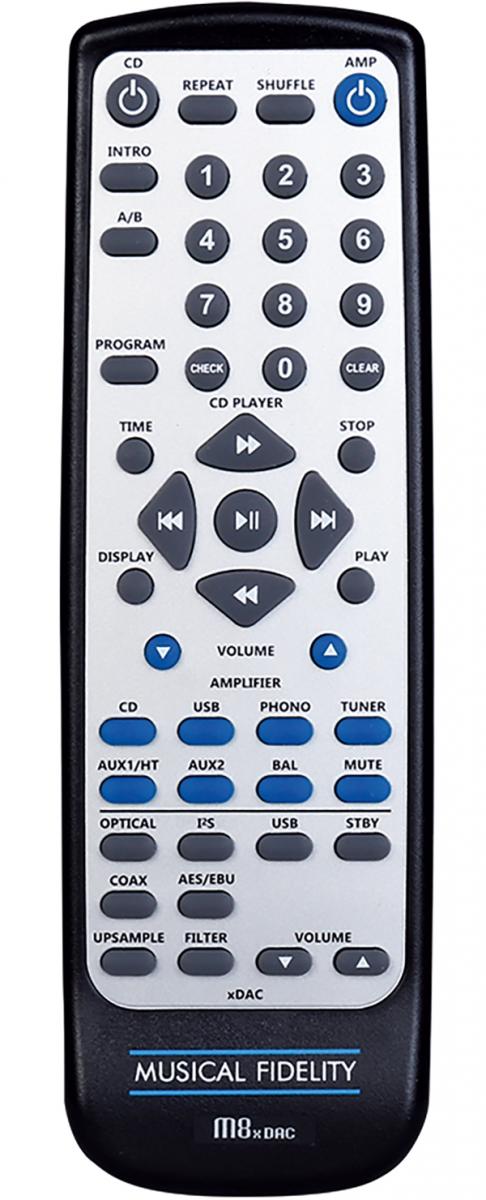
Selecting one of eight filters and engaging reclocking or upsampling is done via small push buttons, while the larger rotaries change input and – if the preamp function is engaged – volume level. Depending on your choices, the corresponding LED will light up, together with one LED out of 14 on the top row indicating sample rate. In practice you’ll quickly grasp how the M8x DAC operates, and you can use the supplied button-infested remote [pictured below], where only the bottom quarter is applicable.
Like the M8x Vinyl, the M8x DAC is 483mm wide, so slipping it into a hi-fi rack might be a non-starter, as many are designed to hold ‘standard’ 420-435mm kit. It’s quite hefty too, thanks to thick aluminium side panels and the large encapsulated ‘Super Silent Power Transformer’ inside. As usual, the unit is available in matt silver or black finish, but the two large dials and the touch buttons are always silver coloured, giving the darker version arguably a more refined guise.
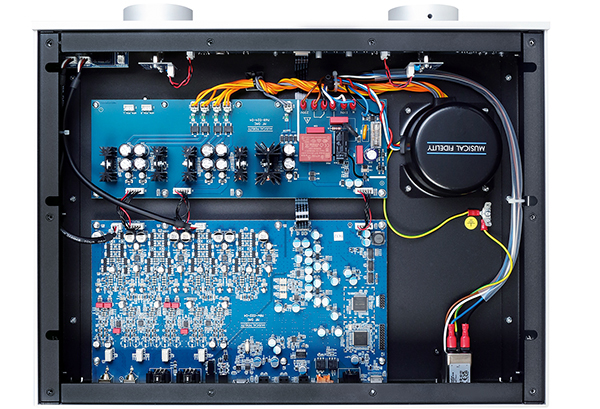
MF’s use of a common chassis aesthetic has a downside because, at first glance, the M8x DAC appears very similar to the earlier (albeit regular-sized) £2099 M6x DAC [HFN Jul ’22]. They’re certainly closely related, as both rely on dual ES9038Q2M DAC chips, but as PM notes in his Lab Report [see PM's Lab Report], the M8x’s implementation is closer to that of the £9999 Nu-Vista DAC [HFN Mar ’24].
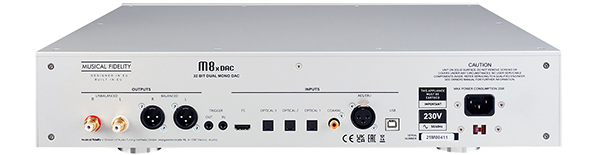
So, compared to the M6x DAC, what does the extra £1500 outlay on the M8x DAC get you? Greater connectivity for one thing, with a third optical input and an HDMI I2S option fitted on the rear panel alongside coaxial (now with MQA and DSD support), AES/EBU and USB-B inputs. There are few scenarios into which the M8x DAC will not fit.
CD incoming
The I2S input is not there because Musical Fidelity’s designers are completists. As the user manual hints, and Lichtenegger confirms to Hi-Fi News, it is there for a soon-to-be-released M8 CD transport.
As mentioned, the M8x DAC employs two ES9038Q2M DAC chips deployed in a dual-differential mode, and enjoys the services of a proprietary clock that promises extremely low jitter. That’s not marketing speak either [see PM's Lab Report], even when the Altera-based reclocker is selected. The oversampling bypass mode is also noteworthy, because this leap-frogs the seven digital filters embedded into the ESS DAC in favour of a default upsampler that takes 44.1kHz-centric media to 352.8kHz and 48kHz-centric files to 384kHz.
The M8x DAC’s balanced output stage, built from discrete components instead of IC op-amps, will be a major plus for many audiophiles. Use the balanced XLR outputs to a suitable balanced input on an integrated or preamplifier, and you can keep the playback chain balanced from back to front. An advantage of the discrete route, the designers note, is in its ease of ‘repairability’. That’s not a trivial point – after all, this is not low-cost hardware and users should expect a long product lifetime.
 Captive audience
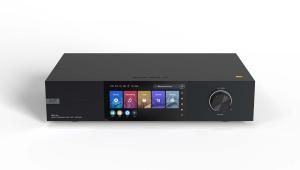
My listening began with the M8x DAC used as just a DAC, connected via its balanced outputs to Primare PRE35 and A35.2 amplifiers [HFN Dec ’19] driving a pair of Monitor Audio Gold 300 6Gs [HFN Oct ’24]. Playing music from an Eversolo DMP-A8 [HFN May ’24], via USB, the performance was immediately engrossing. Musical Fidelity’s new converter, while not possessing a ‘clinical’ nature, offers textural and soundstage detail with clarity.
Polish pianist and neo-classical composer Hania Rani has become a bit of an overnight sensation, not least at hi-fi shows. Inner Symphonies [Deutsche Grammophon; 96kHz/24-bit download] demonstrates why, with the moody ‘Con Moto’ featuring quick-tempo piano sequences layered upon each other, together with a languid main melody and a frenetic cello. This makes for an all-encompassing soundscape, which the M8x DAC deftly presented. The different strands were crafted with superb depth and detail. It’s a great trick, offering a strong sense of increased resolution while retaining a solid overall image.
Some will consider a piece like ‘Whale’s Song Scream’ a dull, note-playing exercise, but others will be enthralled by the drawn-out cello tones (from fellow Pole, Dobrawa Czocher) and the piano fading in and out. With the latter, the M8x DAC served up a weighty portrayal, but again with clear separation to ensure the listener’s focus. And this was all with a soft touch. There was no attention-grabbing extra sparkle, which made Rani’s piano at times appear a bit dark – but authentic, nonetheless.
Filter fiddling
Many DACs feature multiple filters, but selecting one often requires diving into a menu, choosing a setting and awaiting confirmation. Working with the M8x DAC is a lot easier – it lets you instigate changes with a single press of a button, facilitating on-the-fly comparisons.
With Hania Rani’s album, I did exactly that. Variations from filter to filter are subtle, but listening for small differences was fun. That said, I’m sure most M8x DAC users will settle on one filter and leave it at that, as the constant switching stops you focusing on the music at hand. I often preferred the eighth filter, the so-called ‘oversampling bypass’ mode, though PM’s reservations [p87] should still be heeded.
The guitar-driven My Anti-Aircraft Friend [Atlantic; 192kHz/24-bit], the debut album from US band Julie, is very reminiscent of the 1990s grunge era, just more melodious and less dissonant. Not your usual audiophile fare, but there’s beauty amid the brutishness courtesy of the vocals of Keyan Pourzand. The M8x DAC conveyed their delicacy, even as they were surrounded by noise.
The tracks on this album also play around with dynamics and speed changes, giving Musical Fidelity’s unit the chance to show off its rhythmic acumen. By nature, this ‘nu-gaze’ genre has a dense character, but the M8x DAC succeed in extracting every little gear shift of the band.
Stop, look, listen
Next to the DAC’s volume rotary is a button that engages its variable output mode. Do be aware that after disconnecting power, the M8x DAC will return to fixed output. Therefore, check the relevant LED is illuminated after any power outage, or you might get a nasty surprise.
Using the M8x DAC now as a preamplifier, I switched speakers to a pair of Radiant Acoustics’ Clarity 6.2 standmounts, the larger versions of the brand’s diminutive 4.2s [HFN Oct ’25]. Given the classic Karl Böhm and Wiener Philharmoniker recording of Antonín Dvořák’s Ninth Symphony [Deutsche Grammophon PROC-2195; DSD64] – and after first producing some clicking sounds to confirm the switch to a DSD stream – the M8x DAC delivered the sotto strings and horns of the first Adagio movement in an organic, elegant fashion. This sweet, almost soft presentation captured my attention, getting me to lean in. Of course, the composer is in a playful mood here, as just as you are completely fixated on the pensive introduction, the horns ‘call’ out. Even when listening for the umpteenth time, it can be a bit of a surprise.
Reaping rewards
Dvořák’s Ninth has its moments of excitement and bombast, something the M8x DAC fully revealed. I particularly liked how, even though DG’s 1978 recording (remastered in 2018) sounds a bit ‘distant’, this DAC never made it anything less than engaging. The atmospheric opening of the second movement (Largo) had me hooked, thanks to a smooth rendition of its softly played wind and brass instruments.
This was mesmerising stuff. As DACs go the M8x DAC might not be the most analytical, but – especially with the rather neutral approach of my amp and loudspeakers – its refined approach reaped rewards.
Hi-Fi News Verdict
However you pair it, the M8x DAC is superb. Offering a sonic performance that majors on cohesion and delicate detail, it never ‘forgets’ that enjoying music is about emotion, not analysis. Streaming is eschewed, but connectivity is otherwise generous and there are tweaking options to explore. Not everyone cares deeply about subtle filter changes, but if you do then the M8x DAC has you sorted.
Sound Quality: 88%
 | |||||||||||

|
|
| |||||||||














 SPONSORED VIDEO






| Equipment Reviews | |
Music Reviews Awards | |
Latest News Features | |
Resources Newsletters | |
Subscriptions |
WHERE TECHNOLOGY BECOMES ENTERTAINMENT
 © 2026 Hi-Fi News
AVTech Media Ltd
All rights reserved