Wattson Madison Streamer streaming DAC
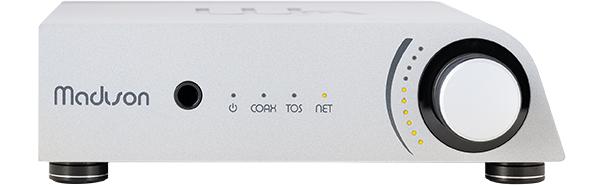

Although Wattson Audio has a relationship with fellow Swiss manufacturer CH Precision (more on which later), its products couldn't be further removed from the latter's monster-sized amplifiers [HFN Sep '25 & Mar '26]. Reviewed and tested here is the Madison Streamer, a network-attached DAC with fixed/variable output, priced at a not-inexpensive £4700 but measuring a positively bijou 175x52x185mm (whd).
Still, there's nothing in the hi-fi rulebook that says components of a digital bent can't be ultra-compact [see also p68]. Moreover, after just a little time with the Madison Streamer you get the impression that it has been so thoughtfully engineered that little could be gained from making it any larger. That said, the bundled power supply can be replaced with the Madison Power S for a two-box solution. Priced £2350, this dedicated off-board PSU sports the same tidy footprint as the DAC and promises performance improvements – specifically a lower noise floor.
These two Wattson units are designed to be stacked, placing the 87mm-high Power S at the bottom, and both feature milled aluminium chassis in Light Grey, seen here, or Dark Grey finishes. The range also includes a compact 2x50W/8ohm-rated Class AB power amplifier, priced £6000.
Mellow yellow
Considering the paucity of its front-panel real estate, it's no surprise the Madison Streamer offers no text or graphic display. Instead, four small yellow LEDs signify whether the unit is in standby mode or set to play via its coaxial, optical or network inputs. Next to this is a small volume rotary, one side framed by more LEDs to show the selected level. A tap on this controller brings the streamer out of standby mode, while a long press powers it fully down. It can also be used to cycle through the various digital inputs.
Spline tingling
Connections on the Madison Streamer are simple. On the rear panel, next to coaxial, optical and Ethernet LAN – the latter feeding Wattson Audio's own bespoke, Roon Ready streaming engine – are single-ended RCA and balanced XLR outputs. The fascia houses a 6.35mm output for headphone use, but there's no USB connection for wired playback from a PC, no support for connecting external USB storage, no HDMI ARC for TV use, and no Bluetooth. But do you need such features?
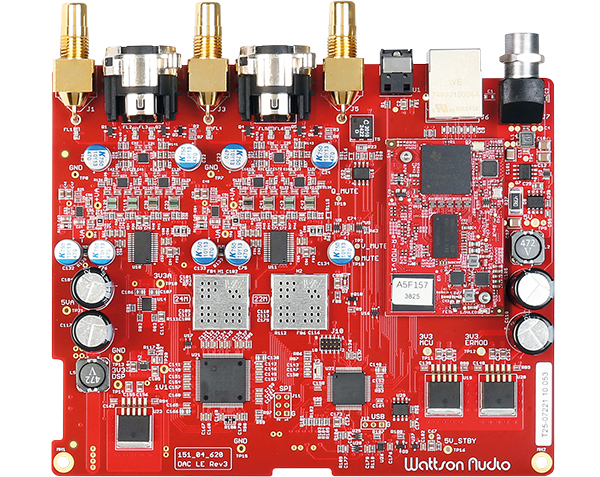
Above: PSU input has additional filtering, feeding a Texas Sitara-based Ethernet board, ARM and SHARC DSPs and a dual-mono balanced analogue stage with two WM8742 DACs
The DAC stage is based around a pair of Wolfson/Cirrus Logic WM8742 chips, while a SHARC DSP handles the manufacturer's custom 'Wattson Spline' upsampling digital filter. The use of Spline interpolants in digital audio is not new, having been employed in the late 1980s by Wadia in its Digimaster DAC and by Pioneer in its CD players featuring the Legato Link converter.
Like those early examples, the Wattson filter aims to minimise distortion in the time domain, trading reduced 'ringing' for poorer rejection of out-of-band digital aliasing. This filter is permanently enabled, so user tweaks are limited to its low-frequency EQ modes, via the Wattson app [see boxout], for different speaker positions.
Regarding the CH Precision connection, Wattson Audio founder Alexandre Lavanchy and CH Precision's Florian Cossy worked together in the early 2000s at ABC PCB, an OEM network audio specialist. When Cossy left to form CH Precision in 2009, Lavanchy remained, evolving ABC PCB and calling it Engineered SA. This period saw the two companies collaborate on digital solutions.
Lounge legacy
Lavanchy setup the consumer-facing Wattson Audio in 2019, embracing a compact, accessible, streaming-focused philosophy – its first models were the Emerson Digital network bridge and the Emerson Analog streaming DAC. In 2024, CH Precision bought Wattson Audio, reuniting Cossy and Lavanchy and moving all operations to its HQ in Préverenges, by Lake Geneva. Explains John Giolas, global marketing director at CH Precision: 'The aim is not to make "budget CH Precision", but to give Wattson access to CH's engineering depth, manufacturing resources, and long-term development structure'.
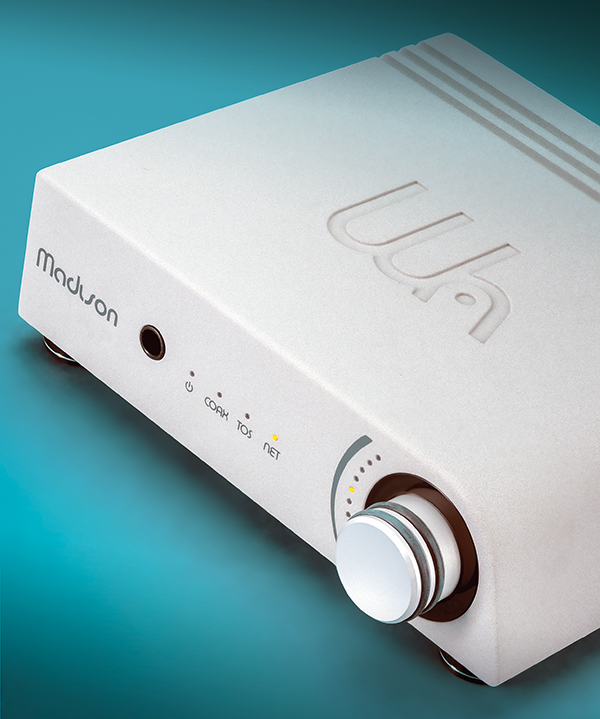
Above: There's a small volume rotary, one side framed by more LEDs to show the selected level
It's worth noting that this is not the first iteration of the Madison Streamer to have been offered by Wattson Audio. In fact there were previously two versions, with the original Classic being joined by an LE (Lounge Edition) model that saw upgrades to both the unit's PSU and balanced output stage. All these refinements have been retained in the new Madison Streamer (the Classic has been discontinued), but the original LeedH digital volume control [HFN Apr '23] has been replaced here by an in-house solution, leveraged from CH Precision and employing a 64-bit attenuator operating in 0.5dB steps.
 Timbral triumph
Anyone familiar with networked hi-fi will be up and running with the Madison Streamer in a matter of minutes. Once connected to your home network via Ethernet (there's no Wi-Fi), Wattson's app quickly finds the hardware and you're ready to go. I tried both the iOS and Android iterations and decided the built-in playback functions of the Apple-specific software aren't essential – its custom presentation of Qobuz is fine, but I preferred the familiarity of using Qobuz's own app, or streaming over Roon through a Nucleus Titan [HFN Jun '25]. Added to the mix were CDs via Hegel's Viking player/transport [HFN Sep '23].
The Madison Streamer offered a performance that was both captivating and relaxing. A smooth and organic portrayal immediately lured me into the music, my attention held by matters of tone and timbre rather than an emphasis on out-and-out clarity. Fine details were present and correct but not spotlit to the detriment of the overall balance. Excellent bass presence and depth yielded a full-range feel, the streamer never once sounding thin.
This was even the case with material that has an innate bright sheen, such as Ry Cooder's Bop Till You Drop on CD [Warner Bros. Records 3358-2], a 1979 album in the vanguard of the digital recording boom. Tracks like the cover of Elvis Presley's 'Little Sister' and the groove-laden, Cooder-penned 'Down In Hollywood' were rendered with sparkling, open clarity in the guitars and percussion, but also rich, buoyant basslines. This uber-compact streaming DAC puts meat on the musical bones.
Similarly, the Madison Streamer's presentation is sympathetic to analogue-era recordings where noise, grit and texture are part of the appeal. Listening to Blue Öyster Cult's 'I'm On The Lamb But I Ain't No Sheep', from their eponymous 1972 debut [Columbia/Legacy, 96kHz/24-bit], I was swept along by both the track's bluesy, rhythmic flow and the DAC's evocation of its warm, of-an-era production. Later, the psych-rock of 'Screams' sounded suitably woozy, with keyboard lines swirling behind Joe Bouchard's floaty vocals.
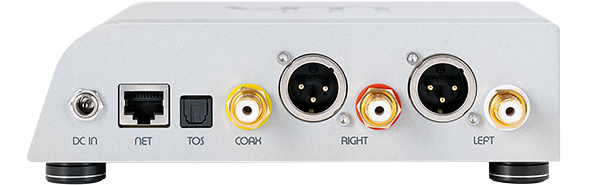
Above: 'Old school' coaxial and optical inputs are joined by an Ethernet port, and both fixed and variable single-ended (RCA) and balanced (XLR) analogue outputs
My appreciation of the Madison Streamer's 'music first' delivery was reinforced by some classic jazz: Sonny Rollins' 'St. Thomas' from his 1956 album Saxophone Colossus [2014 remaster, Prestige; 44.1kHz/24-bit]. Mono soundstaging aside, this had it all – sprightly drums and sweet-sounding percussion, gentle bass and soft piano, and the more urgent, reedy voicing of Rollins' tenor sax. There was pep and vibrancy too, this DAC seeming to lean fully into the track rather than offering a mere facsimile.
Swift justice
While the lack of several digital filter/upsampling modes here is perhaps unusual, I can't say I lamented their absence. Wattson's 'Spline' algorithm, its slow roll-off characteristics discussed by PM in his Lab Report [see PM's Lab Report], appears to have been thoughtfully coded given the hardware's uniformly impressive performance. On the other hand, the app's 'acoustic correction' EQs may find use in systems where the DAC is used in conjunction with speakers placed in less-than-optimal positions. Switching between Free Field and Near-Wall or Corner resulted in a notably reduced low-end output.
Sealing this unit's superstar status, I didn't find any music that it couldn't work its magic on. 'You Belong With Me', from Taylor Swift's album Fearless ['Taylor's Version', 96kHz/24-bit], became unexpectedly beautiful as the Madison Streamer uncovered deeper layers to its pop/country aesthetic – weighty tom-tom drums in the middle eight section, blink-and-you'll-miss 'em vocal harmonies, and background strings. The sample-heavy 1990s hip-hop of Tone Loc's 'Fatal Attraction' [Cool Hand Loc, 4th And Broadway] also sounded fresh and vital, its beats and bassline tightly locked together.
Faith restored
More surprises came from the DAC's handling of Celtic Frost's Monotheist [Century Media 77500-2], which was so enjoyable it made me wonder if someone at Wattson Audio was a fan of the band – they are also Swiss, after all. This eclectic, doom-laden heavy metal album is far from typical audiophile fare, but the Madison Streamer revealed the brilliance of the music and production. With its droning guitar riffs stretched wide, the slow-moving 'Obscured' sounded big and brooding before a male/female vocal duet cut clean through the oppressive atmosphere. Nothing was being obscured here...
Hi-Fi News Verdict
Wattson's Madison Streamer is something of a revelation – sized like a budget solution, it sounds so much more accomplished. Everything about it is precisely engineered, from the sculpted casework and ergonomics to the clean, uncluttered app, but when it comes to performance it marries this precision to inviting, evocative sonics. Add in the blissfully simple operation and we have a digital winner.
Sound Quality: 88%
 | |||||||||||

|
|
| |||||||||











 SPONSORED VIDEO







| Equipment Reviews | |
Music Reviews Awards | |
Latest News Features | |
Resources Newsletters | |
Subscriptions |
WHERE TECHNOLOGY BECOMES ENTERTAINMENT
 © 2026 Hi-Fi News
AVTech Media Ltd
All rights reserved