LAiV Harmony μDAC USB DAC
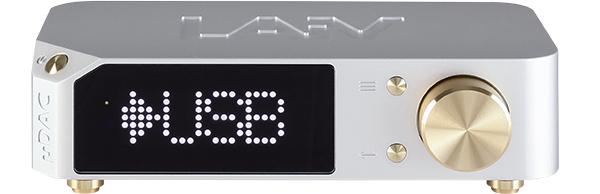

While temperatures in Europe have soared, so have the number of DACs on the market. A fine example of correlation not being the same as causation; but there's no denying the market has been inundated, mainly by newish Chinese brands. Still, the appetite of hi-fi enthusiasts for yet another flavour of converter never seems sated.
While LAiV is only three years old, its origin story is not that typical. For one, the company hails from Singapore – and seems very proud of that fact. It was founded by Weng Fai Hoh, a production engineer specialising in SCADA infrastructure but also a self-confessed audiophile. The µDAC fits within LAiV's broader Harmony range, which includes everything from input extenders to monoblock amplifiers – all are quite compact and housed in idiosyncratic but beautifully crafted housings.
Looking good
The µDAC is a standalone D/A converter, without streaming or a preamp, sporting a desktop form factor that will suit head-fi buffs. But like Chord's petite DACs, it's very plausible that it could find its way into a 'proper' hi-fi set-up. On top of that, the µDAC capitalises on current excitement about R-2R DAC designs [see boxout], which have seen a real resurgence led by Asian brands [HFN Feb '26].

Above: The machined alloy enclosure is part heatsink for the Class A output stage within, reaching 39°C at idle
The µDAC grabs your attention with its unusual styling. Referencing Chord earlier wasn't coincidental – like that brand, LAiV creates devices according to its own design rules. Dimensions of barely 170mm wide and 100mm deep make the µDAC sufficiently svelte to fit a variety of scenarios. And even if the unit doesn't resemble Chord's more expensive (but functionally richer) Hugo 2 [HFN Aug '18], it shares a similar heftiness thanks to a housing that's CNC-machined from solid aluminium. In practice, LAiV's alloy case is part heatsink for the DAC's Class A output stage, the metal reaching 39°C at idle.
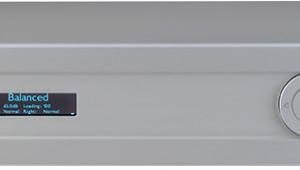
Tiny it might be, but aspects of its design will still get tongues wagging – ie, the sleek-looking cut-off in the top-left corner, which hosts the power button, or the garish gold-coloured knob and buttons on both the silver and black versions. And while the 100mm display might seem too small, the screen, as seen in our pictures, is almost filled with large dot-matrix characters (25x7) lit up in white.
The small form factor means that real estate for rear sockets is limited to USB-B, coaxial, optical and HDMI/I2S [see p73], the latter configurable via the menu for eight different pin configurations to suit PS Audio, Eversolo and other proprietary I2S source components. The fixed audio output is on balanced XLRs only, though high quality XLR-to-RCA adapters are included.
There are two remote options for the µDAC – the basic device supplied with the unit [p73] or LAiV's optional (£189) Harmony RCX handset. The key features you'll consider changing on the fly are no-oversampling (NOS) and oversampling (OS) modes – otherwise there are no selectable filters here [see boxout]. While going about its business, the µDAC opts for total minimalism. You'll see the sampling rate (eg, '96') and that's it. It is very different to the feature-fest of DACs like HiFi Rose's RD160 [HFN Jan '25] or Eversolo's DAC-Z10 [HFN Jul '26], but fine if you don't crave information overload.
Close encounters
As mentioned, this unit is an old-school R-2R DAC with discrete components and a balanced Class A output buffer. The various circuits are packed close together inside, but the PSU is external and there's galvanic isolation between the digital and analogue stages to keep RF noise out of the sensitive audio ground plane. On a practical note, avoid thick or stiff HDMI and/or balanced audio cables as it's easy to lift this 700g DAC right off the shelf...

Above: Altera Cyclone FPGA [centre] takes care of digital processing while galvanic isolation [left of FPGA] isolates digital and analogue grounds when addressing the encapsulated R-2R DAC modules [gold]. Class A buffer is under the PCB
The controls on the µDAC are a bit convoluted, so it's no bad thing that its configuration options are limited, nor that the screen isn't suited to presenting a lot of information. On the upside, this screen is very legible from across the room – I found it harder to read from close by.
 Confidence is king
Connected over balanced XLRs to a Hegel Röst integrated [HFN Jul '17] and Radiant Acoustics Clarity 6.2 standmounts, the Harmony µDAC was pressed into the role of a digital upgrade for the older amplifier. With no direct streaming interface of its own, I connected the µDAC via an Eversolo DMP-A8 [HFN May '24] – a gateway to all cloud-based music – over its I2S connection, and also host to a Mac mini via USB. The result was an assured, engaging presentation – if not one that always sounded completely transparent.
The drum section on 'Never (Lagos Never Gonna Be The Same)', from Hugh Masekela and Tony Allen's percussion-rich Rejoice set [World Circuit; 96kHz/24-bit], appeared rhythmic and robust, the lightest taps on cymbals and the rap of the snare sounding authentic. This is music that's meant to get your foot tapping, at the very least, which was the case here.
Alongside the drumming of Afrobeat founder Allen, the other highlight is the trumpet of Masekela, the late multi-instrumentalist who played a crucial role in elevating the international profile of South African jazz. The 16 tracks here are a showcase for his talent, and LAiV's µDAC fully uncovered the fluency of his playing.
Sweet sounds
The R-2R converter at the heart of the µDAC struck me as very solid, but not totally neutral. This is not a criticism, per se – it no doubt helped these jazz tracks sound that bit more involving through the neutrally voiced Radiant Acoustics speakers. The xylophone on 'Jabulani' moved spryly around the soundstage, showing a light but also 'analogue' texture.
La Rêveuse, the French 'early music' group, have released a string of albums honouring music played in London during the 18th century. 2023's London Circa 1740: Handel's Musicians [Harmonia Mundi, 192kHz/24-bit] includes a transverse flute concert from German composer Carl Weidemann, where the µDAC portrayed the main instrument smoothly and without undue brightness, allowing me to savour its tonality and agility against the string accompaniment.

Above: Digital inputs are USB-B and I2S (to 768kHz/DSD256, the latter with eight pin configurations) and coax/opt (to 192kHz/DSD64 over DoP). Fixed audio is on XLR
James Oswald's 'A Sonata Of Scots Tunes' is folksier, but still exudes the formal character of chamber music. Again, the µDAC excelled at presenting its various elements with definition but also character, just as the flutes and fiddles of 'Ettrick Banks (Adagio)' appeared as well-formed, distinct instruments. This wasn't the airiest of presentations – T+A's DAC200 [HFN May '22] paints a more expansive image, for example – but there was enough clarity to communicate the acoustic space around the musicians.
Northern soul
A similar impression of sufficient but not massive scale came with 'Magnificat: Et Misericordia', from 2L's Grammy Award-winning release [2L-106-SABD] featuring the youth choir of the Nidarosdomens church in Trondheim and the Trondheim Solistene chamber ensemble. That said, I was still impressed by how LAiV's µDAC handled this beautiful recording, evoking a real sense of being present in the historical cathedral in northern Norway, especially when the soprano voice rose up elegantly from the choir.
Out of interest, the µDAC had no issue with 2L's DSD stream as its Altera Cyclone FPGA [see inside pic, p68] converts DSD into PCM internally before passing it to the D/A stage (R-2R DACs can't natively handle DSD). Feeling experimental, I listened again to the Trondheim Solistene track in 96kHz/24-bit PCM. No real differences were audible…
Chain gains
In the end, it's the clear but organic sound that makes LAiV's compact DAC attractive at its price point. It added a touch of warm fuzz to tracks on The Jesus And Mary Chain's Damage And Joy album [Artificial Plastic Records APR001CD] but not too much – it kept the up-tempo pacing of 'All Things Pass' intact and didn't let smaller musical details disappear behind a veil.

Above: Compact remote offers mute, display brightness, input selection and navigation of the configuration menu
Some recent R-2R designs have a tendency to do this, and are being explicitly sold as 'warm' DACs. The µDAC doesn't veer into that territory. On the shoegaze-meets-hippy fusion of 'Can't Stop The Rock', the jingly sound of the background tambourine remained nicely present. At the same time, LAiV's unit still appears to slightly prioritise art above accuracy, but I suspect many buyers will appreciate that choice.
Hi-Fi News Verdict
Riding the wave of desktop DACs, LAiV's Harmony µDAC is quirky but compelling. Its compact chassis, amazing build quality and eye-catching aesthetic will gain it many fans, but at its core the µDAC keeps it simple, focusing entirely on the innovative R-2R converter. The upshot is music presented in a lush, organic way, full of atmosphere and essential detail – this diminutive DAC is certainly no lightweight.
Sound Quality: 86%
 | |||||||||||

|
|
| |||||||||











 SPONSORED VIDEO







| Equipment Reviews | |
Music Reviews Awards | |
Latest News Features | |
Resources Newsletters | |
Subscriptions |
WHERE TECHNOLOGY BECOMES ENTERTAINMENT
 © 2026 Hi-Fi News
AVTech Media Ltd
All rights reserved