Aiwa AP-D50 turntable

Aiwa’s 30 series micro system [HFN Dec ’24] was a fine example of the Japanese urge to miniaturise familiar objects to make them even more desirable to the consumer. It was part of the Micro Systems craze that swept through the hi-fi industry in the late 1970s and early ’80s, in which most of the major manufacturers got involved. Amplifiers, tuners and tape decks were shrunk to an impressive degree, but one key part of the hi-fi chain presented more of a challenge. The turntable, effectively dimensioned by the size of the records it played, was difficult to make any smaller without losing functionality and quality.
Micro machines
Arguably, Sony put more engineering effort into this task than any other, producing the fully automatic/direct-drive PS-Q7 [HFN Apr ’21]. Yet clever though it was it could not compete with the best in terms of audio performance. Technics closed the sound quality gap with the outstanding SL-10 [HFN Apr ’19] but the smallest it could be made was 12in square. The brand made a feature of this by ensuring all other units in its Concise Components series were also 12in wide. Meanwhile, Toshiba/Aurex ducked the issue completely, never offering a small-format turntable of any sort as a part of its 10, 12 and 15 micro series.
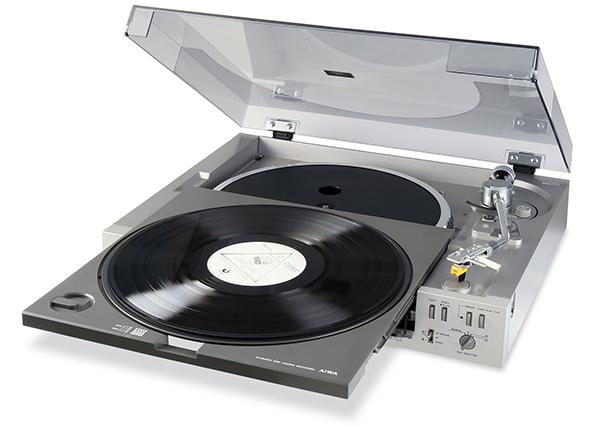
Aiwa’s approach was quite different. The AP-D50 seen here is an acceptance that a quality turntable had to be wide and deep, but a clever front-loading mechanism eliminated the need for the user to lift the lid. The unit could therefore be installed on a shelf of limited height, or at the bottom of the rack which Aiwa offered to house the rest of the system.
At this time Aiwa was better known for cassette decks than turntables, but its 1981 catalogue listed six models, from the ambitious LP-3000 down to basic units like the AP-2300 (the turntable suggested for its previous ‘22’ range of micro components). All were direct-drive and some were very expensive – the LP-3000 cost around £550, which made it one of the more costly options on the market.
Drawer-loading turntables have appeared numerous times over the years, Sony’s PS-FL7 [HFN Mar ’20] and Pioneer’s PL-X50 being two popular examples. In all cases the designer is faced with the same problem – how to arrange the sliding parts so that they move easily yet retain the required accuracy and mechanical stability. Aiwa’s AP-D50 was among the most creative, housing at its heart a conventional Japanese direct-drive solution. It was assembled on a pressed steel base onto which all the key components were attached. What looks like the plinth was simply a plastic bib to protect the working parts.
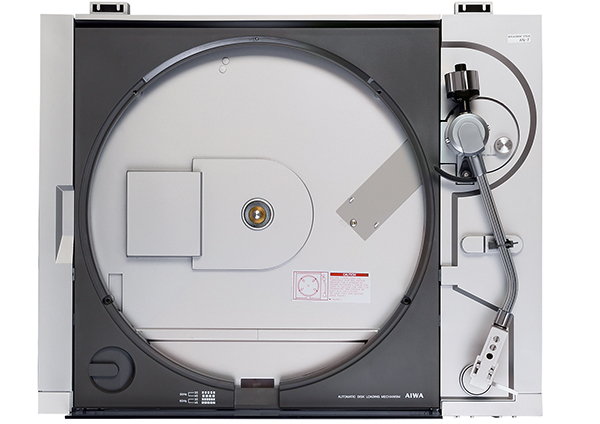
Above: The spindle of the 4-phase/8-pole Hall effect direct-drive motor is revealed once both platters are removed. Note grey loading tray
There was no suspended sub-chassis, isolation being confined to that offered by the deck’s small, soft rubber feet. The main platter was of the conventional alloy die-cast type, complete with strobe rings for fine-tuning the speed since the motor was not quartz locked. On top of this was a second, slightly larger platter made from a mixture of synthetic materials. When the drawer opened this was lifted by its rim and transported out towards the user [see pictures, p131]. Drive was transferred by small felt pads underneath the top platter and accurate centring was assured by a gentle taper, machined into the motor’s spindle, which registered with the underside of the second ‘loading’ platter.
Aiwa’s system may appear overly complicated, but it meets all the requirements of a machine designed to handle records automatically. It can cope with discs of any size, cannot damage the playing surfaces in any way and allows full contact between the record and the turntable once it is loaded. Also, since neither the main platter nor arm need to move with the drawer, their bearings can be rigidly mounted and joined together.
Lighting the way
The AP-D50 was fully automatic, as hand cueing would not be possible if the lid could not be opened. Arm movements were controlled by a small DC servo motor similar to that used in Pioneer’s PL-600 [HFN Jan ’24]. A slider on the front of the deck was used to select different tracks, and was engaged by setting the cueing lever to its ‘manual’ position. A miniature lamp by the arm base illuminated the interior gloom to make cueing easier. A brush next to the rest position of the arm, operated by a push button on the right-hand side of the plinth, could clean the stylus after a record was played.
When Aiwa’s 30 series micro units were replaced by the new M-808 system, the AP-D50 was re-styled and became the AP-D80 – essentially the same turntable, albeit with slightly neater looks and simpler controls. After that, the company’s interest turned to Compact Disc and no more drawer-loading turntables were produced.
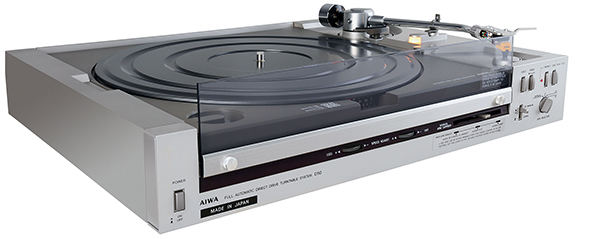
Above: The vertical clear plastic window at the front of the deck drops down as the loading tray slides outwards. Controls under the tray cover fine speed (pitch) adjustment and the point at which the arm lifts/lowers across the LP surface
Drawer aside, this Aiwa deck can also be used in conventional fashion as the lid lifts fully. Therefore, it’s possible to revert to standard manual operation if you wish, although the automatics certainly add to the fun and create an inevitable ‘wow’ when shown to guests (including visitors to the UK Hi-Fi Show Live ’24, where this AP-D50 was on demo). Otherwise, it looks and feels like any other middleweight Far East turntable of its era, the creaky plastic casework contrasting with the well engineered arm. The motor is completely silent and swiftly accelerates the platter to working speed. I found the minor controls to be a bit fiddly, though – the size selector in particular has a stiff, greasy action.
Pressing the play key makes the drawer close but it must be pressed again to start the mechanism, presumably to avoid causing the stylus to bounce across an empty platter by mistake. The manual cueing device is more amusing than it is useful because its limited range means it’s necessary to set the slider in an appropriate position before it is engaged. Possibly this was designed quickly, as an afterthought, when it was realised that it was impossible to select tracks without lifting the lid. Either way, it is a poor substitute for the motor-powered arm transport functions of a linear tracking machine like the Technics SL-10.
Our mint-in-the-box AP-D50 came with its original Aiwa-branded MM cartridge (possibly of Audio-Technica origin), which I retained for my listening tests. Usefully, as the headshell has a standard mount, this could be replaced by a superior item better matching the quality of the arm. In this respect the Aiwa AP-D50 scores over the Sony PS-Q7 and Technics SL-10, both of which use specialist cartridges for which there are few alternatives.
 Tim listens
There are few surprises in the way the AP-D50 sounds. It is bright and crisp with impeccable speed stability and lots of energy and pace. With turntables sold as a package like this it can be difficult to divorce the contribution made to the performance by the cartridge and the rest of the machine, but I think it is fair to observe that the brightness originates mainly in the former. The seasoned audiophile may baulk at the mechanical complexity of the AP-D50’s loading mechanism and the components that automate the arm, but I was unable to identify any specific effect they had over the sound. Both are effectively isolated from the platter and the arm by the time the stylus hits the record.
There are plenty of turntables far higher up the quality ranks which make use of rigid platter mats; the one fitted to the Aiwa is impressively flat and runs perfectly true. That said, the common issue of rumbling, swishing noises in the background if records are not perfectly flat was present here, but this is common to all decks without soft mats. Truly flat records showed the potential of the AP-D50’s drive, there being no hum or other motor-related noises perceivable – either directly or through the speakers – from the listening position [see PM's Lab Report].
Leagues ahead
The AP-D50 seemed to do its best with period popular material where its sonic character added to the experience rather than detracting from it. The Human League’s 1981 album Dare [Virgin V2192] can sound a bit gloomy on some equipment, but it shone via this Aiwa deck and seemed to regain some of the life and sparkle I’ve always felt it lacked. Direct-drive precision gave the music the propulsive security which other types of turntable don’t always capture fully.
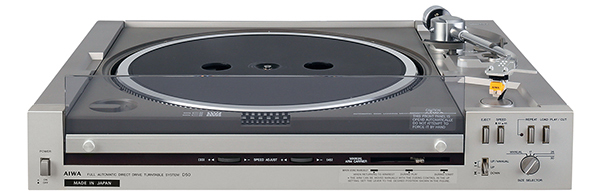
Above: The AP-D50 with alloy drive platter in place
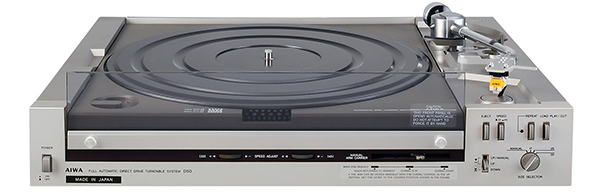
Above: With polymer loading platter in place
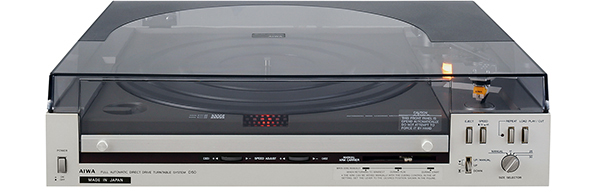
Above: With lid added and power switched on
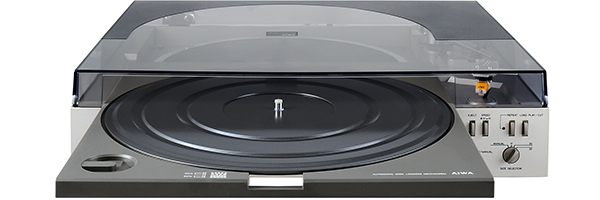
Above: With platter drawer ejected
Compared to the rival Technics SL-10 (which was admittedly a more expensive option when new) the AP-D50 has a hard, glassy sound and a width and depth of soundstage that’s not as expansive, these things being especially obvious with largescale orchestral pieces. Still, while the Technics SL-10 turntable offers a best-in-class performance, Aiwa’s AP-D50 still comes out well when compared to conventional decks of comparable rank.
To this end I felt detail recovery reached a higher standard than appearances would suggest. When I auditioned the Sony PS-Q7 it was clear that the unconventional aspects of its design compromised its performance, but with the AP-D50 this was not so obviously the case. That said, it was difficult to completely set aside the hard, thin nature of the sound, though this dominant colouration could most likely be tempered by fitting a superior MM cartridge.
Top drawer
As an attempt to bring CD-like media handling and convenience to LP listening, the AP-D50 falls short. There are plenty of linear tracking machines with optical track sensors that do this a whole lot better, although I think that Aiwa’s drawer design is probably the best (and the cleverest) of the lot.
Moreover, as a complete solution, it makes a lot more sense, especially in view of the ease with which a better cartridge can be substituted. Additionally, unlike with some, the designers have left the option open to lift the lid and use the arm manually, so you don’t have to wait for trundling mechanisms and grinding gears to do their things before you can play a record. You need to climb a good way up the ladder of basic turntables to usefully better the AP-D50’s design and so it is easy to recommend, not just as an artefact of one of hi-fi’s great eras but as a good listen too.
Buying secondhand
This Aiwa turntable is not especially common but samples are about if you look. The first thing to check is that both platters are there – the AP-D50 won’t work if they are not. Electronically, it is not as daunting as you may imagine and is quite robust, most of the common problems being mechanical in nature. The drawer is driven by two belts which have to take a fair amount of load for everything to work – if they are past their best the drawer will either get stuck or won’t function at all. There are no belts in the arm mechanics but the mass of cams, gears and levers were liberally coated in grease in the factory and this can become sticky with age, jamming up the works.
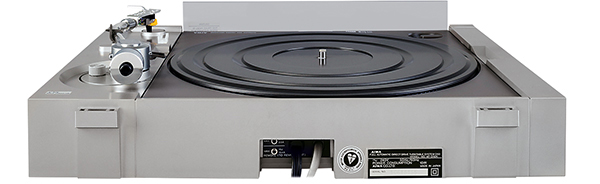
Above: AC mains and phono cables exit from the rear of the AP-D50 alongside ports for wired remote control and (tape) rec sync. Underneath are four basic plastic feet
The micro-switches and sensors that monitor the mechanism also have to be clean and well-adjusted to avoid malfunctions. One of the worst aspects of working on the AP-D50 is how difficult it is to take apart, something which may be enough to put off a beginner.
Hi-Fi News Verdict
The looks of the Aiwa AP-D50 may have some audiophiles running for the hills but underneath all the high-tech garnish is a sensible and well engineered direct-drive turntable with a lot to recommend it. The drawer-loading mechanism is something else, being both clever and functionally effective, and because the arm accepts standard cartridges you can fine-tune the sound to your taste.
Sound Quality: 80%
 | |||||||||||

|
|
| |||||||||










 SPONSORED VIDEO






| Equipment Reviews | |
Music Reviews Awards | |
Latest News Features | |
Resources Newsletters | |
Subscriptions |
WHERE TECHNOLOGY BECOMES ENTERTAINMENT
 © 2026 Hi-Fi News
AVTech Media Ltd
All rights reserved