dCS Lina DAC X streamer
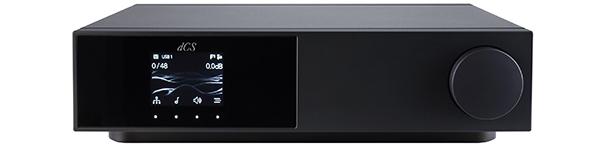

On recent form, the £13,500 dCS Lina DAC X could almost be considered ‘conventional’. Following on the heels of the Lina headphone amp system [HFN Nov ’22], and the massive – and massively pricey – multibox Varèse player [HFN Feb ’25], complete with separate mono DACs and the option of an SACD/CD transport add-on, the Lina DAC X looks dangerously like any number of models from rival companies, from its proportions to the inclusion of a front-panel rotary volume.
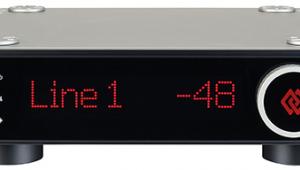
At 444x122mm (wh), it’ll slot into most hi-fi racks where it will also make a good visual match with products from other brands thanks to a choice of matt silver or black finishes. Its preamp output, on either unbalanced RCAs or balanced XLRs, brings added flexibility that’s further enhanced by 0.2V, 0.6V, 2V and 6V maximum output options. These are set via the Lina DAC X’s configuration menu, and dCS Mosaic app plus IR remote [pictured below]. There’s also access to custom digital filter options – no fewer than six for PCM-based data, and five for DSD [see PM's Lab Report].
DAC of all trades
As it stands, the Lina DAC X may be connected into a conventional amplifier system and run at fixed output or hooked straight into a power amp or active loudspeakers, thus creating a top-quality system that’s big on musical ability but small on box-count. But what actually is it?
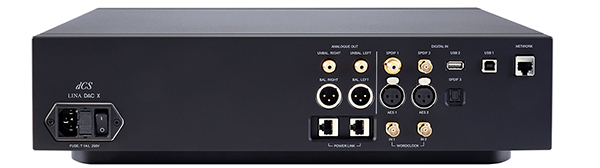
Well, the ‘network-attached DAC’ description almost covers it, but then so does ‘Network player/digital preamp DAC’. With a StreamUnlimited Stream800 platform under the bonnet, it will play music from network storage as well as online services including Qobuz, Spotify, Tidal and Internet radio. It’s also Roon Ready and features a good range of digital inputs including two coaxial and one optical, and two AES/EBU XLRs (able to be paired to handle audio data up to 384kHz).
Down to the wire
There’s also a USB-A port for storage devices and external accessories such as a CD drive, and a USB-B port for direct connection to a computer. Network hookup is wired only via Ethernet, and the unit also has two RJ45 ports for dCS’s Power Link communications, plus inputs for an external word clock. In fact, the only other notable omission beyond Wi-Fi is an HDMI port for TV sound, a facility dCS has chosen to swerve in this purist design given that most TVs/set-top boxes also have an optical digital audio output.
On the outside, the Lina DAC X is very ‘dCS’, with its milled from solid aluminium casework, radiused corners, soft-touch finish and glossy display. It’s hand-built at the company’s Cambridgeshire HQ, and uses now-familiar dCS technology, including the celebrated Ring DAC architecture. As PM explains, ‘the dCS Ring DAC combines the pure monotonic conversion of a genuine “single-bit” DAC with the operation of a PWM bitstream-style converter. Proprietary code truncates incoming LPCM data (and converts DSD) into smaller ‘bit words’ which are then mapped across 48 identical current sources that comprise the Ring DAC. This matrix of current source/resistor elements is clearly visible in our inside shot [below] as is the Xilinx processor that handles all the DSP, separate clocks, and balanced analogue output stages’.

In addition to this core processing, the Lina DAC X offers DXD and DSD (and DSDx2) upsampling, meaning it’s able to handle audio in PCM formats up to 384kHz/24-bit, and DSD64/128, either as native DSD or via DoP. In addition, it can unpack lossless FLAC, AIFF and MQA, as well as handling uncompressed WAV files.
The DAC and upsampling software are potentially upgradable, as dCS has done with previous products, and the same goes for the streaming and control sections, all the circuitry here being arranged around the walls and upper and lower surfaces of the enclosure. This economic use of all three of the chassis’ dimensions is what the company calls its ‘single flex-rigid PCB design’, which was also used in previous Lina products and the flagship Varèse system. This folds the boards up origami-style, both minimising signal path lengths while optimising isolation between the sections of the player/DAC.
New here is separation for the power supply, now in its own housing, and of course that rotary control for volume, which is digitally implemented in the Lina DAC X’s Xilinx FPGA. Apple AirPlay capability is also now handled in software, rather than via a separate chip.
 The big reveal
From the off, the Lina DAC X impresses with its combination of forceful presentation and subtlety though, as dCS would no doubt hope, it doesn’t quite offer the insight and sheer visceral impact of the full Varèse stack heard in the HFN Listening Room. Playing the Steven Wilson remix of ABC’s The Lexicon Of Love [Neutron/UMC download] found the album sounding finer than ever, ‘The Look Of Love’ fast and tight, with the bass line sounding fabulous and Martin Fry’s vocal vibrant and exciting. Meanwhile, the opening of ‘Poison Arrow’ was punchy and full-blooded.
This grip and speed was also heard to good effect with David Bowie’s Let’s Dance [Parlophone 7243 521896 01], with Chic’s Nile Rodgers and Bernard Edwards much in evidence, for example, in the choppy guitar opening ‘Modern Love’. Here the DAC fully developed Bowie’s switches of register from the intro to the vocal, and the sinuous bass of the title track.
What this dCS unit does so well is reveal details other players may overlook, in a manner that makes one wonder quite why they weren’t obvious in the first place. A case in point? That Mick Jagger backing vocal on Carly Simon’s towering ‘You’re So Vain’, from her 1972 No Secrets album [Elektra 960 684-2]. This was immediately revealed by the DAC X, and once noticed it can’t be unheard – the story goes that Jagger demanded so many retakes he drove Simon spare with frustration.
To reconsider another overlooked classic, playing Andrew Gold’s ‘Never Let Her Slip Away’, from the Thank You For Being A Friend compilation [Rhino R2 73511], revealed that what some view as a cheesy throwaway track is actually superbly crafted. The rich, clean and detailed dCS sound showed just how well-constructed is the rhythm line running throughout, until the rest of the instrumentation fades to let it peter out at the end of the song.
Pet sounds
It’s all been a bit poppy so far, taking in the likes of the 50th anniversary release of Elton John’s Honky Chateau [Rocket 4596215] – amazing piano sound, the band tight and focused, and the brass on ‘Honky Cat’ sounding rich and ripe. And the performance was so enjoyable that we listened, rapt, all the way through to the harmonies of the Starland Vocal Band’s ‘Afternoon Delight’ from the eponymous album [RCA Victor RS 1074]. The audacious a cappella line near the end was spine-tingling when opened up by the DAC X.
Time to get a little more serious, with Nigel Kennedy and Killing Joke singer Jaz Coleman’s 2000 release, Riders On The Storm – The Doors Concerto [Decca 467 350-2]. This combines Kennedy’s violin with a full orchestra and the version of ‘The End’ here, running to the full 11-plus minutes of the original, sounded almost as spacey, weird and threatening, if not as violent. Flicking over to that track, from 1967’s The Doors album [50th anniversary release, Rhino download], saw the dCS Lina DAC X revealing the shifting tone of Jim Morrison’s voice, from weak and mournful to rabid and angry. It was thrilling stuff, even if those of us of a certain age can’t now hear ‘The End’ without imagining the thud of rotor-blades above the jungle!
Vintage vibes
Coming back down to more relaxed music, the Lina DAC X did a fine job with the lush brass harmonies of Count Basie’s ‘April In Paris’, from the 1957 album of the same title [Verve 0602498840184]. It glided through the music while keeping the feet tapping right until Basie calls for ‘One more time’. Yes, the sound is undeniably vintage, but played through this latest dCS DAC it’s entirely about the music, rather than any technical deficiencies in the recording.

This kind of communication with what’s being played is where the Lina DAC X earns its keep, whether it’s the sweep of massed brass or the metronomic drive of a track like the Neil Cowley Trio’s ‘Rooster Was A Witness’ [The Face Of Mount Molehill; Naim Label CD171]. I was lucky enough to hear the band playing this track live back in the day, and still remember the pounding, unstoppable sound it created, and that’s just what the DAC X delivered here. Cowley hits his piano hard, and each note was clean and attacking, while Rex Horan’s bass and the drums of Evan Jenkins were in perfect lockstep, pushing the track on and on.
Statement sonics
But of course the Lina DAC X can do rich and subtle, too, as was clear with the Dunedin Consort’s recording of Mozart’s Requiem under John Butt [in DSD64 from Linn Records CKD449]. From the powerful opening to the lyricism of the ‘Lacrimosa’, the DAC X offered all the dynamics and definition one could ever want, allowing the music to swell with the brass blaring, and then sink back into hushed tones before becoming a big, rich statement of sorrow. It was emotional, musically enthralling and with superb insight into voices and instruments – but then that’s just what the Lina DAC X does so well.
Hi-Fi News Verdict
The looks may be those of dCS styling made more conventional, but there’s no change in the way the Lina DAC X delivers the music. It satisfies on all the hi-fi criteria, is simple to use, but above all communicates whatever is being played in a manner that’s as much about emotional impact as technical prowess. With the security of firmware updates, this ‘Lina’ will be the X factor for a host of top-flight systems.Sound Quality: 90%
 | |||||||||||

|
|
| |||||||||












 SPONSORED VIDEO






| Equipment Reviews | |
Music Reviews Awards | |
Latest News Features | |
Resources Newsletters | |
Subscriptions |
WHERE TECHNOLOGY BECOMES ENTERTAINMENT
 © 2026 Hi-Fi News
AVTech Media Ltd
All rights reserved