Soulines tt9/KiVi M3 turntable/arm
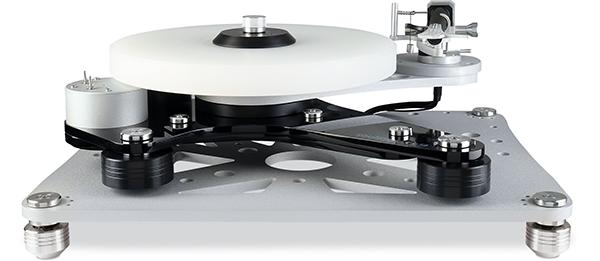

Eastern Europe is no stranger to high-quality boutique hi-fi brands [HFN Apr ’24, Jun ’24 and Feb ’25] with ‘analogue’ audio a particular favourite. Igor Gligorov’s company, Soulines, is based in Serbia and has graced these pages before, but UK distribution has now been re-established thanks to Sound Fowndations. The timing is spot on, as Soulines has recently released a new turntable, the tt9, loosely described as ‘entry level’ and selling for £3990 with partnering KiVi M3 tonearm.
This is currently the only tonearm in the lineup and may be purchased separately for £2090. Soulines’ other turntables are the Kubrick DCX [HFN Jul ’18], which retails for £6490 with the same arm, and the top-of-the-range tt42 – its price yet to be confirmed for the UK.
Material world
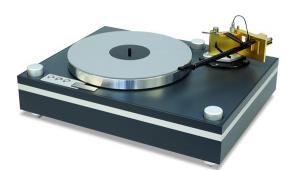
Your £3990 buys you a great deal of ‘materials technology’ in the tt9. Its construction is described by Soulines as ‘solid but light’ and its main plinth is made from a mixture of Delrin – or polyoxymethylene (POM), an engineering thermoplastic – and acrylic, to which an aluminium sub-plinth is coupled at three points using rubber/cork washers of different thicknesses and diameters. The overall aim is to both absorb and channel structural resonances, and generally insulate your choice of cartridge from the noisy outside world.
The turntable is equipped with an inverted main bearing that has a stainless steel ball atop a stainless steel spindle, with a brass sleeve and Delrin thrust plate. The sub-platter is also Delrin and is securely bonded to the bearing housing. The machined acrylic main platter sits directly on this and weighs 2.5kg. A clamp is supplied, plus a set of cork/rubber mix washers for the centre spindle. These can be placed under the record according to its thickness and how much ‘flattening’ is required from the clamp!
It’s a unipivot, but...
Drive to the platter is from a DC motor with speed selected by a switch. Each speed is adjustable using a small screwdriver to reach one of two trimpots that are located inside the motor controller [see pic, below]. Another appealing touch is the on/off switch on the same housing which, rather than dreary old ‘0’ and ‘1’, is labelled with ‘Stop’ and ‘Play’ symbols.
Soulines’ turntable sits on three adjustable inverted cone feet and is supplied with acrylic ‘cups’ into which the conical points locate. These also feature cork/rubber washers on their underside and so help stop the tt9 from sliding when in position. As an added bonus, the deck even comes with a lid.
The KiVi M3, which is pre-mounted, is the manufacturer’s first tonearm and one on which a great deal of thought (and sweat and tears) has evidently been expended. It has its own arm mounting base when fitted to the tt9, but this base, plus the arm’s effective length, are compatible with a standard Rega fitting. The bearing yoke and armtube are machined from a single block of Delrin and, while the arm might broadly be termed a unipivot, it’s a little more complex than that.
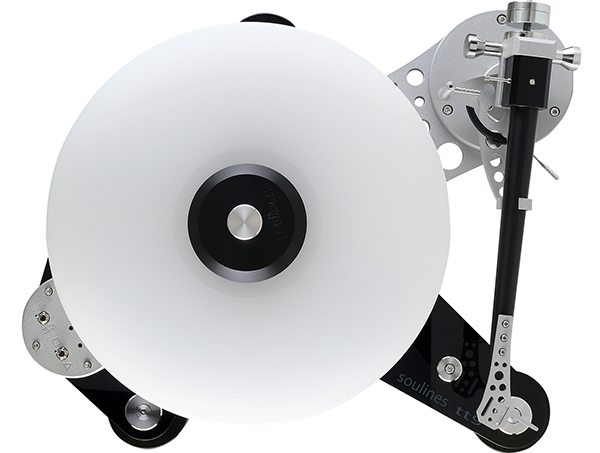
Soulines describes the arm as a captive, or ‘false’ unipivot, as the centre pivot on the housing does not sit into a ‘cup’ as might be expected. Instead, the lower bearing features three hardened stainless-steel balls into which the pin locates. Soulines says this makes the arm feel more conventional and, in use, it is certainly steadier than the likes of a Roksan Nima [HFN Jun ’10] or Naim Aro [HFN May ’91].
Also, while the arm wand is made from Delrin, the lower part of the bearing housing is aluminium, which lowers the centre of mass and applies further resonance damping to the already fairly inert arm [see PM's Lab Report]. The alloy headshell is securely bolted through the top of the armtube.
Four steel counterweights are supplied, which may be used in combination to balance a range of cartridge weights from 5-15g. Bias is applied by the trusty thread and hanging weight method, while a secure locking collar can be loosened to allow VTA adjustment. An azimuth adjustment counterweight can be rotated to ensure the cartridge’s top is held precisely parallel to the LP surface.
Setup of the tt9 is straightforward but the KiVi M3 tonearm is a little more involved as there are a lot of adjustments and some transit brackets and screws to be dealt with. Fortunately, the instructions for both are clear, and go into copious detail about not only what you need to do, but also why you’re doing it.
Soulines also offers various turntable accessories – we were supplied with the £1290 ‘u-base’ isolation platform and a set of three bbs (ball bearing swing) feet (£890 for a set of three, or £1150 for four). The u-base is a stainless steel and aluminium design with a mathematically determined selection of holes and damping inserts designed to control vibration. The bbs feet have a multi-layered construction, including ball bearings, for the promise of ‘de-coupling’. Soulines indicates that the bbs feet can be used for turntables, electronics and loudspeakers.
 Tweakers’ corner
Initially in standard configuration, fitted with a Clearaudio MC Essence cartridge [HFN Aug ’17] and connected to my regular Yamaha C-5000/M-5000 amplifiers [HFN Aug ’20] and PMC twenty5.24 loudspeakers [HFN May ’17], it was apparent that this is a turntable from an engineer with an excellent grip on the fundamentals of vinyl replay. The tt9 and KiVi M3 pairing offers a beautifully ordered but dynamic presentation that’s seemingly ‘in control’ of everything at all times.

I also love the eminent tweakability of Soulines’ design and, after a little experimentation, found that the clamp tightened the bass usefully. However, this initially came with a slight hardening across the midband. Careful selection of a rubber/cork washer under the LP before fitting the clamp not only removed this hardness but also opened up the soundstage a touch, so I resolved to stay with this particular configuration through my listening.
Baby spice
Set like this, the tt9’s performance was one of solidity and realism, locking singers centre-stage and bringing them out into the room by just the right amount. Jazz vocalist Lyn Stanley appeared to be winking cheekily at me as she performed ‘Everybody Loves My Baby’ from her Tribute To 1924 LP [A.T. Music ATM3112], and her backing musicians were arranged around her, each in their own space. The tt9 didn’t quite pull off the left-to-right majesty of my reference Michell Gyro SE [HFN May ’99], but it won’t leave you wanting in terms of soundstage scale.
In the higher frequencies there is a purity to this turntable’s performance that is joyous. In my experience, conventional unipivot arms bring a sense of air and space to the music, and the KiVi M3’s take on the design maintains this strength in spades. Hi-hats sounded crisp and distinct, and cymbal strikes were firm and clear without any spittiness. Given that it is filled with such elements, The Horrors’ Primary Colours track ‘Sea Within A Sea’ [XL Recordings XLLP 418] was given a spine-tingling level of clarity. The long instrumental intro, with its shimmering percussion above stabs of eerie guitar and two-note bassline, sounded wide open and wonderfully rhythmic through the tt9/KiVi M3 set-up.
Movin’ and groovin’
Talking of rhythm, you need to get the bass ‘right’ to enjoy a foot-tapping presentation. The tt9 is up to the challenge, ensuring The Colorblind James Experience’s ‘Considering A Move To Memphis’, from their 1987 album of the same name [Earring Records SAVE 50], was an absolute riot to listen to. Kick drum beats were taut with plenty of chest-thumping weight, and no sign of outstaying their welcome. The double bass that underpins the track was full and textured, and agreeably warm rather than dry.
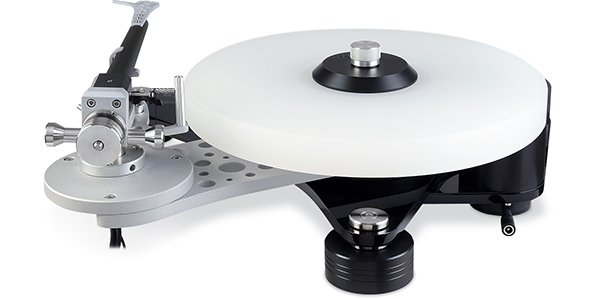
During my audition period I experimented with both Soulines’ optional bbs feet and the u-base platform. The former have the less dramatic effect, subjectively offering a fraction more depth and focus to the turntable’s low-frequency handling but not really altering the overall balance of the sound. Yes, I appreciated the differences these accessories made, but they were fairly subtle – the impact of the u-base was more of an eye-opener.
All about the base
Here, again, there was a fraction more solidity to the lows, but Soulines’ platform also noticeably increased the depth of the tt9’s soundstage and added a lovely sense of sweetness to the midrange. This made the character of instruments, be they electronic or acoustic, shine through just that little bit more. Consequently, Therese Schroeder-Sheker’s harp on ‘Credo Of Ballymacoda’ [Windham Hill Sampler ’89; Windham Hill 371082-1] grew in stature, each string pluck gaining in attack and resonance.
Isolation bases are unpredictable things, their effect ranging from barely there to ‘can’t go back to living without it’. The addition of the u-base to the tt9 is towards the top of that scale, so if you’re shopping for Soulines’ deck, I would strongly recommend finding the budget for the platform, too.
Hi-Fi News Verdict
Soulines’ tt9 turntable and KiVi M3 tonearm work hand-in-glove to deliver a sound that’s detailed, confident and never less than enjoyable. Both deck and arm are intelligently designed, thoughtfully engineered and beautifully finished. Even better, with a range of both standard and optional ‘tweaks’ available, your tt9 can evolve over time, optimising its performance to your system and room placement.
Sound Quality: 87%
 | |||||||||||

|
|
| |||||||||











 SPONSORED VIDEO






| Equipment Reviews | |
Music Reviews Awards | |
Latest News Features | |
Resources Newsletters | |
Subscriptions |
WHERE TECHNOLOGY BECOMES ENTERTAINMENT
 © 2026 Hi-Fi News
AVTech Media Ltd
All rights reserved