EAT F-Dur/F-Note turntable/arm
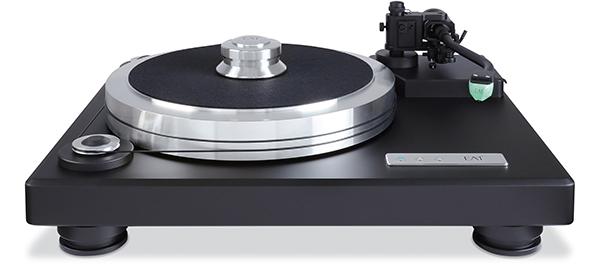

To some hi-fi enthusiasts, European Audio Team (EAT) is the classy sister company of turntable giant Pro-Ject. That’s not entirely the case, though, as owner/CEO Jozefina Lichtenegger categorically puts her own spin on turntable designs – all invariably luxurious, high performance and upmarket. The F-Dur is the firm’s latest creation, based upon the pricier, chunkier and notably senior Forte S [HFN Dec ’10].
The dual-motor, dual-belt F-Dur lies in the middle of EAT’s lineup. Retailing at £4299 without tonearm, complementing the deck with the C-Note or flagship F-Note arm will raise the price tag to £5599 or £7899, respectively. The base price is not far off that of the company’s E-Flat [HFN Jan ’12] or C-Sharp [HFN Feb ’15] decks, but it should be noted that, true to the EAT philosophy, each turntable employs different technologies.
Bend at the knees...
EAT knows how to make an entrance – the F-Dur is delivered in a large wooden box, resulting in a package weighing north of 44kg. Faced with this, some might ask their dealer to assist in installation but doing it yourself is very feasible. Yes, this is a ‘connoisseur’ turntable, but in terms of setup it’s as easy as popular, mainstream disc spinners from Pro-Ject. Just be prepared for a brief workout lifting the CNC-machined aluminium platter and hefty MDF plinth out of the crate.
The F-Dur embraces the current trend of increasing footprints, with a very large plinth measuring 550x440mm (wd) that won’t fit on regular hi-fi racks. This plinth contains no empty spaces, so contributes quite a bit of weight, and sits on four high-quality aluminium feet, with thermoplastic elastomer (TPE) damping, that are easily adjusted for levelling.
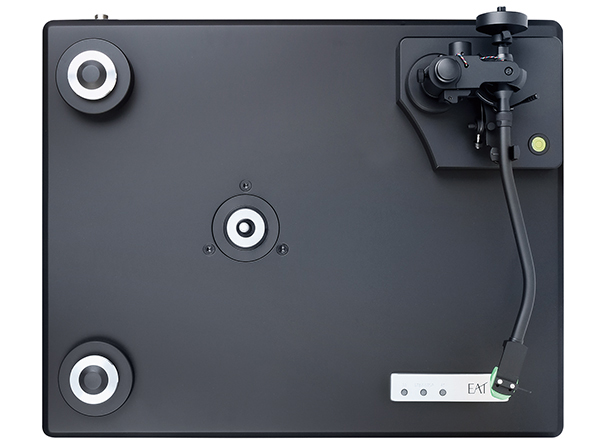
The 50mm-thick platter is no doozy either, its extra mass claimed to improve speed stability while a ring of TPE inside promises to soak up unwanted resonances. And even though it looks and feels huge, it rotates smoothly [see PM's Lab Report], aided by an inverted main bearing with a ceramic ball atop, the mechanical load reduced by opposing magnets in the bearing and turntable chassis.
Further measures to reduce vibrations and improve rotational stability include the F-Dur’s use of two AC motors, which are situated front and back and to the lefthand side of the platter. Each has its own belt, reinforced with carbon fibre to eliminate static build up. These are continuous designs, with no glued joints to cause (minute) speed variations every rotation. According to the manufacturer, the F-Dur’s motors are ‘carefully selected from batches of 100,000 units’ for their silent operation and are controlled by a synthesised AC supply within the chassis.
Many high-end turntables flaunt a complex, technical aesthetic to showcase their audiophile prowess. The F-Dur, on the other hand, opts for a streamlined, minimalist design. The chassis is based on that of the Forte S but is a lot less angular, with edges rounded off to soften the overall appearance, while the controls are discreet. Either side of the start/stop button are ones to select 45rpm and 33.33rpm operation, which blink until the platter has reached the chosen speed. This takes a few seconds, and longer if you use EAT’s supplied record weight.
Taking Note
Our F-Dur deck was fitted with the 12in F-Note tonearm, which was introduced in 2022 as EAT’s leading model. Ours featured a heavyweight J-shaped alloy arm wand, terminating in a collar connecting the tube to the rear of the assembly where four ‘ultra-low friction’ pinpoint bearings are located. These and the mounting assembly come in a choice of matt black carbon or shiny, polished chrome [HFN Nov ’24], both nicely complementing the F-Dur’s matt black plinth.
The F-Note’s anti-skating adjustment is arguably a bit fiddly, with a thread attached to the tonearm needing to be led through a small pulley and fixed to one of three grooves, depending on selected downforce. A bundled RCA cable plugs straight into the 5P connector on the back of the arm mount.
You’ll need to add a cartridge to complete the F-Dur package. EAT recommends its Jo No5 moving-coil [see PM's Lab Report], which can be factory mounted. This is a looker, brandishing a curvaceous mint-green polyamide body formed by ‘Selective Laser Sintering’, similar to the ‘Selective Laser Melting’ employed by Ortofon for its alloy-chassis cartridges [HFN Jun ’25], and fitted with a ‘Nude Fine Line’ stylus.
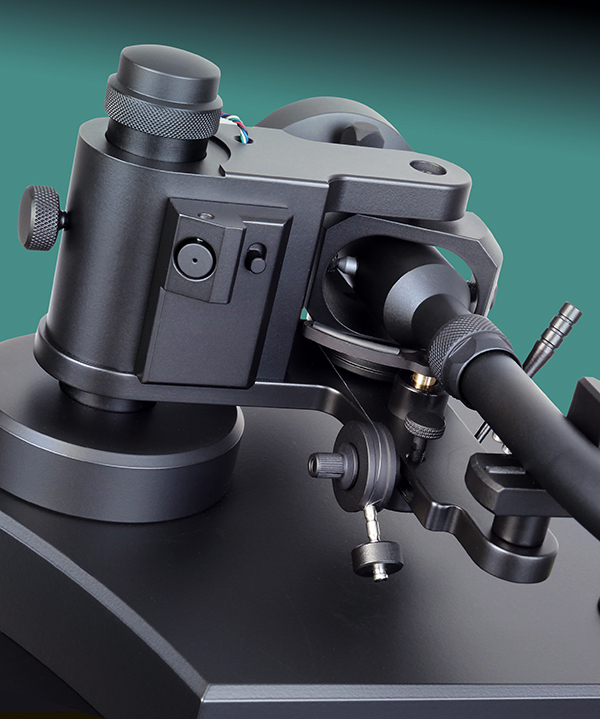
Cartridge swapping is aided by the F-Note’s easily accessible VTA and azimuth controls, plus a laser pointer within the bearing block to assess arm/cartridge alignment. This is done by placing the tonearm on a record and moving it in a position so that the laser hits one of two holes at the rear of the headshell. Should that not be the case, readjustment of azimuth or VTA is required.
 Go with the flow
The F-Dur/F-Note pairing delivers a finely blended performance where detail, dynamism, grand soundstaging and musical ‘flow’ all come to the fore. And it does this with an air of calm authority, too, the subjective result of its impressive mechanical engineering.
Every time I listen to Counting Crows’ August And Everything After [Analogue Productions APP24528-45] I’m transported to the endless vistas of the American Great Plains – this signature 1990s rock album produced by T-Bone Burnett has such a wide-open sound. The F-Dur effortlessly conveyed its huge scale with the tube-amped guitars sounding full of character and Adam Duritz’s singing revealed in all its raw splendour.
In a system with a Musical Fidelity Mx8 Vinyl [HFN Mar ’25] and Primare PRE35/A35.8 amps [HFN May ’22] driving Monitor Audio Gold 300 6G floorstanders [HFN Oct ’24], this EAT turntable did a very good job of bringing over the emotion behind the lyrics of ‘Round Here’, and the band’s first real hit, ‘Mr. Jones’ – a song which somehow manages to be simultaneously upbeat and melancholy.
Heavenly hi-fi
Listening to the folksy percussion on ‘Omaha’, the F-Dur’s sound veered more to the side of revealing detail than delivering opulent bass. No complaints about that, however, as it was fascinating to hear how the turntable uncovered the many, many instruments popping up in the background of this track, including a mandocello, a chamberlin and a Hammond organ. Similarly, excellent separation and a tight bass – surely aided by the deck’s mass-loaded construction – ensured ‘What Heaven’s Left’ on the Calexico/Iron & Wine collaboration album Years To Burn [City Slang SLANG50244LP] was presented in a lively manner on a large, enveloping soundstage.
The songs on this Americana album from 2019 have a dreamy, often slightly diffuse character, spurred on by the reverberant vocals and slide guitars. I’ve heard it on numerous turntables over the years, and EAT’s F-Dur proved one of the best in communicating these performances in such an all-encompassing way. The music appeared precisely defined, yet not so focused as to be devoid of life.
The F-Dur delivered the urgent-sounding ‘All Will Surely Burn’, from Sons Of Kemet’s Burn [Naim Jazz; Naim LP201] with unfailing drive. It never let the rhythm falter, which made for an exciting introduction to this debut LP from the British jazz quartet. Oren Marshall’s tuba sounded deliciously fat, while with the more subdued jazz of ‘The Godfather’, the EAT system gave a seductive portrayal of Shabaka Hutchins’ clarinet, letting me savour the intricacies of his playing. EAT’s very ‘quiet’ deck allowed the subtle backgrounds and gentle drumming to flourish, exposing more of this hidden side of the composition.
Light it up
Vinyl enthusiasts will be accustomed to switching between different pick-ups but the F-Dur’s laser adjustment system will be a new tool for most. I found it very handy when replacing the Jo No5 with a low-compliance Ortofon Quintet Bronze. The different profile demanded some adjustment of VTA, which only took a minute or so – the dial on the top of the bearing block only allows for fine adjustments (large changes require a screwdriver), but enough movement was possible to align the Quintet. Dialling in tracking force was a bit trickier as, when you fasten the lock screw, the counterweight can shift its position.
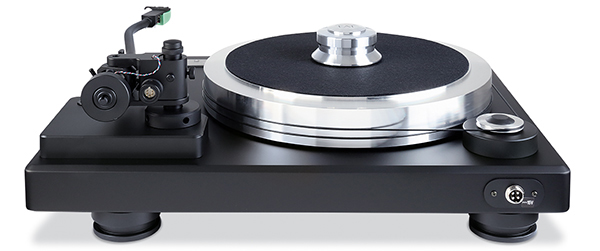
The Quintet Bronze brought sonic changes, including a touch more oomph in the lower ranges. But the essential character of the F-Dur remained on show when playing Andrew Bird and Madison Cunningham’s recent Cunningham Bird [Loma Vista LVR04544], a charming track-by-track homage to Buckingham Nicks’ eponymous album of 1973. The sheer noiselessness of EAT’s turntable meant the soft character of ‘Crying In The Night’ and ‘Stephanie’ shone through, with the pizzicato violin during the latter beautifully defined.
Dive right in
Even with this darker cartridge, the F-Dur extracted plenty of musical information, easily exposing the fact that the replacement for the slide guitar from the original version of ‘Stephanie’ is Cunningham’s nearly unrecognisable dulcet voice. If you are fond of diving into your LP collection, the F-Dur’s ability to flood the room with a pool of musical detail will have you hooked.
Hi-Fi News Verdict
Its large footprint and massive build ensures the F-Dur is a turntable for vinyl enthusiasts willing to clear a substantial space in their lives. For all that real estate, EAT has managed to incorporate many performance-enhancing features into this novel two-motor deck, allowing the finest, intricate detail to be extracted from your vinyl collection. And many will agree – it looks as beautiful as it sounds.
Sound Quality: 88%
 | |||||||||||

|
|
| |||||||||











 SPONSORED VIDEO






| Equipment Reviews | |
Music Reviews Awards | |
Latest News Features | |
Resources Newsletters | |
Subscriptions |
WHERE TECHNOLOGY BECOMES ENTERTAINMENT
 © 2026 Hi-Fi News
AVTech Media Ltd
All rights reserved