Nagra Compact Phono phono preamp
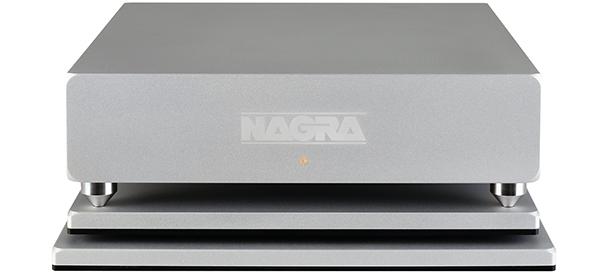

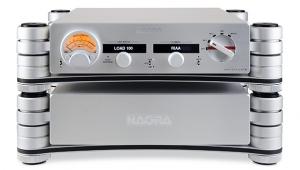
You gotta love a product that lives up to its name. With a footprint of only 185x166mm and a height of 41mm, the Nagra Compact Phono is just that: compact. It’s also about as far removed as possible from the all-singing, all-dancing, all-valve two-chassis £68,500 HD Phono [HFN Jun ’25]. The Compact Phono costs £4500, is solid-state, MC-only and as minimalist as a phono amp can be.
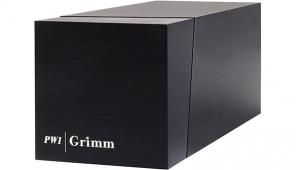
A note about Nagra’s decision to create a downsized line. The Compact Phono and units such as the cigarette carton-shaped Grimm PW1 phono amp [HFN Oct ’25], Chord’s tabletop models, Rotel’s DX-5 amplifier [HFN Dec ’25], and the return of the Musical Fidelity X-Series cylinders, exemplify the trend toward smaller components. At present, the only other item so far in the Compact range is the Compact Server, but if Nagra was to add a preamp, power amp and DAC, I’ve no doubt they’d sell like ice cream in July.
One becomes four
Purchasing the Nagra Compact Phono is determined entirely by the customer’s budget because it offers a systematic upgrade programme which will have you reaching for that credit card a second time. Should you begin with the least costly set-up, your £4500 gets you the unit, a 100ohm mini-XLR loading plug and a small 12V DC ‘on the wall’ (aka wall wart) power supply – the latter being adequate, but only just[see boxout].
Here’s where visions of a sub-£5000 acquisition need to be dismissed. The optional Compact PSU adds £3500, while the £1350 Compact Vibration Free Support (VFS) platform also proved its worth. This comprises two machined aluminium slabs separated by a compliant polymer layer, and is supplied with replacement feet that, once screwed into the Phono or PSU’s base, locate into recesses on the VFS’s top surface. You’ll want two of these isolation platforms if you add the Compact PSU. And trust me, you will want the PSU.
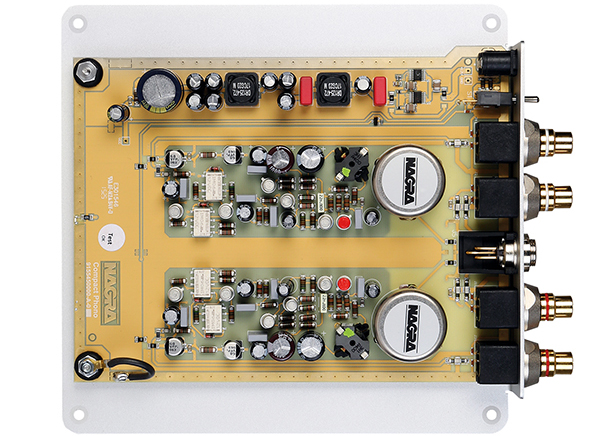
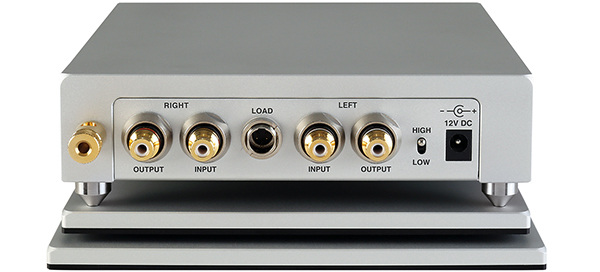
Should your preferred MC cartridge require other than the default 100ohm loading plug, there is a set of five values (39, 180, 270, 470ohm and 1kohm) available for £420 – absolutely recommended if you run multiple cartridges. The socket for the 100ohm plug and the optional values is on the back, between the RCA phono sockets for tonearm-in and signal-out.
Know your limits
As for the remaining elements on the back, they include a toggle switch to select high (62dB) or low (47.5dB) gain, an earthing post, and a socket for the power supply, whether the wall wart or the optional Compact PSU. The latter’s rear contains only an on/off rocker switch, the socket for the lead to connect to the Compact Phono, and another earthing post. Both front panels are empty save for an engraved Nagra legend and a yellow power LED.
The limited nature of the Compact Phono is clear – eschewing moving-magnet means it’s not a ‘universal’ phono stage and matching it with suitable cartridges from the outset will save you much rending of garments. PM spared me a lot of trial-and-error by defining a ‘best fit’ MC for the 100ohm base unit. His advice was ‘pick MCs rated below 0.6mV-0.7mV (1kHz/5cm/sec) and look for an internal impedance below 10ohm. The Compact Phono’s 100ohm loading can be changed on request, of course, but that’s it as far as flexibility goes’. He added that it would have a ‘definite sweet spot for MCs with high enough output to yield a useful S/N, but not so high that the phono stage will be clipped by big grooves’. And I did feed it ‘big grooves’ from the outset.
Lest you think these criteria are too restrictive, with or without the extra impedance plugs, it turns out that a 100ohm default and the output values delineated by PM cover a wide swathe of moving-coil cartridges. My reference TechDAS TDC01 Ti [HFN Sep ’14], which was measured by PM at 440μV, and a half-dozen others in my arsenal fit the bill, and not one fell outside save for a couple of high-output types. Most of the classic MCs work perfectly with the Compact Phono, and the loading kit expands the roster of possible candidates.
 Power up
I’ll be frank – as costly an extra as it is, the Compact PSU must be considered as essential. For anyone who has ever doubted the claims made for optional, upgraded power supplies when available, eg, the aforementioned Musical Fidelity X-Series’ X-PSU, I have never heard it demonstrated so vividly as with the Compact Phono plus PSU.
As good as Nagra’s Compact Phono certainly sounds straight out of the box with the power supplied by its wall wart, every single parameter seemed to improve with the substitution of the Compact PSU. This included dynamic swing, bottom-end control, slam, speed, transient attack, quietness and transparency. The transformation was not subtle.
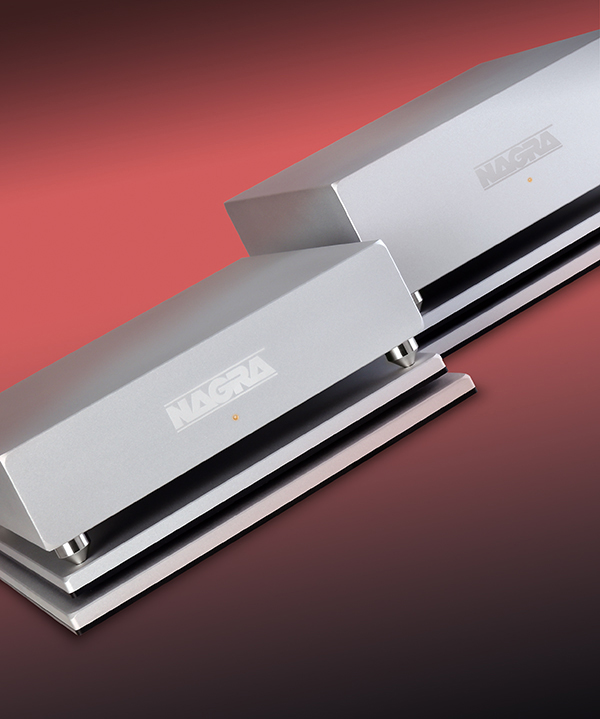
Impressed if not baffled, and eager to test the experience, I dug out my old X-Series X-DAC and ran it with and without the X-PSU. While not quite a shot of steroids to match the gains of the Compact Phono-plus-Compact PSU, it did provide context and repeatability. Power supply fetishists have a point. Suffice it to say, the remarks which follow apply to the Compact Phono with the Compact PSU.
Whole lotta bass
Having switched on the unit and left the room for a couple of hours, as is my habit with new components, I can’t tell you how long the warm-up is from ice-cold, but I can assure you that the sound remained consistent from that point onward. I dug out a guaranteed juggernaut of an LP, Led Zeppelin II [Atlantic R1-535224], and was immediately made cognisant of two qualities the Compact Phono possesses in spades, and regardless of ancillaries.
Both are mandatory sonic elements for Led Zeppelin playback, and this phono preamp delivered them with such aplomb that I felt like I had been cheating Wilson’s The WATT/Puppys [HFN Sep ’24] of music worthy of their capabilities. The first was the sense of mass, obvious from the opening notes of ‘Whole Lotta Love’. Whether serving the frenetic bass of John Paul Jones or the powerhouse percussion of John Bonham, the delivery had the visceral force I would normally attribute to the presence of a bigger amplifier. ‘Compact’ in this instance refers only to the unit’s case size, not its bottom octaves.
So taken aback was I by these new-found depths that I inserted the Compact Phono into a second system feeding BBC LS3/5As. Even with the limitations inherent in that small monitor, it was clear the lower registers via the Compact Phono enjoyed a level of freedom which changed the impact of the song. That small woofer could not disguise nor hinder the way Nagra’s Compact Phono preamp establishes the foundation of the sound.
Leap of faith
As for the second revelation, it was a matter of another sort of quantity. This phono amp creates a soundstage which can only be described as ‘gargantuan’. In the recent documentary Becoming Led Zeppelin, Jimmy Page describes how during the recording he spread Bonham’s drums across the listening space to a point that’s arguably wider than reality. Relocated to a domestic living room, it comes across convincingly as a life-sized drum kit. Not only did the Compact Phono create stage width beyond the speakers’ edges, it also provided uncanny height and seemingly limitless front-to-back depth. I realise the Swiss suffer a questionable sense of humour, but this unit’s name was starting to become ironic.
Needing a bit of subtlety, I turned to the more delicate moments of Blind Faith’s eponymous LP [ATCO SD33-304B]. The loping sound of ‘Well All Right’ played into the hands of those who think an electronic component can affect the rhythm of a recording. I remain sceptical, but the ebb and flow of the piece spoke of a fluidity I associate more with valve gear than with solid-state. The Compact Phono was starting to sound like a sharper if cooler younger brother to the HD Phono.
The vocals of Steve Winwood, with his characteristic nasality, came through with a naturalness allied to a lack of sibilance, in a precise location with correct scale. Moreover, echoing what I heard on the Led Zeppelin album, Ginger Baker’s solo begged the question as to who was the better drummer – something I’m not prepared to answer. But what this Nagra phono stage did was allow me to hear and compare not just Baker and Bonham’s speed or complexity but their sonic characteristics, one fatter sounding, the other tighter – but both astonishingly powerful.
Compact king
As vocals remain my preferred measure of a system, I turned to a singer who delivered perfection every time she opened her mouth. The clarity of Linda Ronstadt’s vocals will test the mettle of any system’s midrange and her delivery of ‘Love Is A Rose’ on Prisoner In Disguise [Mobile Fidelity MFSL 2-608] showed the Compact Phono’s midband and treble to be the perfect companions to that peerless bottom end.
Hi-Fi News Verdict
In a hi-fi universe awash with amazing phono stages, I can easily name a dozen I’d be happy to own. Adding the Nagra Compact Phono to the list is a no-brainer, even with caveats about it being MC-only and calling for matching skills bordering on OCD. If there’s a downside beyond those practical limitations, I can cite only the need to add the Compact PSU. In other words, if you’re an MC-only user, it’s a taste of heaven.Sound Quality: 88%
 | |||||||||||

|
|
| |||||||||











 SPONSORED VIDEO






| Equipment Reviews | |
Music Reviews Awards | |
Latest News Features | |
Resources Newsletters | |
Subscriptions |
WHERE TECHNOLOGY BECOMES ENTERTAINMENT
 © 2026 Hi-Fi News
AVTech Media Ltd
All rights reserved