Grimm Audio PW1 phono preamp
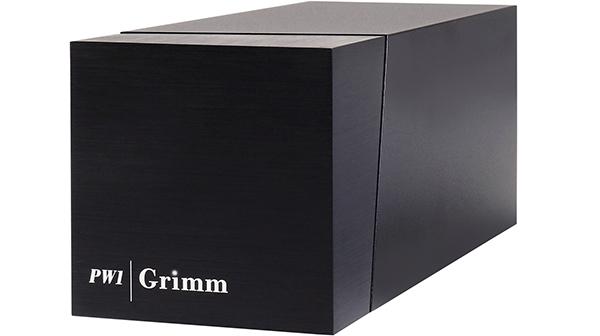

Although long ago settled by the declaration ‘We agree to disagree’, the tubes-vs-transistors (or if you prefer ‘valves-vs-solid-state’) debate continues to keep us busy. Grown-ups use both, the deliberately argumentative choose sides, and there are ample products to support or counter either stance. Grimm Audio, though a maker of not just solid-state gear but with a reputation for digital hardware, has given us in the PW1 ‘Phono Wizard’ (£4695) a chameleon of a product that will both delight and confound music lovers who are still fascinated by hi-fi’s greatest dichotomy.
Analogue magic
As a valve-biased (pun intended) listener, I pitted the PW1 against both like-priced and much-less-costly phono stages, three all-valve and two solid-state. Exploiting this in assessing the PW1 was a given, because Grimm Audio all but proposed the shoot-out when explaining why a company known for a streamer is suddenly addressing the Vinyl Revival. In order for this to help you to understand the PW1’s raison d’être, I will quote co-founder Peter van Willenswaard’s stated rationale:
‘Even in these days of high-performance digital audio playback systems it is hard to imagine a future without LPs. There’s just something magical to it.’ Note the word ‘magical’, calling to mind the works of a certain pair of famous brothers who share the company’s name. The brand continues, ‘Grimm Audio has spent a lifetime designing and improving phono preamps, both in solid state and with tubes’. Grimm’s casus belli? ‘For the PW1 “Phono Wizard”, Peter managed to develop a solid-state phono preamplifier that matches his best tube-based designs.’
Before deciding whether or not Grimm Audio has found the ideal device to settle the dispute between the two technologies, it deserves kudos for producing a phono stage that’s simply so sensible. Firstly, it’s designed to sit next to one’s record deck, the dimensions of 100x100x250mm (whd) enabling it to look at home next to almost any turntable with a rectangular plinth.
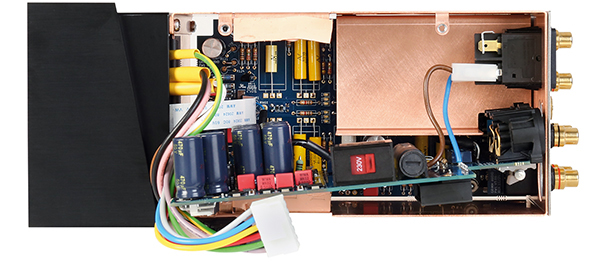
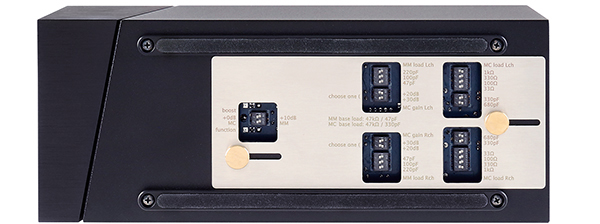
Next, Grimm came up with a neat solution for providing access to the gain and loading settings. These are via banks of DIP switches on the underside, protected by a sliding cover held in place by two knurled screws that are opened and closed by hand. Grimm supplies a little black plastic ‘toothpick’ to flip the DIP switches, switching between +37dB gain for moving-magnet and another +20dB/+30dB for moving-coil, with an optional further +10dB to be added at the output. MCs are offered 33ohm-1kohm loading while the high treble response of MMs (at 47kohm) are ‘tweakable’ with 47-220pF of parallel capacitance.
Two’s company
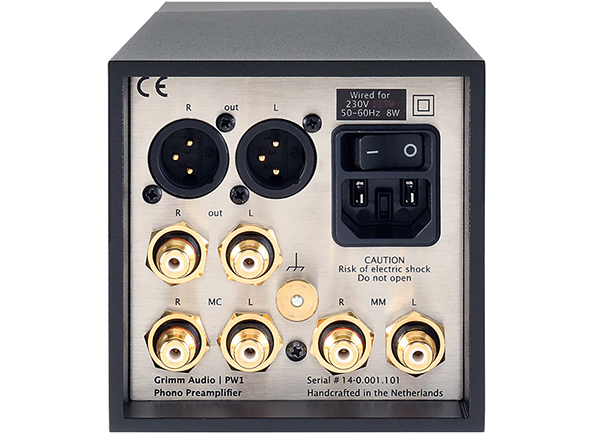
The PW1 is also able to accept two turntables or a deck with two arms via its RCA phono sockets, selectable by one of the aforementioned switches. One input is specifically for MM and the other for MC, so you can’t really run MCs into both unless one is high output [see boxout], but the genuinely comprehensive bank of switches can set pretty much any gain and loading value your cartridge requires.
Using two completely different turntables, I tried both MM and MC cartridges of low-to-medium output (including London Deccas with their slightly odd behaviour) and was delighted to hear how the PW1 absolutely lapped up an Ortofon MC X40. Matching the various cartridges resulted in fine-tuning almost as authoritative and precise as with MoFi’s MasterPhono [HFN Dec ’23] – arguably the champion for this and a strong rival for the PW1.
Setup was therefore a breeze, abetted by a choice of either single-ended RCA or balanced XLR outputs. As with the debate which fuels this device, of tube sound versus solid-state, the balanced/single-ended contretemps will also forever rage, and so the PW1 allows the sceptical to try both.
 A proper fairy tale
Like all sensibly designed hi-fi (PM succinctly calling the Grimm Audio PW1 ‘the first phono preamplifier designed for “hi-fi realists”’) this will be making music in minutes, cartridge adjustments notwithstanding. The manufacturer is categorically of the long burning-in school, and recommends leaving the phono stage on for 24 hours before settling in with a stack of LPs to savour. But while I did hear improvements in focus and bottom-end control and extension, it wasn’t of such a magnitude that you can’t enjoy the PW1 while exploiting the running-in time – and this period affords the user the opportunity to tweak the adjustments. Again, so conveniently sized and shaped is the PW1 that you simply turn it on its side, or upside down, to access the settings. Precise MM/MC matching rewards the fastidious listener with far greater improvement than any extended running-in period.
The sound of the PW1 is so inviting – instantly exhibiting more in common with valves than transistors to these ears – that I found myself experiencing the ultimate in hi-fi litmus tests: realising I had been listening for four hours or more without a pause. Even my desire for a ‘comfort break’ couldn’t wrest me away from the PW1!
Warm welcome
It started with three mono LPs, which showed the PW1 to deliver a rock-solid central image but with incredible front-to-back depth. They comprised the Miles Davis 55 [Craft CR00691] box set which contains the Prestige recordings from June through November of 1955, leading up to the debut of the Quintet. Here was peak Miles accompanied by a variety of sidemen – if you can call them that, each a giant in his own right – including Ray Bryant, ‘Philly Joe’ Jones, Red Garland, Milt Jackson and no less than John Coltrane. Not having to worry about soundstage, stage width, imaging, etc, allowed me to really focus just on the instruments.
Miles’ flurries of notes during the more hyperactive moments, doing to his trumpet what decades later the fastest axemen would to a guitar, provided me with a taste of the PW1’s attack and speed. His slower, bluesier moods showcased the dynamic contrasts, and this phono stage has the range to go from near-silent to jump-from-your-seat bursts without any constraints.
What threw me off-balance, however, were the warmth and ‘bloom’ to the overall sound. Here my prejudice was exposed – I was expecting solid-state hygiene, but instead I heard sonic textures and richness in keeping with the all-valve 1950s equipment in the recording studio.
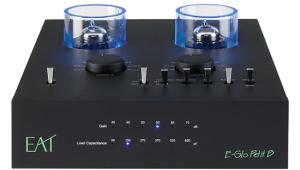
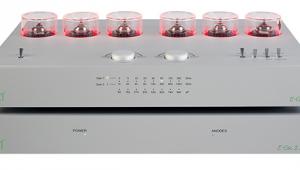
If anything, I would have guessed that there were no transistors in this phono preamp, a consequence (perhaps!) of Grimm pursuing the virtues of valves in a solid-state design. I was convinced of a low-level whoosh, which vanished once the music began, also heard via my EAT E-Glo 2 [HFN Feb ’25], despite both models enjoying similarly wide S/N ratios [see PM's Lab Report]. I hasten to add that it neither mattered nor detracted from the listening experience, because I recognised it was simply part of the ‘recipe’ which made this sound more like tubes than trannies.
Setting the stage
As for the second irresistible set, Santana’s Lotus [Mobile Fidelity MFSL 3-540], it too contained three LPs. Recorded live in Japan, the concert covers a multitude of the band’s styles, but fans know that two instruments in particular define Santana: slithery electric guitar and Latin-flavoured percussion.
It was a solo of the latter, on the track ‘Kyoto’, which reasserted the solid-state side of the PW1. Within a cavernous soundstage, the drums filling it from left-to-right, each instrument had its own space, and the ‘feel’, if that’s the right word, changed from the warm ’n’ fuzzy nature of the Davis recordings to something more detailed and visceral. I was beginning to wonder if the PW1 was deliberately designed to be schizophrenic, or more sonically versatile than adhering to one technology or the other?
While not keeping score, it looked like the sound was proving to be more valve-like than solid-state, despite no glassware within. I will never forget Bob Carver telling me over 30 years ago that he could make any solid-state amp sound like tubes, while EAR’s Tim de Paravicini proved it with his first-ever Yoshino amplifiers. And yet hearing it from the PW1 was still unsettling.
What tipped it over to the tube side for me was Donovan’s The Hurdy Gurdy Man [Impex IMP6055], which I had played days before with the Ortofon MC X40 and through other phono stages. It was all about that distinctive voice, in some ways sharing the same with John Coltrane’s playing in the Miles Davis 55 performances – not musically, that is, but for hearing so many subtleties. Irrespective of the cartridges, Grimm Audio’s debut phono amplifier is magnificent.
Hi-Fi News Verdict
Grimm by name, not by nature! For those running two cartridges or decks, the PW1’s flexibility is invaluable, but that’s not its main virtue... that’ll be the more-ish way it reminds some of us why we prefer LPs to everything else. This is a fantastic phono stage, both transistor-quiet and valve-warm without sacrificing the virtues of either. Circa £4k is a hotly contested sector, but the PW1 will prove tough to beat.
Sound Quality: 88%
 | |||||||||||

|
|
| |||||||||










 SPONSORED VIDEO






| Equipment Reviews | |
Music Reviews Awards | |
Latest News Features | |
Resources Newsletters | |
Subscriptions |
WHERE TECHNOLOGY BECOMES ENTERTAINMENT
 © 2026 Hi-Fi News
AVTech Media Ltd
All rights reserved