Nagaoka MP-700 cartridge

Timed to coincide with its 85th anniversary, Nagaoka is launching the MP-700 as the new flagship model of its longstanding MP series. Sidestepping the usual cartridge question – is it moving-magnet or moving-coil? – by answering ‘moving-permalloy’, this range is already well established.
Until recently it topped out with the venerable £799 MP-500 [HFN Jan ’23], which was introduced about fifteen years ago, yet the MP line is even older than that, dating back to 1979 and itself based on earlier cartridges from the company. To this day Nagaoka remains a family concern and one of the largest manufacturers of stylus tips worldwide. It’s not hard to see why the introduction of this cartridge is considered an important milestone.
Legacy looks
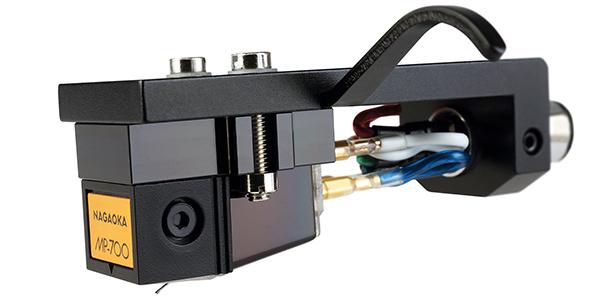
This sense of tradition is writ large with the MP-700, as it retains the iconic square MP design and brandishes a gold-coloured Nagaoka inscription on the front. Internally, of course, the mechanism features a series of refinements, but like all other Nagaoka pick-ups, the MP-700 is still completely built by hand in Japan.
This is no heavyweight cartridge, coming in at a mere 8g. That’s a slight increase on the MP-500 (7.8g), possibly due to the cartridge frame being made here from rigid ultra-duralumin. Nagaoka further applies a triple-layer finish to the shielded chassis, consisting of nickel plating coated with black tin and a protective insulating layer to top it off. This not only makes the cartridge durable and look the part but is also intended to resist the build-up of a static charge.
Making gains
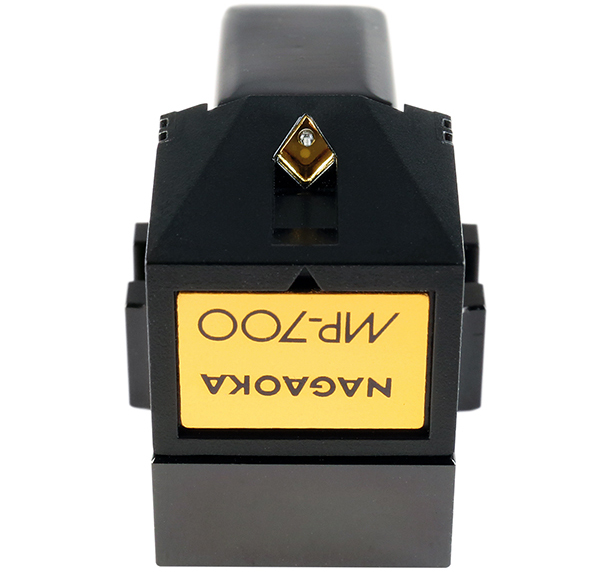
The MP generator uses a lightweight permalloy element attached to a boron cantilever. This terminates in a nude microridge diamond that should make for a nimble and reactive stylus [see boxout], and its responsiveness is further improved by a very soft damper, which is stabilised by a suspension wire as part of the pivot system. This is one of the major improvements in the MP-700, underscoring the promise of rail-like tracking – a claim borne out in [see PM's Lab Report].
While moving-permalloy is touted as marrying the best of MM and MC cartridge types, the MP-700 doesn’t come cheap at £1149. At that price it’s competing with entry-level ‘high-end’ MCs, and as moving-coil is habitually seen by audiophiles as the ne plus ultra of cartridge technology, this might be a serious disadvantage. However, MP does have some real upsides – next to sonic performance – that give the Nagaoka pick-up an edge.
For one, in terms of loading it essentially mirrors MM behaviour. A required load impedance of 47kohm means you can connect a turntable fitted with this cartridge to virtually all integrated amplifiers with a standard phono input (although, with a device of this quality, investing in a separate phono preamp probably is a wise idea).
Another benefit of Nagaoka’s design is that its stylus can be replaced, at a price, with the brand’s JN-P700. That takes away the anxiety lingering in the background when dealing with expensive MC carts, where a moment’s lapse can lead to a catastrophic – and costly – outcome.
Like the MP-500, the MP-700 is offered as a standalone cartridge or in a premium ‘H’-package (£1249) pre-mounted on a Nagaoka headshell with SME-style connector. I have no complaints about the presentation of this bundle – it arrives in a neat box, with the cartridge and headshell presented under a transparent plastic dome. This is another trademark of the brand and handy if you want to exchange the MP-700 with another cartridge/headshell when the fancy takes, as you can place the unused cart safely in the see-through box and proudly show it off.
However, it’s worth noting that Nagaoka has opted for a hefty headshell design arguably less suited to the tonearms seen on many contemporary turntables. Using a Technics SL-1200GR2 [HFN Sep ’24], with its 9g effective mass tonearm, I elected to install the MP-700 in the lighter Technics headshell instead. This made it a good deal easier to set the 1.4g tracking force, for one, without having to resort to employing extra counterweights. I also needed to unshackle the MP-700 from the bundled headshell when I took the cartridge for a spin in a Pro-Ject X2 B [HFN Sep ’22], this turntable having a typical Pro-Ject carbon tonearm upon which the cartridge is directly fixed.
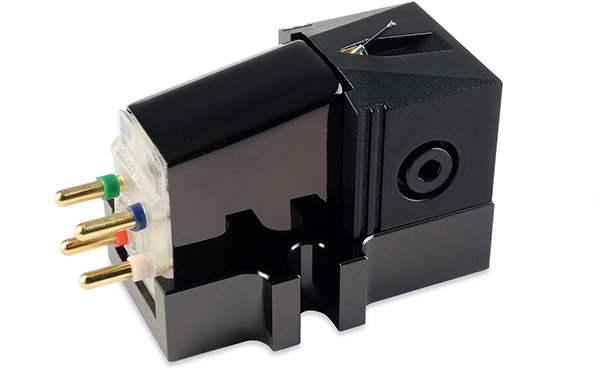
Setting up the MP-700 is not particularly difficult. In common with many Audio-Technica as well as Nagaoka pick-ups, it has non-threaded mounting holes with a convenient opening to the side. Everyone has their preferred technique for securing cartridges, but I find this construction makes connection to the headshell effortless. The fatter pins at the rear of the MP-700 might make attaching them to headshells with thinner cables and lugs a little trickier, but the square shape and design of the chassis otherwise makes for easy alignment.
 Most pleasurable
Calling any piece of hi-fi equipment an ‘all-rounder’ might seem something of a copout or, alternatively, a diplomatic way to say ‘jack of all trades, but master of none’. That’s not the case with Nagaoka’s MP-700. This is a very capable cartridge on multiple fronts – equally proficient at extracting complex music from your vinyl as delivering subtle treble detail, and so much more. There’s a rich and detailed low-end performance on offer, as I experienced with the Technics SL-1200GR2 hooked up to Musical Fidelity’s superb M8x Vinyl phono stage [HFN Mar ’25], and with Primare PRE35 and A35.2 amplifiers [HFN Dec ’19] driving a pair of Monitor Audio Gold 300 6G loudspeakers [HFN Oct ’24].
In the eyes of many enthusiasts, Technics decks and Nagaoka cartridges go together like strawberries and cream (or sushi and wasabi) but in the case of the MP-700 there is an additional serendipitous connection. Stalwart Matsushita engineer Tetsuya ‘Tony’ Itani [HFN Jun ’18] joined Nagaoka once he retired as Chief Technical Officer at Technics and Panasonic, after a career working on several milestone products [including its debut SL-P10 CD player, HFN Jul ’83 and Oct ’12] and being instrumental in the ‘revival’ of the Technics brand a decade ago.
Tasty tunes
A fulsome low end is not this cartridge’s lone strength, but it is one that was immediately noticeable when I started playing the second song from Billie Eilish’s Hit Me Hard And Soft [Interscope 602465223651]. Despite this track’s evident compression, the detail the MP-700 found in the bass guitar during ‘LUNCH’ transformed it from simple low-frequency sounds to precisely defined notes and slides played on a real instrument. Criticism of the quality of this pressing notwithstanding, at least the MP-700 tracked its grooves impeccably.
Nagaoka’s flagship really came into its own with The Horace Silver Quartet’s Song For My Father [Blue Note ST-46548], which remains a perennial Blue Note favourite. Again, there was that rich, weighty foundation to the sound, but here it was joined by superb midrange separation. During the jazz standard title track, with its very recognisable vamp, Carmell Jones’ trumpet and Joe Henderson’s alto-sax sounded beautifully organic and vivid – even when they played in unison.
The MP-700’s resolving ability ensured Silver’s nimble background piano playing wasn’t overshadowed, despite it sounding just a bit thin, as recorded. Meanwhile, it didn’t falter with the rapid tempo and percussive flourishes of the same album’s ‘The Natives Are Restless Tonight’, as even the highest notes on the alto-sax sounded smooth, but never stressed. Enjoyable stuff!
Complete picture
One of Nagaoka’s goals for the MP-700 was an improved high frequency performance. As my subjective listening and [see PM's Lab Report] confirms, its engineers can pat themselves on the back. The finessed treble presentation of this cart is especially noticeable in recordings that have a spatial quality, but equally it plays its part in delivering the complete picture of orchestral pieces.
After I had swapped out Pro-Ject’s MC9 for the Nagaoka cartridge on the X2 B deck, there was a notable – and rewarding – shift from intense HF detail to a sound that was smoother but still not lacking in resolution. Yes, the MP-700 superbly communicated the attack and fizz of the military band’s drums and brass in ‘Overture’ on Maurice Jarre’s Lawrence Of Arabia soundtrack [The Soundtrack Factory, SF 579412]. But just as impressive was the flowing, sweet character of the strings during ‘Main Title’, as it veered between playful portions and the sweeping romantic movement that calls to mind the windswept desert vistas of David Lean’s epic film.

Arguably even more striking was the delicate quality of the flutes and strings in the first Morning movement of Edvard Grieg’s Peer Gynt-Suite Nr.1, heard here on Deutsche Grammophon’s ‘The Original Source’ recording of the Berliner Philharmoniker/Von Karajan [DG TOS 00289 486 6123].
Full lilt
As anyone who is familiar with this Grieg suite can attest, Nr.1 starts in a very low-key vein, giving the MP-700 no orchestral fireworks to hide behind. But that doesn’t matter, as its rendition of the lilting melodies and gentle tempo was smooth, detailed and full-bodied – and utterly thrilling in its own way. File this Nagaoka flagship under ‘musical’.
Hi-Fi News Verdict
The MP-700 is an exceptional achievement by the Nagaoka team. An evolution of the widely respected MP-500 has been a long time coming, but it’s certainly been worth the wait. Offering grand dynamics, excellent detail and superb tracking, the MP-700 builds on the brand’s ‘moving-permalloy’ generator, realising a highly versatile cartridge. It’s now the one to beat at this price point.Sound Quality: 91%
 | |||||||||||

|
|
| |||||||||










 SPONSORED VIDEO






| Equipment Reviews | |
Music Reviews Awards | |
Latest News Features | |
Resources Newsletters | |
Subscriptions |
WHERE TECHNOLOGY BECOMES ENTERTAINMENT
 © 2026 Hi-Fi News
AVTech Media Ltd
All rights reserved