Exposure DAC
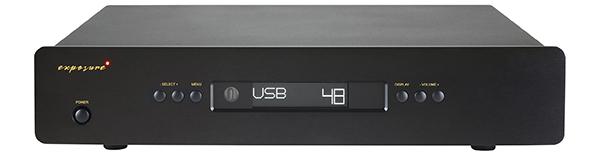

According to the marketing materials accompanying Exposure’s latest product launch, ‘a great DAC is at the heart of almost every modern hi-fi system’. Few audiophiles would argue with this statement, but it’s perhaps something of a surprise coming from this particular UK brand. After all, an onboard DAC isn’t offered as standard in Exposure’s integrated amplifiers, and the new model on test here is only its third ever outboard converter, following the 2010S2 launched some 14 years ago, and the subsequent 2010S2 DSD upgrade, retired in 2019.
Tin machine
Still, the availability of digital sources – beyond CD – that prompted the development of the 2010S2 is even more widespread in 2026, no matter how successful the vinyl revival has been in the meantime. Streaming services have increased in quality as well as quantity, meaning hi-res files are no longer the preserve of music fans with server-based systems. DAC technology itself has moved on, too. Time, therefore, for a new arrival.
Adopting the ‘Ronseal approach’, Exposure has named its new DAC the ‘Exposure DAC’ – another reminder that the brand offers no other models. Further highlighting its one-of-a-kind stature, the Exposure DAC doesn’t slot into any of the company’s existing series (2510, 3510, 5510, VXM, etc). A price tag of £2500, however, makes it more of a partner for the 5510 Integrated amplifier at £4600 [HFN Dec ’25] and the 3510 pre/power system, for around £4000 [HFN Nov ’22], than the brand’s entry-level gear.
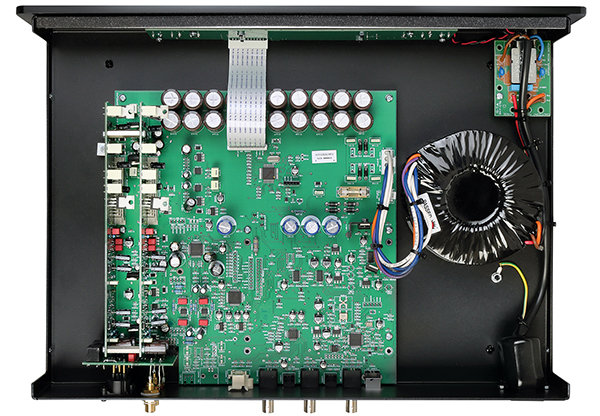
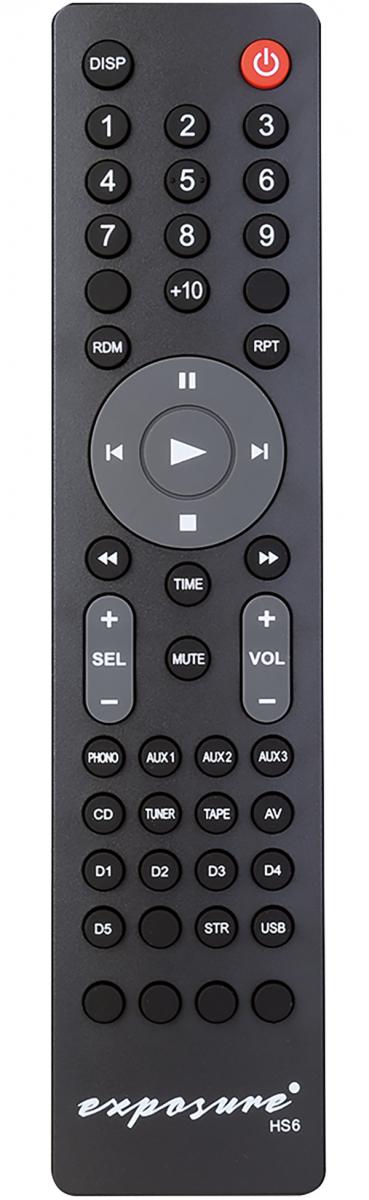
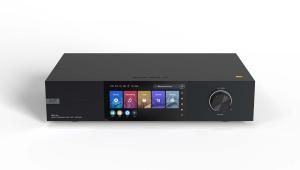
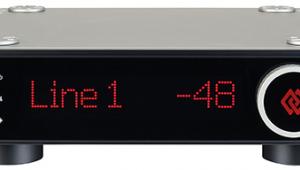
That said, should you use this new DAC with any other piece of Exposure hardware, it will blend right in. The chassis, an all-aluminium affair said to limit resonances and EM interference, is identically sized to the 3510 Pre and 3510 CD [HFN Sep ’24] at 440mm wide and 90mm high. Finish options (black with gold-coloured legends, or a more modern-looking titanium-with-black-details alternative) are found across Exposure’s catalogue. The crisp, monochrome central OLED display is the same as that seen on the flagship 5510 Integrated, and the bundled remote, while not identical to that of Exposure’s amps, looks familiar too.
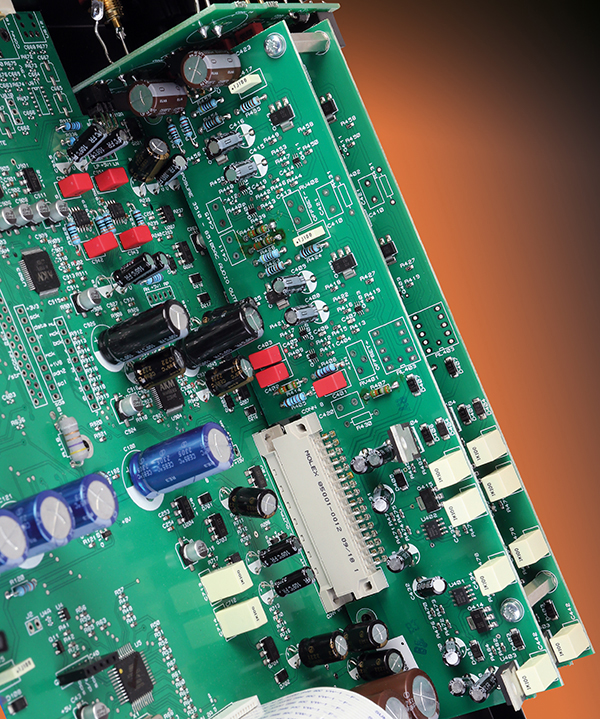
So, what is new? Gone is the Cirrus/Wolfson solution used previously, and in comes the flagship dual-chip upsampler/DAC combination from Japan’s AKM [see PM’s boxout, p87]. Music file support has expanded to include 768kHz/32-bit PCM and DSD256 (versus 192kHz and DSD64 via DoP). Not offered are the 2010S2’s handful of digital filter choices, as Exposure has opted for just one of the available options [see PM’s Lab Report, p89].
Magnificent seven
Downstream of the AKM devices are newly developed analogue filter and balanced preamp stages on ‘dual mono’ PCB cards mounted edgewise to the main board. As for the power supply, Exposure claims its custom toroidal transformer ‘with hum shield and low-noise’ design results in ‘ultra-quiet’ backgrounds.
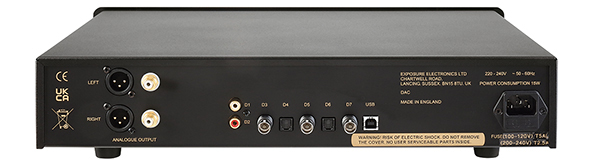
Use of the DAC stage is through seven digital inputs on optical, coaxial (RCA and BNC) and USB-B, an extraordinarily healthy choice that’s more a legacy of Exposure’s earlier model than a reflection of a modern user’s needs. It’s arguable someone may have a use for all those S/PDIF options, but missing are the HDMI and Bluetooth connections offered by many rivals, and there’s no streaming functionality onboard either. Of course, as Exposure has yet to make any streaming hardware, this is hardly surprising.
On the Exposure DAC’s rear panel are unbalanced RCA and balanced XLR outputs. Both connections offer fixed (2.1V and 4.2V, respectively) or variable operation, this status set within the DAC’s menu rather than through any physical switch. The digital volume control, actioned within the DAC electronics and covering 99 ‘steps’, is managed via the remote handset or ± keys on the unit’s fascia, rather than the seemingly ubiquitous rotary.
The plug-and-play nature of the Exposure DAC – no filters/EQ, no streaming – means there’s nothing else to explore in the menu beyond that fixed/variable mode (which includes the option of setting the variable output’s default start-up level between 30 and 55). The only other user adjustment is a brightness setting for the OLED display, set just by tapping the Display button. My advice here is to avoid the two brightest options as these automatically shut off the display after a minute, presumably to limit screenburn. That’s a sensible feature, but with Exposure using a red LED to signify the unit is switched on (rather than, say, green), this did lead me to think the DAC had gone into standby when it actually hadn’t. Indeed, there is no standby option at all.
 Warm welcome
Should a DAC be designed to offer nothing more than complete transparency, or should it – like any other part of the audio chain – offer a little of its own character? How you answer this admittedly rather broad-brush question may inform your opinion of Exposure’s new DAC, as there’s a touch of warmth and generosity to its sound that calls to mind the brand’s amps.
This is no bad thing, particularly from a product designed to match said amps, and might also explain the lack of digital filter selection – Exposure’s designer has a clear idea of what its products should sound like.
No longer having the 5510 Integrated to hand, I ran the Exposure DAC directly over its balanced, variable output into a Primare A35.2 power amplifier [HFN Dec ’19] and used a Roon Nucleus Titan server [HFN Jun ’25] and Hegel Viking CD player [HFN Sep ’23] as sources. Incoming sample rates are shown on the DAC’s display, in a font of decent enough size to read from across a room. Which makes a change from the norm…
Plump it up
‘Lonely Road’, the opening track from Natalie Bergman’s My Home Is Not In This World [Third Man Records; 44.1kHz/24-bit], sets out the album’s nostalgic, recorded-to-tape sound. Warmth and analogue colour are off the charts as keyboards, strings and buoyant bass support vocal harmonies that wouldn’t sound out of place on a late ’60s Beach Boys record. Exposure’s DAC really leaned into the tone and vibe of the piece, resulting in a lush, comforting listen.
This richness of sound was also evident in the recent Buffalo Philharmonic Orchestra/JoAnn Falletta recording of Debussy’s Iberia For Orchestra [The French In Spain, Naxos; 96kHz/24-bit], where the low strings and timpani that punctuate ‘I. Par les Rues et par les Chemins’ were plump and full-sounding, avoiding any dryness. Equally, the pounding percussion and low backing vocals on Bastille’s ‘Pompeii’ [Virgin Records] were dramatic and weighty, pushing this pop/rock track forward. It was a big rendering, full of heft.
Subjective A/B tests using Topping’s recent D900 DAC [HFN Feb ’26] further affirmed the Exposure unit’s own character. There was a slight softening of the musical picture when spinning Chris Rea’s ‘Texas’ on CD [The Road To Hell; WEA 246285-2], the Exposure DAC not delivering the percussion with quite as much crystalline detail, and giving the bass guitar a slighter rounder feel. Additionally, in soundstaging terms, certain elements appeared set a little further back. The result? A performance that traded some immediate excitement for a more relaxed, tempered experience.
On the attack
On the other hand, ‘relaxed’ is not a good description of Megadeth’s new single ‘Let There Be Shred’ [BLKIIBLK; 48kHz/24-bit], so I was pleased to hear the Exposure DAC handling this track’s ice-cold riffs and fret-melting solos with attack and focus. Snarled lyrics arrived from my loudspeakers backed by a tightly wound rhythm section. Where previously the system had sounded large and lush, it was now sharper and more energetic, responding to the music at hand.
This was something I noticed again and again. Exposure’s DAC, even while never sounding truly ‘neutral’, easily conveys the spatial and tonal nature of recordings, whether live or in the studio. The hypnotic ‘Sexo, Violencia y Llantas’, from Spanish flamenco/pop artist Rosalía [Lux, Columbia; 96kHz/24-bit], mixes up its mic positions, so that an opening distant piano is swept aside by vocals and strings (from the LSO) that appear close enough to touch. Similarly, the different recording styles of ‘Sweet Black Angel’ and ‘Loving Cup’ from The Rolling Stones’ Exile On Main Street [Polydor; 44.1kHz/24-bit] couldn’t be more obvious, the former placing the players in a large, reverberant acoustic, the latter honing right in on Nicky Hopkins’ piano.
There’s a lot going on in this Stones track, too, as co-writers Mick Jagger and Keith Richards turn what begins as a gentle ballad into a full-on swinging groove with shades of brass and percussion. The Exposure DAC shone just enough light on the instruments – including trombone and saxophone kept respectfully in the background – without destroying the knotted, almost chaotic flavour of the whole thing.
Again, there was that fulsome quality to the mid/lower octaves, a little bit of honey to sweeten the sound, just as there was on the DAC’s wide, atmospheric delivery of Roy Budd’s main theme to the Michael Caine thriller Get Carter [JHP]. Such a trait might be considered ‘old school’ by some, but it’s what fans of this stalwart British brand will expect.
Hi-Fi News Verdict
A lack of bonus features means Exposure’s long-awaited outboard DAC faces stiff competition at and below its price point, so much so that some digital music fans are unlikely to give it a second look. However, judged on its sonic performance (and acknowledging its ease of use) the Exposure DAC is easily recommended to purists, from the way it builds cohesive, layered soundstages to its hint of warmth and smoothness.Sound Quality: 86%
 | |||||||||||

|
|
| |||||||||













 SPONSORED VIDEO






| Equipment Reviews | |
Music Reviews Awards | |
Latest News Features | |
Resources Newsletters | |
Subscriptions |
WHERE TECHNOLOGY BECOMES ENTERTAINMENT
 © 2026 Hi-Fi News
AVTech Media Ltd
All rights reserved