Unison Research CD Uno CD player
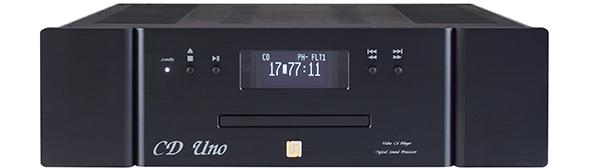

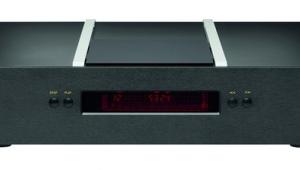
You might be forgiven for thinking – bearing in mind the product name – that the Unico CD Uno from Italy’s Unison Research is ‘just’ a CD player. Yet on its website the Italian manufacturer gives it the title of ‘hybrid DAC with CD transport’, while legends on the player itself read ‘Valve CD Player’ and ‘Digital Sound Processor’. So, yes, this is a CD player with a little more to it than some rivals, including a switchable tube/hybrid output stage, USB DAC, and even built-in Bluetooth streaming. With all this, and the heavyweight build, its £2700 asking price seems far from unrealistic.
Unison Research is no stranger to valve technology and sells a wide range of tube-equipped pre, power, phono, and integrated amplifiers, including the new Triode 25 Black Edition [HFN Jul ’25]. Meanwhile, amplifiers in its Unico series combine tube inputs with transistor power amp stages. It’s also in this range, which the company says ‘merges design and sound quality’, that you’ll find two valve-toting CD players – the CD Uno auditioned here and the step-up CD Due [HFN May ’16]. That both units have been in production for close to a decade shouldn’t surprise, as Unison Research isn’t a brand noted for its product ‘churn’.
Triode tactics
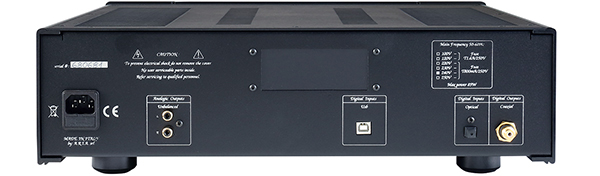
Apart from the large model names inscribed across their three-panel fascias, the CD Due and CD Uno appear identical when viewed front on – after all, they do use the same 450x130x380mm (whd) aluminium casework in matt black or silver colourways. It’s a different story around the back, though, where this more affordable player strips away the inputs and outputs. Gone are the CD Due’s balanced XLR analogue outs, and the digital stage has been trimmed to optical and USB-B ins, plus a coaxial output, versus the full slate (including an AES/EBU input on XLR and three output options) of the pricier machine. File handling is the same, but with the USB connection supporting PCM to 384kHz/32-bit, and DSD to DSD128.
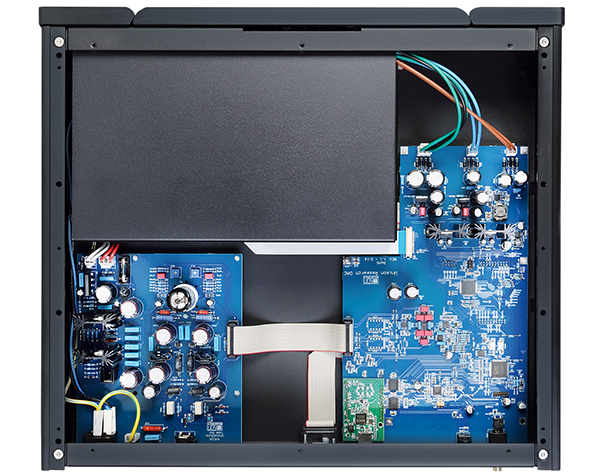
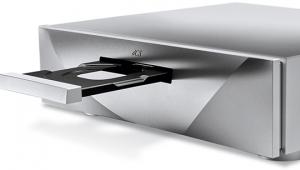
Inside, the CD Uno follows the Due’s template by shielding its tray-loading CD mechanism under a metal cover, and separating digital and analogue circuits. Both players use the tried-and-tested ESS ES9018K2M DAC, with switchable tube and solid-state output options. Yet while the CD Due has separate tube and transistor stages, each driving the player’s output, the CD Uno may be switched between a simpler, single 12AU7/ECC82 triode stage and a solid-state (op-amp) stage that both feed the same discrete transistor output. So while the maximum level, and source impedance, vary dramatically between the CD Due’s tube and op-amp options, they are almost precisely matched in the CD Uno, enabling useful tube/op-amp A/B comparisons [see PM's Lab Report].
Remote rules
Further sound seasoning is available through the CD Uno’s choice of ‘fast linear phase’, ‘slow linear phase’ and ‘fast minimum phase’ digital filters from the ESS DAC. Switching between tube and op-amp options, or changing digital filters, has to be done through Unison Research’s RC3 system remote, as the CD Uno’s front-panel controls only cover stop/eject, play/pause and track search/skip.
Changing from CD to one of the digital sources, including an internal Bluetooth receiver, also requires the IR remote, as does switching the absolute phase of the output. The remote’s numerical keys enable direct track access, and the ‘Repeat’ button also instigates a shuffle mode.
With its minimal connections and simple controls, the CD Uno is straightforward to setup and use. The black-and-white OLED display, while small, is well-contrasted and its main elements (track number/time with CD, sample-rate with digital inputs) are visible from across a room. Smaller fonts at the top of the display show selected source and digital filter, plus ‘OPT’ if the tube output has been bypassed, correlating to the button on the remote. Nevertheless, it would surely be more logical and helpful for the display to declare ‘TUBE’ when the triode stage is in use... That said, when the CD Uno is first powered on (the power switch is located on the right-hand side of the chassis), a 30-second ‘tube warm up’ countdown is shown on the display.
In use, I found CD playback to be faultless, and quickly adjusted to using the remote control to find desired tracks. The CD Uno’s digital inputs did throw up some operational quirks, though. On one occasion after playing through Bluetooth I had to switch the device off and then on again in order to return to CD. Similarly, I experienced some ‘freezes’ when playing from Roon over USB, although the DAC stage otherwise worked as advertised in its support for hi-res files.
 Character counts
With the CD Uno in its default tube output mode it’s immediately clear that it has something of a characterful sound. Some CD players and DACs catch the ear with their clarity, balance and transparency while the CD Uno presents your music in a more loose-limbed manner, combining a slight softening of sharp edges with a vibrancy and energy. It’s enjoyable to listen to, but far from the last word in neutrality.
During A/B comparisons with a Hegel Viking [HFN Sep ’23], using that player’s unbalanced RCA output rather than XLRs, the shiny indie pop of George Ezra’s ‘Don’t Matter Now’ [Staying At Tamara’s; Sony Music 88985459782] acquired a more upbeat presentation through the CD Uno. This wasn’t only a question of tonality and detail, but also soundstaging, as Unison Research’s player gave a forward push to the track. Ezra’s vocals and blasts of trumpet leapt from my B&W 705 S3 Signature speakers [HFN Aug ’24].
This exuberant nature shone through in the CD Uno’s punchy delivery of the drums and bass guitar on Guns N’ Roses’ ‘Catcher In The Rye’ [Chinese Democracy; Geffen/Black Frog 0602517906075]. In this Queen-meets-Elton John epic, songwriter Axl Rose throws together piano, strings, multi-tracked vocals and wailing guitar solos, but underneath it all is a tight, crisply recorded rhythm section brought to life here with superb snap and heft. Bass weight and richness is one of the CD Uno’s strong suits, and this plays a part in the appealing overall nature of its sound.
Slotting in the second disc on the 2CD Thin Lizzy Greatest Hits compilation [Universal Music TV; 9849627], the fast blues-rock of ‘The Rocker’, followed by the all-out assault of the live version of ‘Are You Ready’, had me cranking the volume on Primare’s partnering PRE35/A35.2 pre/power amps [HFN Dec ’19]. There was no sterility in evidence, just a free-flowing presentation of a band firing on all cylinders, made all the more listenable by the somewhat smoothed treble handling of the CD Uno.
Great western
Ennio Morricone’s soundtrack for Sergio Leone’s Once Upon A Time In The West [The Very Best Of Ennio Morricone; Music Club MCCD056] is arguably the composer’s masterwork. I’m not going to suggest any magical affinity between this Italian CD player and the Italian-born composer, only that the Unico CD Uno’s sound was a fine fit for the movie’s ‘Main Theme’. First with its long string notes and dreamy harpsichord, then the rich, wordless vocals of Italian soprano Edda Dell’Orso, this was superb stuff, sounding both lush and musical.
Of course, it’s Morricone’s ‘Man With A Harmonica’, later to be sampled by both The Orb and Beats International, which sticks in the memory. When the titular instrument sent out its eerie, haunting call, this Unison Research player elicited goosebumps, the discordant notes having just the right edginess while appearing in the stereo spread as if from thin air.
State of play
PM gives his verdict on the player’s digital filters in his [Lab Report]; my own take is that differences between them are hard to discern, whether with CD or higher sample rate material. Much more impactful is that option to bypass the CD Uno’s triode stage, which can be done on the fly. This can have a very tangible effect, although it is somewhat dependent on the content.
The piano, bass and organ that begins Morricone and Joan Baez’s ‘Here’s To You’ on the Very Best Of… CD sounded cleaner with the player in its solid-state guise. There was a loss of harmonic colour, the track becoming a little cooler and flatter as a result. It’s therefore a useful tuning tool, although listening over the CD Uno’s USB connection to Kate Bush’s synth-heavy ‘Hounds Of Love’, from the album of the same name [Fish People; 44.1kHz/24-bit], the subjective difference between the two options was less obvious. I can easily imagine owners sticking with the tube output for all listening, both for the sake of convenience and to extract the kind of performance Unison Research’s ‘Valve CD Player’ branding suggests.
Making use of the CD Uno’s perfectly serviceable Bluetooth input, C. W. McCall’s ‘Convoy’ [Greatest Hits, Island/Mercury; CD res download] showcased the same smoothness and sweetness in its strings and bass guitar as the CD Duo provided from disc, while Judas Priest’s ‘The Ripper’ [Sad Wings Of Destiny, Repertoire Records; CD res download] offered driving energy and a forthright rendition of Rob Halford’s vocals. So, despite the varied inputs and tweaks on offer here, the inherent sound signature of Unison Research’s player never drifts far from the tree.
Hi-Fi News Verdict
User-switchable tube output, USB DAC, built-in Bluetooth… Unison Research’s CD Uno is perhaps as idiosyncratic as a CD player gets. Yet this is all part of its charm, as is its engaging performance that infuses a little lushness and glow into digital sources. Those looking for a fresh take on their CD collection can settle here, their listening fun aided by comprehensive playback controls and the CD Uno’s sound ‘tweaks’.
Sound Quality: 84%
 | |||||||||||

|
|
| |||||||||







 SPONSORED VIDEO






| Equipment Reviews | |
Music Reviews Awards | |
Latest News Features | |
Resources Newsletters | |
Subscriptions |
WHERE TECHNOLOGY BECOMES ENTERTAINMENT
 © 2026 Hi-Fi News
AVTech Media Ltd
All rights reserved