Sphinx Audio Element 3 loudspeaker
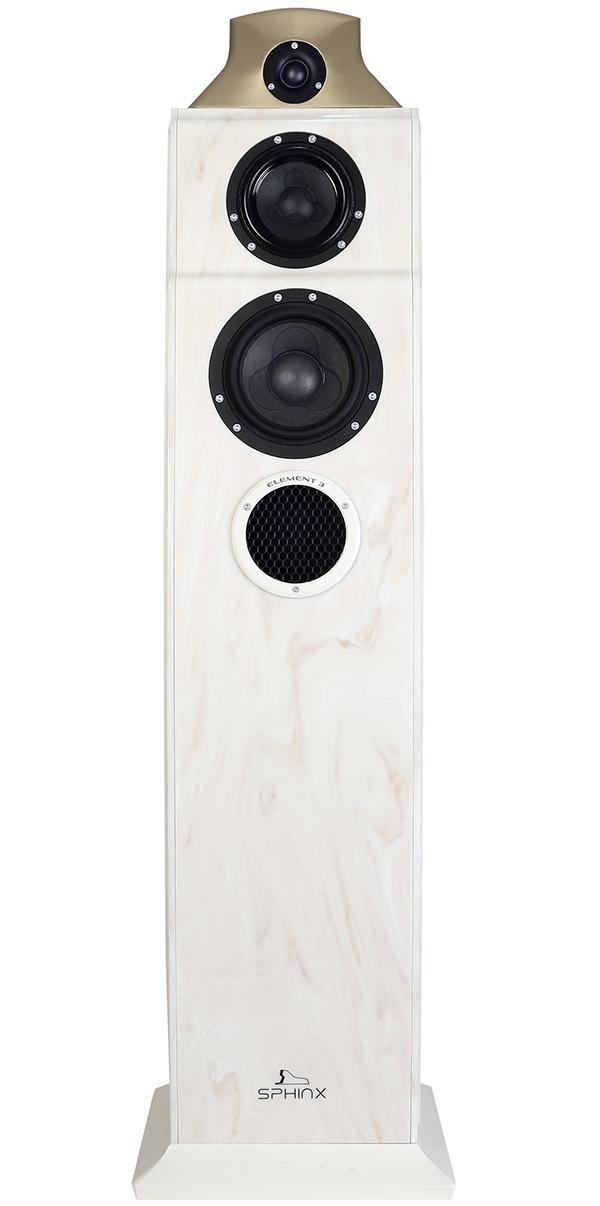

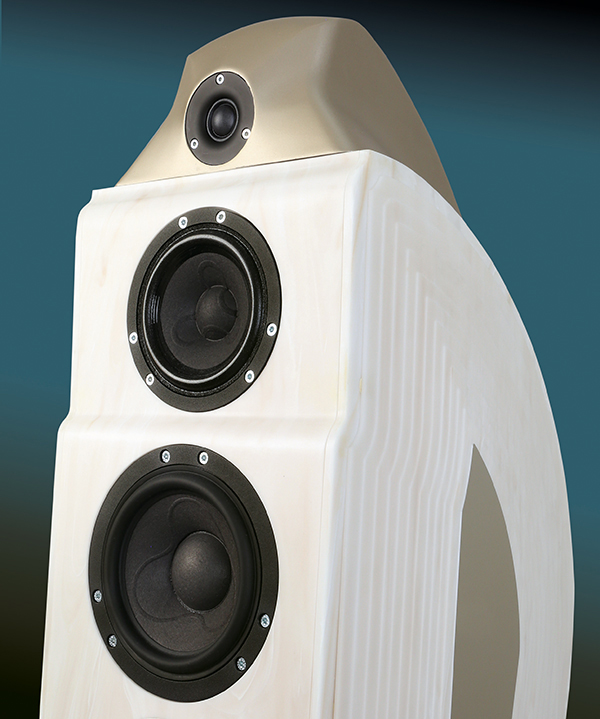
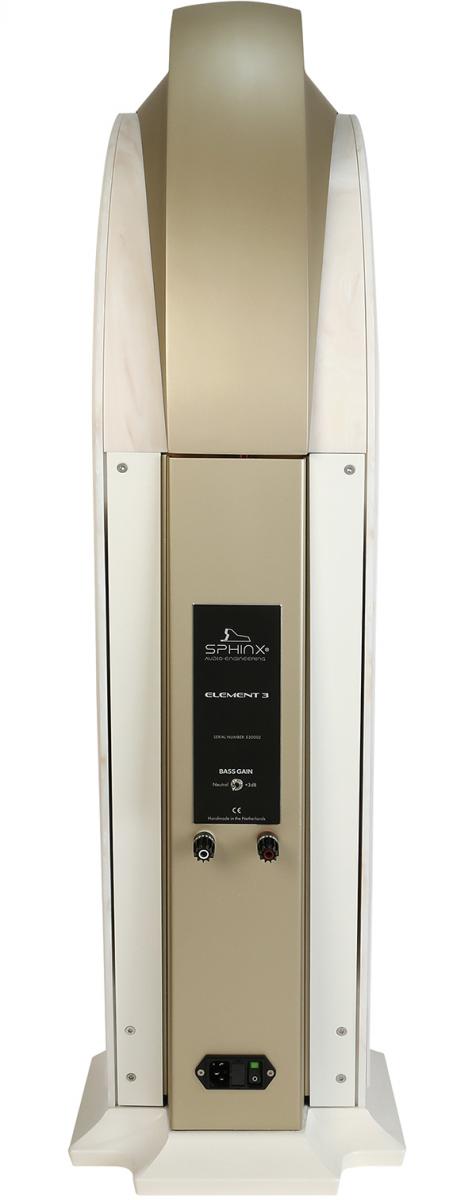
Sometimes, sitting in front of a product for review, a degree of puzzlement sets in. Yes, the style of the £40,000 Sphinx Audio Element 3 speakers, which made their debut at the UK Hi-Fi Show Live in Ascot in Sep ’25, is entirely in accord with the name of the brand. The stone-effect outer panels, harp-like side profile and sphinx-like head housing the tweeter are all redolent of the 1920s Art Deco Egyptian revival, following the discovery of the tomb of Tutankhamun in November 1922.
So far, so well and good – we’re used to artistic influences being brought to bear on the industrial design of high-end audio components. But there’s another question one faces when confronted with the substantial, but not exactly huge, Element 3s, and their larger Element 5 stablemates. What’s actually going on? Here we have what looks like a pair of passive speakers, powered conventionally from the user’s amplifier. Yet as well as the single set of cable terminals, and a switch for Neutral or +3dB of ‘Bass Gain’, there’s a mains input. And without that connection, the speakers produce no sound at all…
Tales of the unexpected
Colour us confused, and things only become marginally clearer when one delves deeper into the design with the team behind the speakers [see boxout]. Yes, the Element 3s need an input at ‘speaker level’, with the suggestion that 50W of solid-state power, or 40W from valves, should be sufficient. They also have a sensitivity of circa-100dB and a very easy 16ohm impedance [see PM's Lab Report].
I guess we should expect the unexpected of Sphinx, given that Edwin Rynveld, the driving force behind the revival of the brand, was responsible for the Siltech SAGA amplifier. This enclosed a high-intensity LED array in a hermetically sealed chamber with a photoelectric cell, thus creating galvanic isolation between its battery-powered valve voltage amplifier section (the V1), and the mains-powered current amplifier (the P1). To say this configuration, not least the ‘Apollo Light Drive’, was unconventional is perhaps to understate matters.
Rynveld is remarkably candid about his approach, describing the process behind the development of the Element speakers as being ‘part marketing and part technology’. Yet the serious intent here – to dial out as much as possible of the usual effects of conventional crossover design – is apparent. Despite its complexity, Rynveld’s approach is all about creating a more direct (or at least less destructive) path for the audio signal from the input terminals to the drivers. As he puts it, the intention is to be ‘like power steering – you’re still driving, but it’s lighter’.
Made to measure
The Element 3’s drivers are from the Scan-Speak Illuminator series. The 20mm tweeter uses a textile dome and is mounted in a ‘head’ atop the cabinet for isolation and time alignment, while the 120mm midrange and 150mm bass unit use paper sandwich cones and neodymium magnets for ‘stiffness, speed and neutrality’. A larger woofer might have been employed but the 150mm unit was deemed the ideal trade-off between driver excursion and transient response.
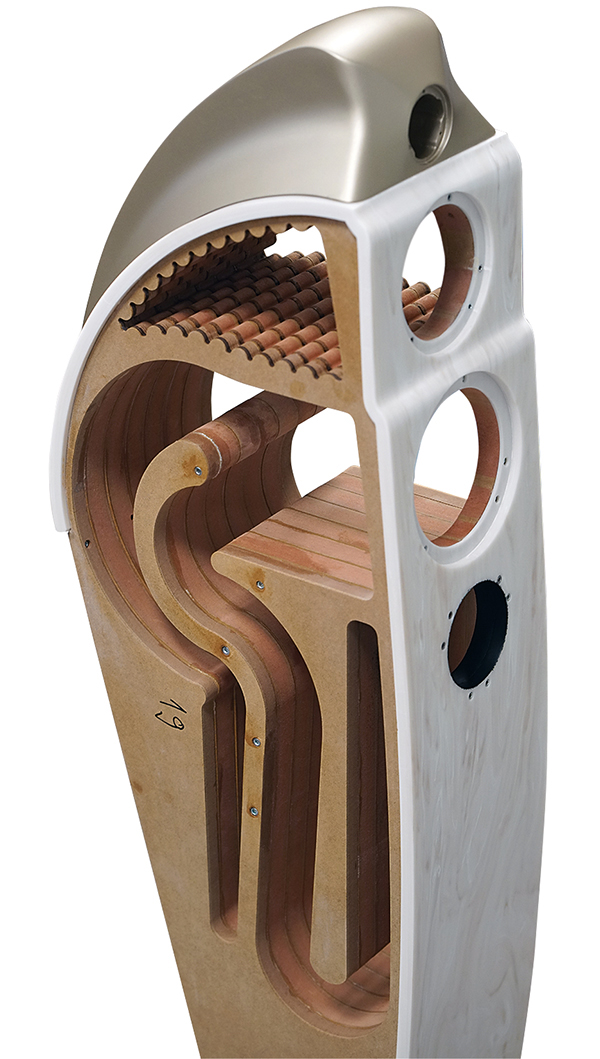
The bass configuration, described by Sphinx Audio as ‘zero gravity’ – remember that ‘part marketing and part technology’ comment – is loaded with not one but two chambers in a modified transmission line configuration. The first chamber is an almost conventional tapered line, coated with damping material and designed to bring the rearward output of the bass driver to the front-venting port in phase with the forward output. The second, closed offset chamber is tuned to null the harmonic modes occurring in the transmission line and avoid a significant dip at ~120Hz that might otherwise occur.
Meanwhile, the midrange driver sits in front of a large, curved and tapered chamber, designed to suppress resonances and optimise linearity, while the Element 3’s tweeter head is made from high-density polyurethane, curved to control dispersion and enhance focus.
Under those synthetic stone outer layers, the main cabinet is made from CNC-cut MDF layers, creating the internal chambers, and designed to be both rigid and inert. An aluminium section at the base, where the main enclosure meets the plinth, provides a heatsink for the internal electronics, and the entire enterprise is nothing less than striking when in place in the listening room.
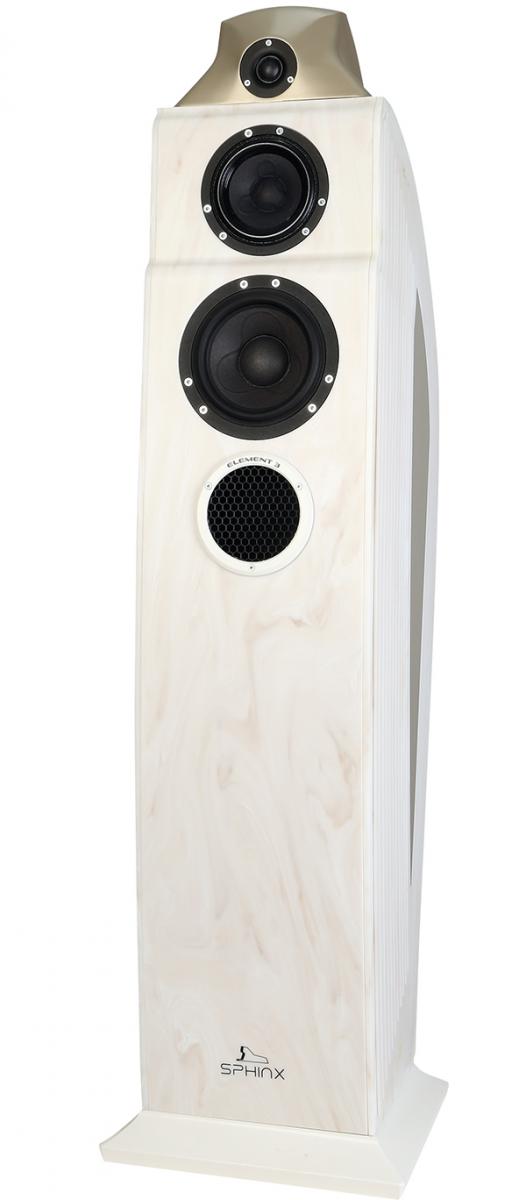
The Element 3s are far from massive, standing just 108cm tall, but that curvaceous design immediately commands attention – as does the fact the drivers seem almost comically small for a speaker of such lofty ambitions, especially in the closeness of dimensions between the midrange and bass units.
 Actually fantastic
In the HFN Listening Room [HFN Yearbook ’25], with bass set to +3dB, that curiosity about these unusual speakers soon gives way to admiration when they’re heard in action. They immediately sound mature, confident, refined and so much bigger than their relatively compact dimensions might seem to promise. Notable in particular is the scale and quality of the bass they deliver, and the way it underpins the focused, finely etched imaging and soundstaging of which they’re capable.
With Taylor Swift’s immaculately produced The Life Of A Showgirl [Republic Records; 48kHz/24-bit], the combination of that prodigious bass and the crisp, intimate view of her voice on tracks such as ‘Actually Romantic’ made these speakers a compelling listen. Say what you will, but this album continues Swift’s track record of superb recordings, and the Element 3s make no secret of all the quality in there.
From Swift to Schiff, these abilities made a fine fist of András Schiff’s performance of the ‘Appassionata’ sonata on his 1997 set of Beethoven’s piano concertos [Teldec 0630-13159-2]. There was an open, detailed presentation of the instrument in a generous acoustic, with excellent scaling, finesse and weight, not to mention speed in the second movement.
What’s more, the Element 3s delivered an effortless sense of orchestral power and drive with the recent release of Dvořák’s Slavonic Dances [Pentatone PTC5187414]. The Czech Philharmonic under Sir Simon Rattle turn in a vibrant performance full of colour and charm here, and the Sphinx speakers responded with fine instrumental tone, punch in the percussion, and a spacious, detailed soundstage.
Fun with faces
Nothing seems to faze the Element 3s. That old prog warhorse, The Alan Parsons Project’s The Turn Of A Friendly Card [in the 2015 ‘right speed’ remastering; Sony/Arista/Legacy 88875143712], was rendered with an exceptionally effective combination of snap, weight and insight. Similarly, the way the speakers smashed into Blondie’s ‘Rapture’, from 1980’s Autoamerican [Chrysalis/Capitol Records 72435-33595-2-2], instantly dispelled a desire to play things safe with ‘audiophile’ recordings. Where’s the fun in that, when you can be revelling in Debbie Harry’s voice shining out, above a driving rhythm with its grumbling bass, massed percussion and more?
Faces’ A Nod’s As Good As A Wink...To A Blind Horse [Rhino/Warner; 96kHz/24-bit] is an album I’ve loved in all its rawness since I bought a copy on the verge of my teenage years, and it took the Sphinx Audio speakers even further down the ‘rough and ready’ road. And they triumphed, proving a riot with the band’s elevated pub rock, from the big stomper ‘Stay With Me’ to the reflective ‘Debris’. The whole album, produced by Glyn Johns, has a real live feel, and it came over full-strength through the Element 3s. There was an excellent, edgy timbre to the lead guitar throughout, plus the gravelly voice of Rod Stewart on fine form, long before he went all granny-pleasing.
Oh Henry!
Change genre to the Prince-produced ‘Why Should I Love You?’, from the 2011 remaster of Kate Bush’s 1993 album The Red Shoes [Noble & Brite download], and the Element 3’s detail/power mix is again bang on the money. Bush’s idiosyncratic voice shifts from hushed sweetness in the verse to a shrieking chorus, and the Purple One stacks layer after layer in the complex mix. The backing (including Sir Lenny Henry on vocals) was tight, funky and delicious.
With Pink Floyd’s ‘Dogs’ [Animals; Sony Music/Columbia 88875170932], the Element 3’s ability to dig deep into a mix was used to good effect. Here that warm, extended but taut bass underpinned all, while the tight imaging in the midband and treble served well all the studio trickery that consumes the latter part of this 17-minute track. It sounded big, bold and magnificent, even with the volume cranked to very serious levels. But did I ever manage to trigger that bass-limiter? Pigs might fly…
The pounding drums and soaring, repeating harmonies of Philip Glass’s Akhnaten [Stuttgart State Opera/Dennis Russell Davies; CBS Masterworks M2K 42457], found the Element 3s shaking the room with thundering bass. They then opened up wide with the intertwining voices of ‘The Window Of Appearances’, sung between the countertenor Akhnaten and the contralto Nefertiti. This is always tricky for any system to reproduce as the voices reverberate over each other. The Element 3s held it all together, before gathering things up with more dramatic power chords as the scene ends.
Time to dial back and examine how well the Element 3 handles more relaxed music. Given the thoughtful Espen Eriksen Trio cover of ‘We Don’t Need Another Hero’ [What Took You So Long; Rune Grammofon RCD 2129], the simple clarity of piano, bass and brushed drums was so effective. As was the rock-solid stereo soundstage picture, creating a ‘you are there, as good as live’ experience. And I swear I have never heard Elvis Costello’s vocals on Squeeze’s ‘Tempted’, from their East Side Story set [A&M 96kHz/24-bit], quite so shiver-inducing.
Let it rip
The drums and organ were cleanly rendered, but it was the ‘deep and low’ Costello contribution, almost appearing to hang in space, which made the music move along so effortlessly – when in fact there’s so much going on.
Finally, listening with a bit of serious orchestral clout, the magisterial BFO/Iván Fischer recording of Brahms’ First Symphony sounded typically clean, this dynamic Channel Classics recording [CCS SA 28309] capturing the smallest detail, but also letting rip when the score demands. Both recording and speakers allowed the sound to breathe in a manner that was never forced or restrained – and always totally exhilarating.
Hi-Fi News Verdict
Everything about the Element 3 speakers seems almost wilfully oddball, from the looks to the chosen drivers, and from the passive/active drive to the other seemingly arcane elements of their engineering. But they work – spectacularly – across any music you choose to play. As I decided after designer Edwin’s lengthy explanation of what they were all about, they’re probably bonkers, but definitely ‘good bonkers’.
Sound Quality: 88%
 | |||||||||||

|
|
| |||||||||








 SPONSORED VIDEO






| Equipment Reviews | |
Music Reviews Awards | |
Latest News Features | |
Resources Newsletters | |
Subscriptions |
WHERE TECHNOLOGY BECOMES ENTERTAINMENT
 © 2026 Hi-Fi News
AVTech Media Ltd
All rights reserved