Radiant Acoustics Clarity 4.2 loudspeaker
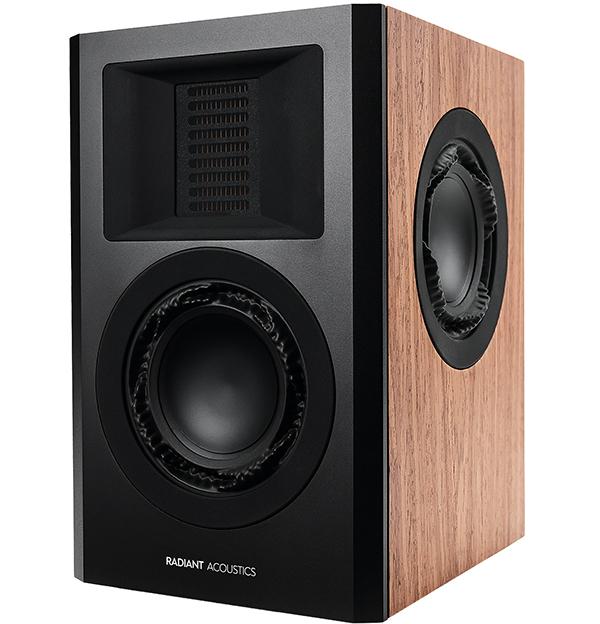

To call the Clarity 4.2 ‘petite’ is no understatement, as this second loudspeaker to be introduced by Radiant Acoustics boldly puts the ‘book’ back into ‘bookshelf’. Moreover, the cabinet, just 260mm high and 164mm wide, still manages to host a full four drive units. This Danish company only surfaced a year ago and won’t yet be a hi-fi household name, but it’s clearly not your run-of-the-mill debutante.
The Clarity 4.2 (and the similar, but larger, Clarity 6.2 introduced in 2024) arguably represent a high point of an exceptionally prolific career in the hi-fi business. The hype meter might appear in danger of overheating – there’s no denying that Radiant Acoustics seems to be very skilled at marketing – but if your company is founded by Peter Lyngdorf then you do have a tale to tell. After all, Lyngdorf started the HiFi Klubben retail chain in his native Denmark, founded DALI, owned NAD and Gryphon for a while, and created Lyngdorf, along the way convincing legendary piano maker Steinway to lend its name to luxurious speakers and electronics.
Come together
Crucially, there are two names missing from that list. One is Nordic Hi-Fi which, among other things, is responsible for the inexpensive Argon Audio products and now Radiant Acoustics. The second is Purifi, the audio OEM from engineers Bruno Putzeys and Lars Risbo, which is financed by Lyngdorf. Many elements of this life story are distilled into the Clarity speakers, including Purifi’s Ushindi driver technology [see boxout]. Lyngdorf also openly admits that Radiant Acoustics’ hybrid retail and online sales model is a response to direct-sales competitors.

The Clarity 4.2s are undeniably small, but their cube-like proportions make them less delicate looking than similar minuscule loudspeakers, such as the slender Magnat Signature Edelstein [HFN Apr ’24] or ELAC’s Elegant BS 312.2. Build quality appears superb while the braced, 15mm-thick MDF cabinet walls and internal Basotect foam damping all contribute to the 4.2’s relatively inert but hefty 5.6kg cabinet weight. You’ll do a double-take when first lifting these speakers from the box!
Black beauty
Three distinct colourways are offered, two of which are fitted with a matt black baffle milled from a single piece of aluminium. A broad chamfer on the side makes for a neat transition to the rear, while the different colours each exude a different look and feel. For example, the satin black Clarity 4.2 has a distinctly ‘pro’ air about it, while the walnut veneer edition is more retro styled. The white Clarity 4.2 is the most modern, as the baffle is also painted white, in a stylish contrast with the speaker’s all-black drivers.
The three 100mm Ushindi bass/mid units are equally striking, though only the main driver has a motor assembly, the side-mounted pair being ABRs. These are costlier, but superior, alternatives to conventional reflex port loading. The proprietary ‘NeutralSurround’ of each Purifi driver looks chaotic, not unlike a 3D model of a geological feature found in a museum exhibit, but it’s all part of the smarts behind this innovative driver. The complementary waveguided AMT tweeter is a custom design, built for Radiant Acoustics by next-door neighbour DALI.
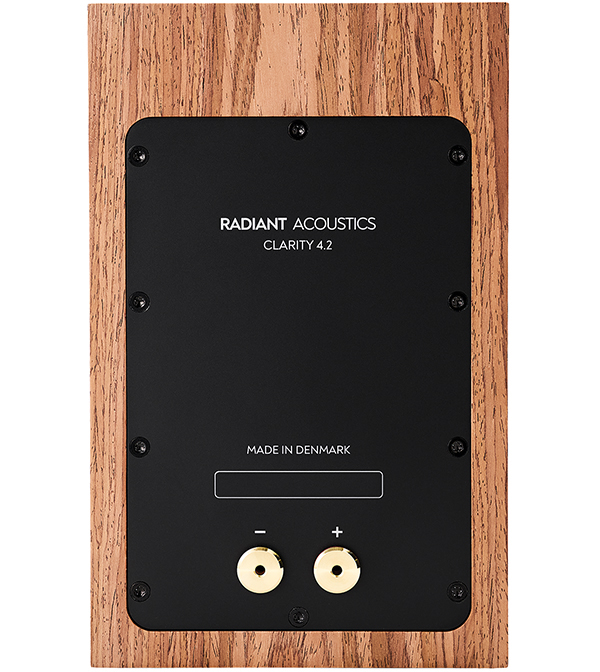
Some loudspeaker designers are now moving away from traditional, exposed cable binding posts – these being a potential weak point if speakers are shipped through mass carriers – and that’s the case here. Only cables with banana plugs can be used with the Clarity 4.2’s sockets. These are a single set, feeding into a crossover network claimed by Radiant Acoustics to be ‘as simple as possible, as complex as needed’.
 Turn it up
As noted by PM [see Lab Report], the Clarity 4.2s require an amp with a good amount of ‘juice’. During my audition period I connected the speakers to various amplifiers, and most of them needed a more extravagant twist of the volume knob than would usually be the case.
It’s also worth taking time over the 4.2’s positioning. The limited vertical dispersion of the AMT tweeters means you should ensure the boxes are sited at ear height, and some playing around with toe-in will probably be required to balance treble heat against clarity. Radiant Acoustics says that the speaker is engineered for use in a ‘Scandinavian-style’ room with limited damping. My own room has some acoustic treatment to remove rear reflections from windows, and that certainly had an impact.
Installing these speakers closer to a wall is less of an issue, which makes them suited to parking on AV furniture below a TV, perhaps in combination with an HDMI ARC-equipped amplifier. If this results in the tweeter being too low, consider tilting the speakers slightly backwards. Radiant Acoustics’ own stands – priced €798 and weighing 22kg without optional sand filling – feature an adjustable plinth to tilt the speaker back by up to four degrees. The company also says it’s considering providing a desktop stand that does the same job. The 4.2’s side-facing radiators do need free air, though, so jamming them between your Penguin Classic book collection isn’t a good idea.
Sonically, these speakers are attention-grabbing on a few fronts. First there’s the bass extension, which caused some major cognitive dissonance the first time I played Massive Attack’s ‘Angel’ [Mezzanine; Virgin WBRCD4] or ‘Limit To Your Love’ from James Blake’s self-titled album [Atlas Recordings ATLAS02CD]. During the latter, which is often used at hi-fi shows to demonstrate a system’s low-end, the clear and distinct nature of the pulsating bass note was very impressive. I’ve heard this track many times, and on some speakers these notes don’t throb, but often abruptly ‘switch’ on and off. The Clarity 4.2’s bass was smooth, detailed and deliciously integrated into the whole, without any suppression of the vocals.
Forward thinking
While this bass performance is remarkable considering the speakers’ size, the Clarity 4.2’s have a certain ‘quiet’ aspect to them. Some might translate this as ‘dry’, which could apply if the speakers are not toed-in sufficiently, but it’s more the result of a precise and relatively even reproduction that makes some music feel very close and intimate. This tendency for exact reproduction was most notable on jazz albums that had been recorded in smaller spaces, or with minimal instrumentation, such as those found on Forward by The Swell Season [Masterkey Sounds MASTSS01], streamed in CD quality through Qobuz. Glen Hansard’s voice on ‘Stuck In Reverse’ was nicely embedded in the music, effectively conveying the raw energy of his outbursts. And with ‘Pretty Stories’, sung by Markéta Irglová, the Clarity 4.2s proved adept at portraying vocals with a light touch.
Once again, this song sounded far larger than the physical size of the Clarity 4.2s would suggest, enveloping me with its delicate singing and piano. This ability to create a large soundstage was also present with ‘Measurements’ on the minimalistic James Blake album, which has backing vocals appearing from various depths and positions, all of which Radiant Acoustics’ speakers managed to portray.
Electric shock
I did some of my listening with a TDAI-3400 integrated amplifier [HFN Aug ’18] from Lyngdorf. Considering the behind-the-scenes link between Lyngdorf and Radiant, it might not come as a surprise that this digital amp offers a speaker profile for the Clarity 6.2 – the only non-Lyngdorf loudspeaker in the list. The current firmware, however, didn’t support the Clarity 4.2. This presumably will follow later. In the meantime, I used the ‘standard stereo’ setting.
It’s a bit predictable to bandy the word ‘clarity’ around when describing a speaker brandishing exactly that name. But it’s apt, as coherence and distortion-free listening was on offer when playing Electric War [Easy Eye Sound EES-041], a collaboration between the band Little Barrie and multi-instrumentalist Malcolm Catto. This time I had the Clarity 4.2s fronting a more complex system, with an Eversolo DMP-A8 [HFN May ’24] driving a Hegel D50/Raven DAC [HFN May ’25] connected to a Röst amplifier [HFN Jul ’17] from the same brand. And they slotted in easily, offering all the nuances of the percussion during ‘Creaky’ below fat pedal-driven psychedelic guitar and strings. Painting a complete but also consistent picture, they delivered a sense of resolution I normally don’t expect from a smaller speaker.
The requirement of a relatively powerful amp can’t be ignored, more so as this speaker really comes to life if you turn up the volume. Still, the Hegel Röst wasn’t grasping for breath when I reached a volume level which exposed the subtleties of ‘From Jewish Life: II. Supplication’ on Edgar Moreau’s Transmission [Erato; 96kHz/24-bit download]. This is a beautiful, mournful track, with Moreau’s cello appearing full-bodied against a symphonic backdrop, and it was very easy to forget it was all coming from these little boxes…
Hi-Fi News Verdict
Far from minuscule when it comes to sonics, the Clarity 4.2s are small speakers that wed solid stereo imaging and insightful detail with eye-opening bass, effortlessly challenging some floorstanders. Take care with positioning, and partner with a beefy amp, and this miniature will fill the room with a glorious sound. It’s a great little speaker – and a persuasive demonstration of Purifi’s driver technology.
Sound Quality: 88%
 | |||||||||||

|
|
| |||||||||











 SPONSORED VIDEO






| Equipment Reviews | |
Music Reviews Awards | |
Latest News Features | |
Resources Newsletters | |
Subscriptions |
WHERE TECHNOLOGY BECOMES ENTERTAINMENT
 © 2026 Hi-Fi News
AVTech Media Ltd
All rights reserved