Sansui 7070 stereo receiver
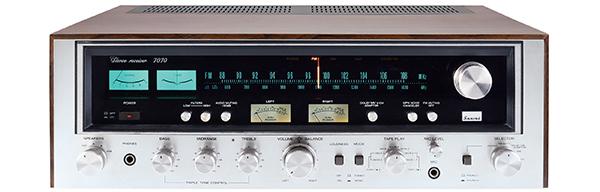

Big stereo receivers never made much of an impact in the UK, but this did not stop the importers servicing the large Japanese manufacturers from offering them from time to time. Pioneer, Marantz and Kenwood all boasted full-fat machines with colossal power output ratings stretching into hundreds of watts per channel – these numbers far in excess of British audiophiles’ experience. Add to this list Sansui, a brand that always had heavyweight models at the top of its ranges. The 7070 model seen here is typical of the breed – it was introduced in 1976 and remained in the catalogue until 1978.
One of many
Sansui had carefully positioned itself as a specialist manufacturer producing only hi-fi equipment. This contrasted with the likes of Sony and Technics which, as part of larger groups of companies, offered ranges of other products in addition to domestic audio systems. Nevertheless, Sansui’s export range was admirable and for the 1976 season included no fewer than 26 amplifiers, tuners and receivers of which the 7070 was but one. Add to these nine loudspeakers, nine styles of headphones, five turntables and four cassette decks and it was clear that Sansui was serious, although not all of the models were available in the UK in significant quantities.
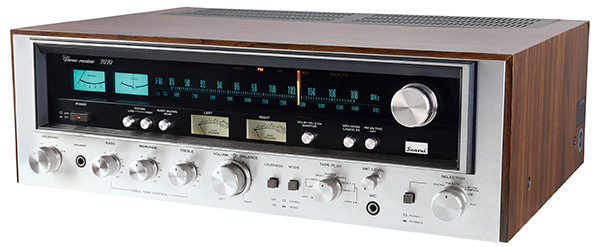
Amid all this the 7070 receiver was described as being in the medium power and medium price range. The first of these claims was certainly accurate, the 7070’s 2x60W rating sitting between the largest model (the 9090 with a mighty 2x120W) and the smallest (the 221 with just 2x10W). Viewed in isolation the 7070 did not look like a mid-range model. Its half-metre wide fascia sported banks of gleaming controls as well as four meters (two for tuning, two for output power) and a long illuminated tuning scale. At 16.6kg it was no lightweight either, although at 23.3kg the 9090 was more substantial still.
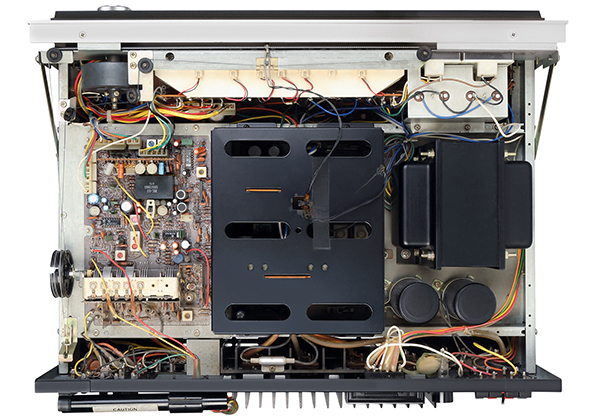
Large Japanese receivers of this type were made almost entirely for export and most of them ended up in the United States. This market focus meant that the styling of models like the Sansui 7070 already looked dated to some British and European consumers, especially those accustomed to the work of the likes of Dieter Rams (Braun) and Jacob Jensen (B&O), who between them had defined a look for large, modern, elegant looking receivers. This was not reflected in the engineering inside the 7070 though; the circuitry was all very much in line with the trends of the day. Points of particular interest included DC-coupled power amplifiers using complementary output transistors. These were fitted with an elaborate protection system with electronic current limiting and a relay to safeguard the loudspeakers should anything go seriously wrong.
Dolby ready
The FM section of the tuner used the latest integrated circuits from Hitachi, one for the IF amplifier and one for the stereo decoder. The former worked in conjunction with five cascaded ceramic filters to give really accurate tuning, the latter using the PLL (phase-locked loop) principle to ensure the best possible stereo separation. Provisions were also made for decoding the Dolby FM broadcasts which were being proposed at the time. Since the exact specification of the system was still under discussion when the 7070 was being designed the decoder itself was to be an external unit, although as Dolby FM never came to pass in the UK the feature was moot. More useful was the carefully designed phono stage which was unusually sophisticated for this type of unit. It used three low-noise transistors in each channel and was separately powered from a dedicated, smoothed and regulated PSU.
Other refinements included Sansui’s ‘triple tone control’ which added an extra knob to regulate the midband as well as the treble and bass. A switchable loudness function was also fitted, giving the user a multitude of ways to fine-tune the sound. The 7070 receiver could be used as the centrepiece of a really complex installation, potentially incorporating two turntables, two tape recorders with off-tape monitoring and cross dubbing, an auxiliary source, a microphone with its own level control, and two pairs of loudspeakers.
After a brief interlude with the truly vast, two-piece G-33000 (the biggest stereo receiver of them all), Sansui continued into the 1980s with full-sized receivers in the form of the new G-700 series. Each of these models directly replaced one of the 9090-5050 range, the updated alternative for the 7070 being the G-6700. Essentially unchanged in size and weight, this revised design offered a little more power (2x90W) and a few additional features such as LED bargraph power meters and an electronic frequency readout for the tuner. Another key part of the specification of all five G-700 models was a focus on TID (Transient Intermodulation Distortion) in the power stages, the distortion du jour!
Solid stereo
The sheer bulk and glitz of the Sansui 7070 make it difficult to ignore. Switched on and glowing in a variety of hues it’s a real eye catcher. I find it a bit chintzy for my taste, but for many this is still what ‘proper’ hi-fi looks like. Indeed, after some time in the doldrums, these monster receivers (and their new-but-retro-styled counterparts) are fashionable again in certain quarters. There’s no disputing how solid it all feels either, giving the impression that Sansui’s amplifier will last forever.
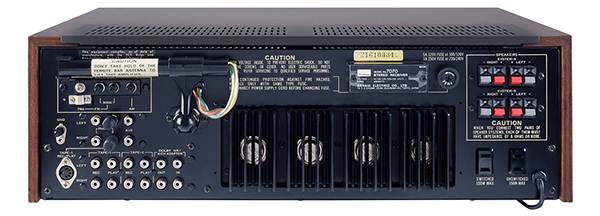
Setting up is simple as there is a socket for everything and all are standard RCA types with plenty of space around them for today’s bulky cables. The loudspeaker connectors are spring-clip terminals which are less user-friendly, but they make a good contact and it is simple to make up short pigtail adapters if your loudspeaker cables are terminated with 4mm plugs. The comprehensive protection systems inside the 7070 mean that expensive or delicate loudspeakers can be used with confidence.
The FM tuner section requires a separate aerial and, for best results, an outdoor FM rig is recommended. However, the sensitivity is pretty good so it is worth experimenting with indoor wire and dipole types if you live in an area of reasonable signal strength. All these large Japanese receivers seem to have the same sorts of controls arranged in a largely similar manner, so operation is both familiar and straightforward. There are a few extra controls at the bottom of the tuning scale but they are all the kind of things which are seldom used (high and low pass filters, –20dB muting, Dolby FM, silent background tuning, etc), so once they are set they can be ignored.
Rotary hub
As is the norm, all the main sources are on a single rotary selector so you have to crank through all the tuner bands to get from the turntable(s) to the CD player. When the unit was new it was supplied with shorting plugs to prevent a sudden loud hum if a vacant turntable input was selected in error – these are useful and easily replicated if now missing. The two little yellow-illuminated power meters are an unexpected extra, though I’ll admit to not being a fan. While they are commendably accurate for measuring continuous signals into an 8ohm load [see PM's Lab Report], the meter ballistics are just too sluggish to be of any use with dynamic music signals.
 Tim Listens
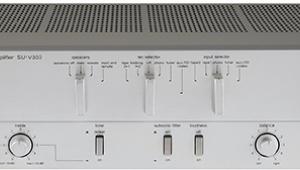
The 7070 may look like the antithesis of a modern audiophile product but in practice it sounds pretty decent. It’s even-handed with all tone controls and filters (six in all) set to ‘neutral’, with just a little added bass lift to potentially thicken up the bottom end with an unsympathetic loudspeaker. The tone controls themselves are delicate enough in their action to be genuinely useful (why change your cartridge or your loudspeakers when you can just turn a knob?) and the effect of the loudness contour is surprisingly subtle, not that HFN readers would ever use such a device. Like the Technics SU-V303 [HFN Sep ’25] the action of the low (rumble) filter is audibly obvious which is not as things should be, but this function is seldom used with modern sources in any case.
Power delivery is healthy and with sensitive, 8ohm nominal loudspeakers this unit can easily reproduce realistic levels of musical intensity. At the limit the sound becomes compressed before any really heavy distortion sets in, warning the user that the power amplifier has no more to give. Damage to both the receiver and the loudspeakers is therefore fairly easy to avoid.
Listening to Sade’s ‘The Sweetest Taboo’ [The Best Of Sade; EK 85287] I found the 7070 worked well when used as an amplifier. Only the slightly slow and heavy bass gave me reason to mark it down, something which repositioning the speakers would likely help mitigate. Sade’s vocals could also sound fractionally recessed compared to other amps that typically push them to the fore. In spite of this the 7070 is an engaging performer, a real ‘listen through to the end of the album’ type.
The Adagio of Haydn’s Symphony in B flat major No. 102 [Deutsche Grammophon 449 204-2] suited this big Sansui model perfectly. The strings sounded chesty and rich with no trace of coarseness or grain. Again some upper midrange muddle was evident, but not so much as to detract from the enjoyment of the piece. The Sansui 7070 is very good at capturing what makes music good to listen to, and delivers it with energy and drive.
Finally, I could not resist giving the FM tuner section a try. Listening to the BBC Proms on Radio 3 showed that the tuner was capable of recreating an excellent sense of concert hall ambience with plenty of width and depth to the sound image. In contrast to the sound of the 7070’s MM/line inputs, it brought a slightly soft quality which typically took the edge off the percussion without, admittedly, marring an otherwise fine performance. You would need a separate tuner of advanced design and high quality to usefully better the 7070’s FM performance, which is the whole point of buying an expensive receiver in the first place.
Buying secondhand
Despite my reservations about the appearance of this unit I can recommend it as a good example of the breed. It’s brash on the outside, but clearly refined inside. As already mentioned, these large and expensive receivers were never especially common in the UK but were more popular in continental Europe so a search for quality examples is more likely to be fruitful there – the source of our sample. All are well built and tough; don’t let anyone talk you into having to change handfuls of capacitors as it is not routinely necessary here.
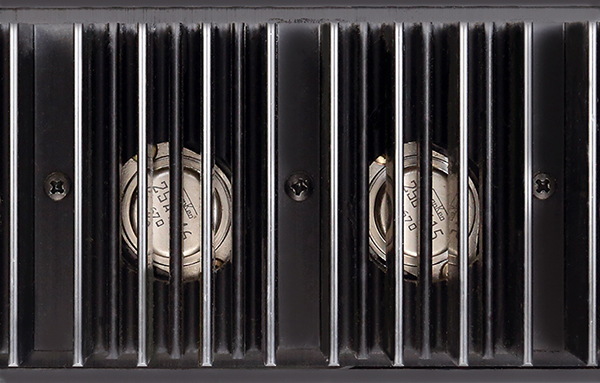
What does cause problems is a type of small resistor used in some positions in the power stages. They can increase in resistance greatly with age and this causes all kinds of problems ranging from weak output to overheating and no sound at all from either or both channels. Simple checks will quickly reveal the defective parts. Another common problem is uneven illumination of the 7070’s array of meters and dials. This can be a result of failed bulbs, but the bulb holders themselves can cause a similar effect if their contacts get tarnished or relax their spring tension. Gentle cleaning and re-bending is the simple remedy. Finally, don’t forget the usual bias current setting and speaker relay contacts. Setting the former and cleaning the latter is essential if top performance is to be obtained.
Hi-Fi News Verdict
If you’ve admired the large Japanese receivers of the 1970s from afar, then Sansui’s 7070 is definitely worth a look and a long listen. In practice, and despite its heroic proportions, it’s still not the largest or, indeed, the most powerful model from the era. Nevertheless, the 7070 looks the part and possesses sufficient ‘grunt’ and versatility to take on many separate amplifier and tuner combinations.
Sound Quality: 75%
 | |||||||||||

|
|
| |||||||||












 SPONSORED VIDEO






| Equipment Reviews | |
Music Reviews Awards | |
Latest News Features | |
Resources Newsletters | |
Subscriptions |
WHERE TECHNOLOGY BECOMES ENTERTAINMENT
 © 2026 Hi-Fi News
AVTech Media Ltd
All rights reserved