Philips GA 209S turntable
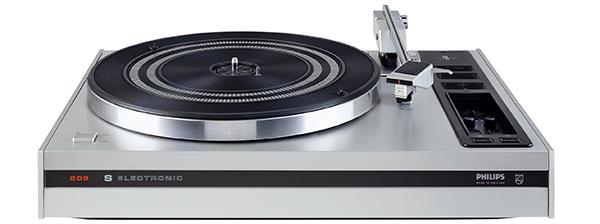

There is always some kind of surprise in store when reviewing vintage Philips products. Whether a new way of doing things or an extra feature you never knew you needed, Philips always had a knack for this sort of thing. The GA 209S seen here was an attempt to completely automate a high-quality turntable. Introduced in 1973, it entered a market where the grinding gears, clicking cams and greasy levers found in the mechanisms of some BSR and Garrard decks were still very much the norm. The Philips approach was quite different; it made extensive use of electronics to control and sequence the mechanism.
Get your motors runnin’
To do this required an acceptance of a high degree of complexity. Three DC servo motors were used, more than in any other turntable – or so it was claimed. One drove the platter and two more were used for the automatic functions. The former was the same tacho-controlled type that could be found in the popular, manual GA 212 model, described in our review of the earlier GA 202 [HFN Mar ’22]. The two other motors were similar to those found in the firm’s portable cassette recorders, such as the EL 3302 [HFN Apr ’12].
Unlike traditional automatics the spindle of the platter was not used to power the mechanisms in any way. Instead, Philips’ circuitry was composed of banks of individual transistors, its engineers eschewing the recently available digital logic ICs like those employed by B&O to perform a similar task in its contemporary Beogram 4000 [HFN Jun ’14]. Nevertheless, however they worked, automatic turntables were not a new thing in 1973.
To move the state-of-the-art forward Philips chose to make the GA 209S completely automatic. The turntable would instantly play a record of any standard size as soon as it was placed on the platter – no further intervention was necessary until the side was over and the arm returned to the rest. The advertisements of the day claimed that the only thing which had to be done manually was to remove the record from its sleeve.
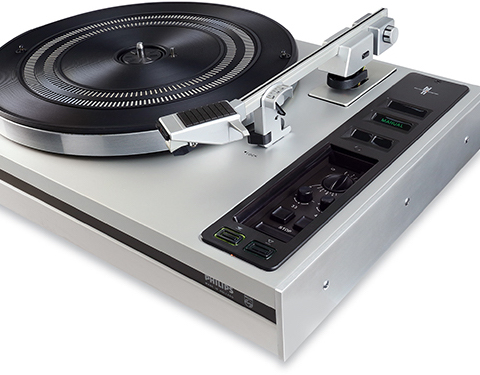
Above: Opening the control hatch [far right] switches the deck from auto to manual operation, though the electronic arm lift/lower controls are enabled in all modes. Fine speed control, bias adjustment and ‘stop’ are offered
This may all sound like a gimmick, but it wasn’t. 1973 was exactly halfway into the 20-year gestation period that culminated in the arrival of Compact Disc, a Philips project aimed at making high-quality music reproduction in the home as simple as possible. The GA 209S can be seen as a test of the market by demonstrating these principles within the existing vinyl format. It launched as the most expensive turntable in its range and at £135 sold for nearly twice the price of Philips’ manual GA 212.
Making contact
The record’s presence was sensed by a small peg protruding from the mat within the radius of the label. Two further pegs were used to determine the record’s size, operating mechanically with a plate underneath that was withdrawn once playback started. The first peg worked electrically – it was arranged so that the contacts were parted when a record was in place, thus avoiding additional friction and mechanical noise. A traditional cueing lever was banished in favour of two illuminated touch pads [visible, below, at the front of the hidden control bay]. These, via one of the servo motors, commanded the standard Philips sealed trough of silicone oil and Bowden cable cueing arrangement already included in many of its decks.
For when automatic operation was not needed, a set of manual controls were provided in the bay, beneath a smoked sliding door on the righthand side of the plinth. Opening this switched the GA 209S from automatic to manual mode, the change being confirmed by a pair of green-illuminated indicators at the back. Beneath this were separate push buttons to start the platter at 33 or 45rpm, a single button to stop the platter and return the arm, and dials covering fine speed control for both speeds (for use with the strobe rings built into the mat) and anti-skating.
Watch your weight
The GA 209S came with a Philips GP 412 cartridge, second from top in its range below the GP 422 intended for CD4 quadraphonic recordings. This was factory-fitted into the straight arm, the bulk of which was formed by a length of U-shaped alloy channel. Static balancing was achieved by an underslung counterweight whose position was set by a skew-cut rack and pinion. The sliding collar method of adding the correct downforce from the GA 212 was dispensed with in favour of a tiny weighing scale built into the arm rest, something which would become a popular feature in future models.
The GA 209S looks very smart in the catalogue pictures but it’s even better when encountered first-hand. Philips’ styling of this era was distinctively European and gently futuristic, making a refreshing change from the legions of essentially identical Japanese turntables of the 1970s, and the many British decks which looked a bit home-made. The only drawback is that unless the rest of your system comprises Philips components, it can appear out of place.
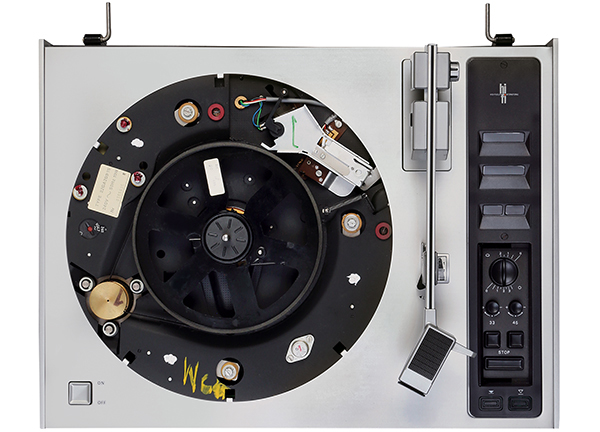
Above: Seen with platter removed, part of the auto mech is revealed [right] with motor [lower left] and belt drive around a sub-platter ‘wheel’. Note tracking force gauge on arm rest
Otherwise, the automatics work well. They are rapid, quiet and well timed and with a perfectly measured pause between placing the record down and things getting going. Just as when it was new this turntable is the ultimate dinner party pose. Even so, using the GA 209S is not without its frustrations. There is no time to clean the record before the arm lands so you must make sure that it is dust-free before placing it on the platter. Neither is there a sensible way of rejecting playback before the arm reaches the end of the disc. Opening the cover to use the stop button is the best way but closing it again afterwards instantly resumes playback from the start, something that is seldom wanted.
Manual labour
Automatic lift/lower (power cueing) isn’t really part of the automatic sequences so it is possible for one to interrupt the other, a problem which a few more transistors would surely have solved. And its manual mode is arguably a bit too manual – once the speed has been selected everything else has to be done by hand. Unlike the microprocessor-based designs that would follow, including the Technics SL-10 [HFN Apr ’19], the GA 209S’s sequences are rigid and cannot adapt themselves to unusual circumstances or user errors.
 Tim listens
Usefully, the output from the cartridge is muted unless and until the stylus has been delivered into the groove. This system works exceptionally well and is completely effective since its vacuum-sealed reed relay contacts cannot corrode. The sub-chassis suspension is a lot less compliant than that of the ‘floaty’ GA 212 but still appears to give good isolation – placement did not seem to be that critical.
That said, there is plenty about the GA 209S which will offend the traditional audiophile. Start with the fact that it was made by a company which also produces a wide range of other consumer products. Also, it came as a package complete with arm and cartridge, was designed to look attractive, and had many automatic functions and parts seemingly fashioned from flimsy plastic. On the other hand, Philips also had its own record label, recording studios and pressing plants which, between them, produced some of the best and most respected classical and popular music recordings available. There are few (if any) other turntable manufacturers that could claim such a detailed understanding of the subject.
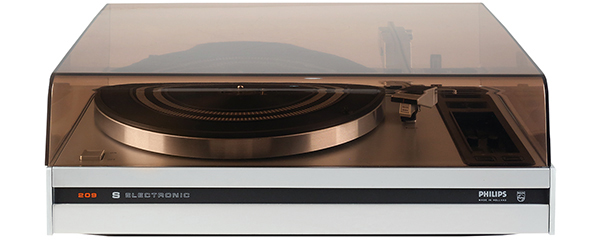
Above: The GA 209S came complete with a heavyweight and stylish smoke-coloured lid. The alloy-skinned plastic chassis has a flat base, supported by small, non-adjustable feet
The GA 209S, used here with a Philips GP 401 MM cartridge, has a large, plump, rich sound which is mercifully free of the colourations many associate with fully-auto LP listening. If someone had told me that I was auditioning a Philips CD104 CD player [HFN Apr ’14], I’d have suspected nothing until the first click or pop came along, and these are few and far between. Set at 2g this standard MM hugs the groove securely with only the very strongest of modulations causing any hint of mistracking. Similarly, the belt-drive is silent and seems to hold its speed well [see PM's Lab Report] – in this respect the GA 209S demonstrates its superiority over period rivals with noisy and hot-running mains-driven motors. Once the automatic systems have done their work they are soon forgotten, as none of this deck’s electro-mechanical ballet impacts on its listening experience.
Something in the air
Keen to introduce one piece of 1970s European futurism to another, I spun-up Jean-Michel Jarre’s ‘Oxygène’ [Polydor Super 2310 555]. The six parts of this composition are spread over two sides of an LP, and even though the GA 209S can’t turn it over halfway, the big, chewy sound of Jarre’s pioneering electronics was reproduced with huge confidence. Some turntables can make this recording sound too dry and rob it of its impact, but not so here. The massive if synthetic soundstage was recreated with ‘lifelike’ proportions.
Assessing neutrality is difficult with purely electronic music so, by way of any number of examples, I also used the GA 209S to enjoy Gershwin’s Piano Concerto In F [Philips 412 611-1]. As expected, the deck and cartridge was coloured slightly to the warmer end of the spectrum, but while the overall tonal balance was subjectively smooth neither was there any undue emphasis of any one group of sounds. A near ideal compromise between gentleness and immediacy was struck, with plenty of bite from the percussion but no unpleasant harshness from the strings.
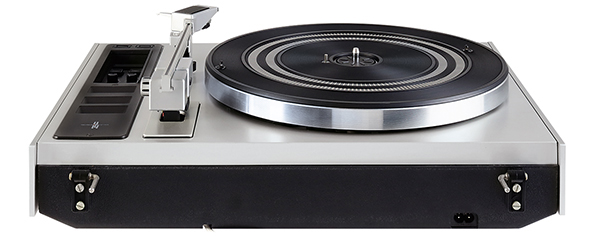
Above: Two-pin ‘shotgun’ AC mains inlet [far right] is joined by a captive audio lead [left, but hidden here] terminated in a 5-pin DIN plug suitable for direct connection to the MM phono input of most contemporary (early 1970s) amplifiers
Even if the GA 209S doesn’t quite put you in the front row of the audience, neither are you left right at the back. No, you hear just about everything – and played at concert volume it is absolutely thrilling. One could argue that the thinnest of thin veils still seems to be present between the listener and the performance but you will need to spend a lot more on less user-friendly equipment to remove it.
Like many Philips products, the GA 209S ends up being something of a paradox. The clever systems make it easy for anyone to use but those who were in the market for a turntable of this quality, and at this price, could normally operate them without assistance. Later Philips turntables worked in a more conventional manner, both outwardly and internally. This may have been more sensible both commercially and technically, but none of the models which followed felt as special as the GA 209S.
Buying secondhand
Philips’ fully auto turntable is not as easy to find as the popular GA 202, GA 212 or GA 312 but thousands were made and they are still discoverable. The problem is that many no longer work and any fix may well be beyond the realm of a traditional turntable specialist – finding someone familiar with intricate tape recorder mechanisms may be more fruitful. Most of the problems centre around the rubber parts, such as the drive belt for the platter and the two idler wheels underneath. The material used for these decomposes into a messy, tar-like substance which is difficult to clean up.
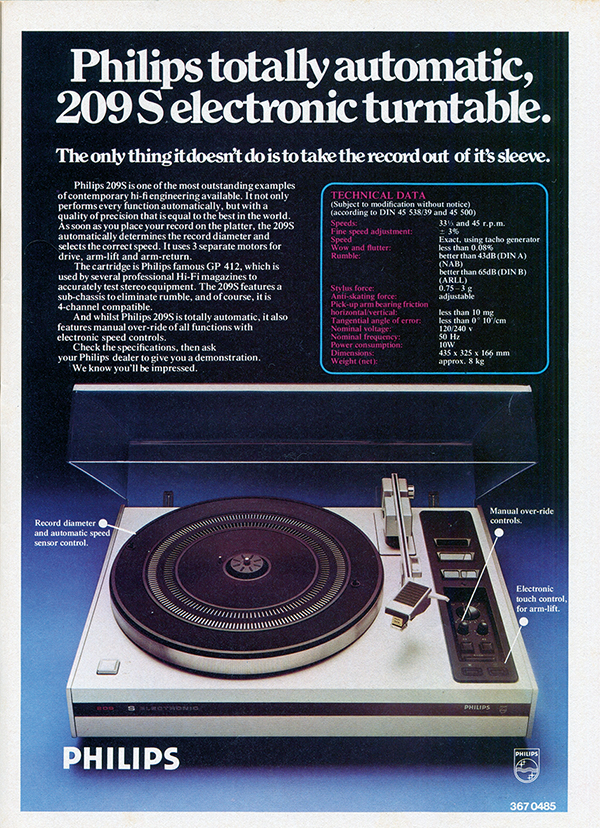
Above: Advert for the GA 209S (also known as the 209 S) extols the virtues of the features and flexibility of its design
Everything must be spotless for the deck to work properly, and while the idler tyres are no longer made they can still be replaced with rubber O-rings. The rubber grommets in the suspension can settle too, letting the platter rim scrape on the top plate. They are made of a different material which doesn’t liquefy so there’s no mess. Packing out the gap with standard M5 washers is one solution.
Problems with the GA 209S’s electronics are rare and usually limited to blown bulbs and faulty transistors. The bulbs (there are nine in total) are 6V/0.06A types which aren’t easy to find. Using the wrong rating can damage associated circuitry so, as ever, care must always be taken with new-for-old component replacements.
Hi-Fi News Verdict
Philips’ fully automatic turntable may appear to some a wanton study in pointless complexity, but in practice it works really well and seldom fails to delight. The GA 209S also rates well in sound quality terms, putting many of the more obvious choices from this era in the shade with its smooth-yet-bold performance. However, any secondhand purchase comes with a warning – repairs and overhauls can be a challenge.Sound Quality: 80%
 | |||||||||||

|
|
| |||||||||














 SPONSORED VIDEO






| Equipment Reviews | |
Music Reviews Awards | |
Latest News Features | |
Resources Newsletters | |
Subscriptions |
WHERE TECHNOLOGY BECOMES ENTERTAINMENT
 © 2026 Hi-Fi News
AVTech Media Ltd
All rights reserved