DeVore Fidelity O/Bronze loudspeaker
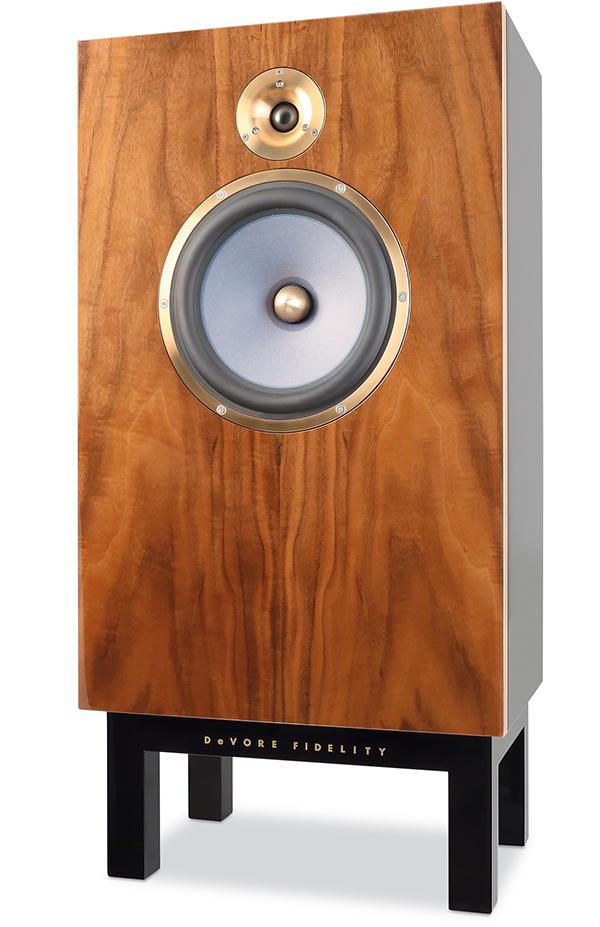

At the risk of making an inappropriate statement, size really does matter, at least in the realm of the loudspeaker. Being an owner of the smaller DeVore Fidelity O/93 [HFN Mar ’23], I learned this again after listening to the manufacturer’s larger DeVore O/Bronze (£28,998). It was a similar situation to hearing Quad’s newly launched ESL 2912X [HFN Feb ’26] right after spending time with its slightly shorter grandfather, the otherwise similar ESL63. But more about this aspect in a moment.
New York-based DeVore named this speaker series after orangutans, but whatever simian aspects they may have elude me. I suspect it’s owner John DeVore’s sense of humour. The O/Bronze fits in above the O/96 [HFN Apr ’21] and below the O/Reference, the latter’s drive concepts trickling down to the ’Bronze, which gets its name from the use of that material [see boxout].
Deluxe devore
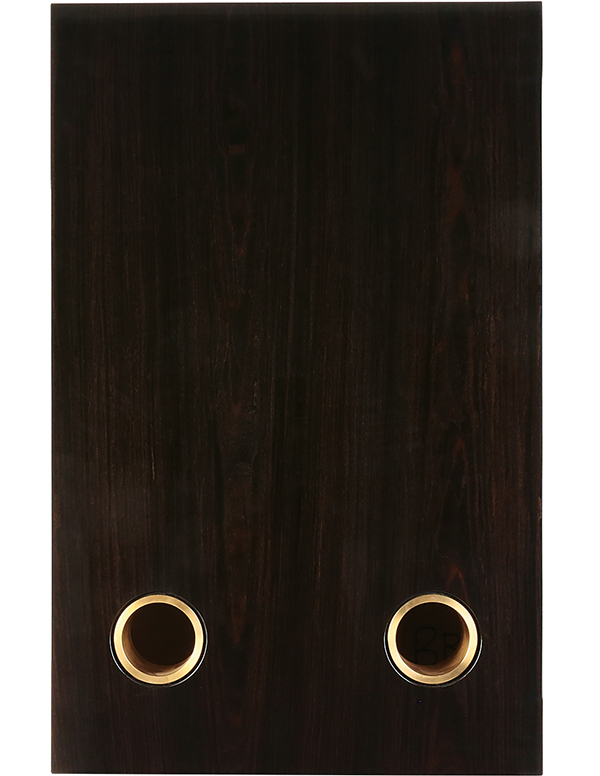
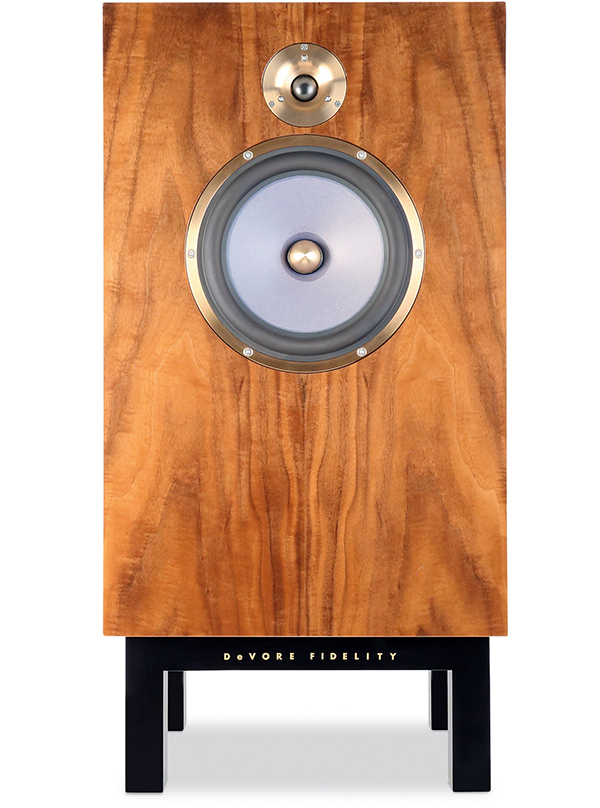
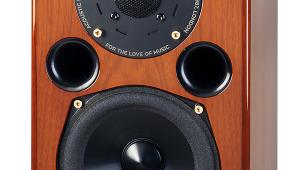
In keeping with all of DeVore’s loudspeakers, the O/Bronze’s cabinetry is exemplary, the wood veneers stunning, and the finish rivalling fine furniture. My only complaint about the external elements is the positioning of the multi-way cable binding posts beneath the speaker rather than around the back. Stands and grilles are supplied (the latter useful in taming the speaker’s top-end performance if your system is bright), but at just under £30k, DeVore should make it easier to access those terminals.
To understand its positioning within the Orangutan hierarchy, John DeVore describes the O/Bronze as ‘being a hybrid of the O/96 and the O/Reference’. Specifically, he regards it as approximately 30% of the way to the flagship as far as the materials, technology and performance are concerned. The aim was to make a speaker with wider appeal than the four-box Reference – it’s hard enough for most homes to accommodate two cabinets let alone a quartet – while spreading the build costs of the bronze components developed for the flagship. This includes the cast bronze pipes used for the rear ports, instead of the ABS ports of the O/96. The decoupling of these pipes into the cabinet differs in the O/Bronze too.
It’s important to stress that this speaker isn’t merely an O/96 on steroids, but more of an O/Reference ‘Lite’. Yes, size-wise, the cabinet is identical in exterior dimensions to the O/96 at 905x458x310mm (hwd), but with some differences. As with the O/96, the enclosures are made from a mix of 25mm birch ply, 25mm and 19mm soft plywood, and 19mm MDF, but added to this are phenolic resin sheets bonded to the inner walls with a ‘lossy’ flexible adhesive, as per DeVore Fidelity’s O/Reference model.
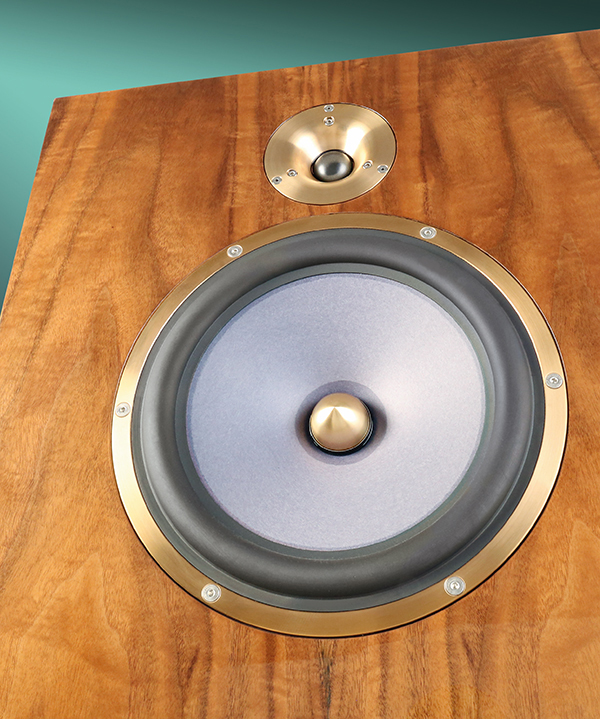
The O/Bronze is fitted with the soft dome O/Reference tweeter (which shares no parts with the O/96 tweeter). Meanwhile, the 250mm woofer is a hybrid of the units found on the O/96 and O/Reference. It employs the same paper cone, four-layer voice coil, ferrite magnet and stamped steel pieces as the O/96, rather than the AlNiCo magnet and machined steel parts from the Reference woofer, but uses the Reference’s bronze phase plug in place of the O/96’s ABS part. The result, says DeVore, includes a reduction in higher-order harmonic distortion. Finally, the O/Bronze’s crossover employs the same level of components as the Reference: foil and paper-in-oil caps, exotic resistors, and foil coils.
 More is more
But back to the O/Bronze (and for that matter, the O/96) versus the company’s smaller O/93 and O/Baby [HFN Aug ’23]. Most audiophiles appreciate that – all else being equal – the larger the loudspeaker, the deeper or more pronounced the bass. Among any possible trade-offs is a loss of the usually pinpoint imaging of smaller models, which may be closer in concept to a point source, but DeVore sidesteps this possible issue for the most part because as you go up the model range, the jumps in size are not that drastic. If anything, the main gains of the O/Bronze over its smaller siblings are in the bottom end.
When recently asked by a friend ‘how does DeVore do it?’, referring to its speakers’ ear-opening mix of vintage allure and modern attitude, I posited that it’s by creating clever hybrid solutions. The O/Bronze marries a few hi-fi traditions, some rather ancient – the most obvious being the use of paper cone woofers – with both current and lateral thinking.
Paper weight
Paper cones sound identifiably different from those fashioned from Bextrene, carbon-fibre, polypropylene, aluminium or other materials which have replaced paper in modern times. For some of us, however, especially those who grew up listening to hi-fi in the 1960s, it’s almost an exercise in nostalgia, for the tenor of the bass (by this I mean voicing, rather than ‘a male vocalist above baritone’) is softer, less aggressive but no less impactful.
Further divorcing these speakers from the accusation that they’re just aping classics of the 1960s and ’70s is the recessing of the dome tweeter enough to allow it to be described as enjoying ‘quasi-horn loading’, which I assume also adds to the high sensitivity [see PM's Lab Report]. And while it might seem anachronistic to have a large, cubist, ported wooden enclosure with a paper cone woofer in this day and age, the O/Bronze, like all other DeVore speakers, defies accusations of merely being a blast from the past.
I tested this theorising with one of the most weighty recordings I’ve heard of late – Syl Johnson’s astounding cover of The Beatles’ ‘Come Together’ [Complete Mythology; Numero Group NUM032]. The rhythm section here delivers a classic southern funk interpretation of a familiar rock masterpiece, and the sheer mass and extension of bass changes the mood to one that’s even more sinister than the dark Fab Four original. The track also features percussion that rivals any purely ‘audiophile’ drum records, while the organ to stage right just burbles alongside it, adding to the richness. The O/Bronze lapped it up.
While paper cone woofers are only part of the DeVore recipe, and I am trying desperately not to overstate their role, they do set the stage for whatever music is being played. Soul/funk such as Johnson’s, as well as hip-hop, rap, much current dance material and, yes, heavy metal all possess a bottom-biased experience, but even these bass-dominated recordings can be undermined by a small speaker. The O/Bronze not only champions the lower registers, it appears to free them of any constraint or compromise.
Nothing added
Note that I avoided the word ‘augmented’. DeVore’s O/Bronze doesn’t add anything in the way of enhancement or artifice, unlike some speakers I could name with uncontrollable lower registers. Whatever this showcasing of the bass brings to the listening experience, it is disconcerting only for those unfamiliar with what’s available from a massive-sounding if otherwise physically manageable speaker.
Lest you think the O/Bronze’s appeal is only about its bass handling, I have to counter that with the sweet yet super-sharp upper frequencies. Just as the bass reproduction is free of the aggression of overly damped, plastics-based drivers, so is the tweeter settled into a happy middle ground between a ‘classic dome tweeter sound’ and horn loading.
As one who is not predisposed toward pure horns (notable exceptions coming from Lowther and Klipsch), I find that the O/Bronze enjoys all the speed and crispness of horns with none of the brashness. This is what endeared me to the O/93 and O/Baby, and now the O/Bronze proved its mettle with John Coltrane’s ‘India’ from the Coltrane/Ravi Shankar Jazz Raga anthology box set [él Records ACME3CD379].
The right stuff
With Coltrane’s soprano saxophone duelling with Eric Dolphy’s bass clarinet against a warm background of bass, drums and piano, the upper registers were enjoying a real workout. At the same time, the rhythm section benefitted from what we have already established: that the DeVore O/Bronze is an ideal choice for those who want peerless bass reproduction that’s just as ‘right’ as Baby Bear’s porridge.
What delighted me even further, given that half my life is spent listening to LS3/5As, was the spectacular scale and three-dimensionality of the soundstage. I even segued into some mono material through the O/Bronzes – including the delicious rockabilly of Dance Album Of Carl Perkins [Intervention Records LP-1225] – which was conveyed with a rock-solid central image and disarming front-to-back depth. However, the way that the stereo Coltrane track was presented was on a par with panel speakers which seem to disappear with greater ease than box-type systems.
Vanishing act
Perhaps I needn’t have been so surprised. For some decades, certainly since the Wilson WATT/Puppy first appeared in 1989 through to today [HFN Sep ’24], along with massive and/or radically enclosured systems from Magico, Bowers & Wilkins, Sonus faber, etc, cabinet colouration has become less of an issue. All these latter loudspeakers vanish with the same facility as dipoles. And so, wooden though DeVore Fidelity’s O/Bronze’s cabinet may be, it’s fashioned with such integrity and damped so conclusively that you may have to rethink what you know about dynamic, box-style speakers.
Hi-Fi News Verdict
Anticipating a treat, the DeVore O/Bronze delivered not what I expected but more than I could have imagined. The room-filling, wall-vanquishing presentation of this speaker will worry those producing costlier, harder-to-drive, harder-to-house systems. Within the gigantic performance area are sweet sounds supported by pure, rhythmic mass. And at the price point? I’ll not call it a gift, but it is a game-changer.Sound Quality: 89%
 | |||||||||||

|
|
| |||||||||











 SPONSORED VIDEO






| Equipment Reviews | |
Music Reviews Awards | |
Latest News Features | |
Resources Newsletters | |
Subscriptions |
WHERE TECHNOLOGY BECOMES ENTERTAINMENT
 © 2026 Hi-Fi News
AVTech Media Ltd
All rights reserved