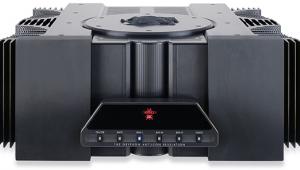
D’Agostino Momentum C2Z/Z pre/power amplifier Boxout
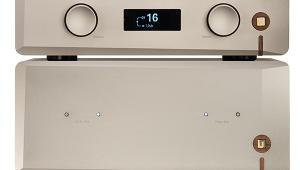
A JFET-based voltage gain stage is at the heart of the big upgrade to D'Agostino's Momentum pre and power amplifiers, but with a twist. While JFETs are typically employed for their very high input impedance (and other tube-like characteristics), the Z circuit is specifically engineered to present a very low impedance (low 'Z') input. At 300ohm, instead of 47kohm or higher as is typically the case, the Momentum Z can only be driven via a preamp with a very low, balanced source impedance – the C2Z has a sub-1ohm output, seen only in the best headphone preamps – and with the current to maintain this voltage as the signal conditions demand. Why do this? The advantages are esoteric – thermal noise is reduced just as stray EMI/RFI picked up by the interconnect is more easily shunted to ground. The high current drive also mitigates any charge developed in the cable's dielectric, rendering the Z pre/power fairly 'interconnect agnostic', especially over long runs. Using another preamp? Turn the low-Z input 'off' via its internal switch.
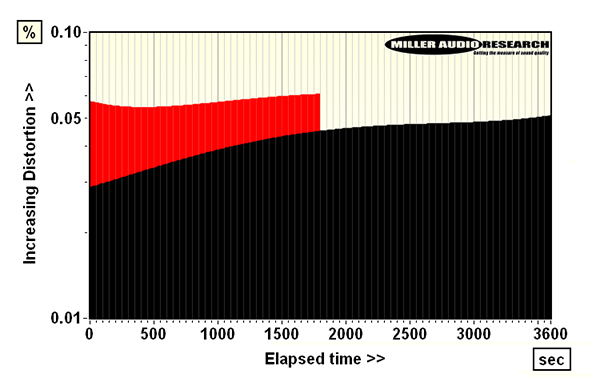
Otherwise, designer Dan D'Agostino's familiar multi-parallel transistor output stage still has a protracted warm-up as the amplifier's thick copper and alloy chassis achieves thermal equilibrium [red trace, Graph above, shows the original Momentum, HFN Jul '11]. With over 500W/8ohm on tap, and some 58A in reserve to support 3.4kW into the toughest loads [see PM's Lab Report], the new Momentum Z sinks ~110W at idle. This, together with D'Agostino's relaxed approach to corrective feedback, means the Momentum Z shows a modest 0.03% distortion at 1kHz/10W/8ohm from cold but this increases to 0.05% after an hour [black trace, Graph above]. After a full two hours, the chassis reaches a very warm 50°C and distortion settles out slightly higher still at 0.08-0.09%/10W. PM
 | |||||||||||

|
|
| |||||||||









 SPONSORED VIDEO







| Equipment Reviews | |
Music Reviews Awards | |
Latest News Features | |
Resources Newsletters | |
Subscriptions |
WHERE TECHNOLOGY BECOMES ENTERTAINMENT
 © 2026 Hi-Fi News
AVTech Media Ltd
All rights reserved