B&O Beogram 1000 turntable
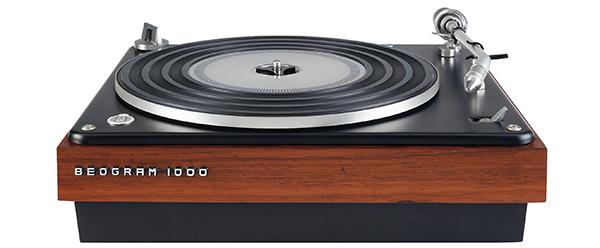

B&O’s Beogram 1000 was one of those turntables that seemed to be everywhere in the late ’60s and early ’70s. Combining simplicity with careful design, for many years it was one of the most popular high-quality decks on the market. As ubiquitous as a Garrard SP 25 [HFN Jun ’25] or a Pioneer PL-12D [HFN Jun ’25], the inexpensive Beogram 1000 made great sound available to listeners of all levels of experience.
Stereo stalwart
The design of the Beogram 1000 had its origins in a previous and visually similar B&O turntable called the 42V. It was with this model that B&O introduced the SP1 and SP2, its first moving-iron (MI) stereo cartridges. These offered a similar output to standard MMs and were highly regarded in the early days of stereo LPs. From their introduction in 1958 to the end of B&O turntable production in the late 1990s, the cartridges’ basic principles never changed, other than their parts becoming progressively miniaturised.
For the Beogram 1000, B&O proposed that the vertical tracking angle of the stylus should be 15°, a standard that was later widely adopted before being increased to the 20°seen today. The arm and cartridges were also changed, with the new SP 7 similar in appearance to the SP 2 but with its outer screening can integral with the stylus assembly.

The Beogram 1000 retained the drive system of the 42V with only minor revisions. An AC motor drove a thin rubber idler wheel via a stepped shaft which gave a choice of three speeds. A second pulley on the shaft transmitted drive to the platter through a round-section rubber belt. Fine speed control was from a centrifugal governor fitted inside the motor. This used a floating steel disc hung from phosphor bronze leaf springs, with bob weights, the whole assembly being dynamically balanced. Felt pads acting on the disc controlled the motor’s speed, their position set via a steel wire connected to a small knob set into the centre of the speed selector dial. A strobe ring in the centre of the platter aided correct adjustment.
Elegant design
Compared to the complexity of the motor the rest of the Beogram 1000 was disarmingly simple. The centre bearing used a precision ground needle point to bear the weight of the platter and a thin copper sheet with an accurately punched hole controlled the side loads. Minimal friction was thus assured. The arm, also available separately for use on other turntables as the 9in B&O ST-L, was similarly elegant. Since the mass and geometry of the cartridge was already known it was possible to dispense with most user-adjustments.
The counterweight simply clicked into place on a ball lock and downforce was set by sliding a small collar along a calibrated scale, which tensioned a delicate spring under the arm. Anti-skating force was applied by the helical ball race – as the arm moved across the LP it also had to move fractionally upwards at the rear. The arm was so perfectly balanced that B&O salesmen frequently demonstrated the Beogram 1000 playing perfectly well standing on its side.

While the 42V’s plinth had been completely rigid, the Beogram 1000 benefitted from a sprung suspension. Here the top plate and upper plinth fitted over the lower chassis. Foam-damped coil springs were used, restrained by strips of canvas for when the turntable was lifted or dismantled. The upper plinth was available in either teak or rosewood veneer; the lower chassis was always painted black.
Low-output magnetic cartridges were still unusual in the mid 1960s and not all amplifiers, even some of B&O’s own, could accommodate them. So B&O offered a version of the deck, called the Beogram 1000VF, that was equipped with a built-in all-transistor RIAA preamplifier. The phono amp could also be plugged into the standard model as the socket and all the necessary wiring was already there.
Getting better with age
The design of the Beogram 1000 matured over the years. Models produced in 1965 and 1966 had top plates finished in hammered grey but this was changed to satin black in 1967 to match designer Jakob Jensen’s black version of the Beomaster 1000 receiver. Underneath, the working parts were also gradually refined, the construction of the main bearing housing and the motor becoming simpler to produce in later versions.
The phono preamp module in the 1000VF model also improved with low-noise silicon transistors instead of the original germanium types. In 1970 the Beogram 1000 became the 1001 with a new plinth and revised suspension. A new design of motor was fitted which included a much simpler speed adjustment mechanism based around a conical motor pulley, and production continued until 1972. Our version of the deck was fitted with this motor type.
Plug and play
The Beogram 1000 pre-dates the beautifully slim and sleek designs for which B&O is famous – it is no Beogram 4000 [HFN Jun ’14] to look at. Nevertheless, it’s nicely finished, sturdy and must be one of the easiest ‘proper’ turntables to set up and use – only the Technics SL-10 [HFN Apr ’19] and its successors are simpler.

Levelling and positioning are not especially critical and the small footprint means the ’1000 should fit anywhere. Lifting the arm off its rest starts the motor while a hydraulic lifting device assists with cueing. Operation is completely manual and the speed is set by a dial at the rear; this should only be turned in the direction of the arrow due to the shape of the cam inside. The action of the fine speed adjuster is a bit stiff and fiddly – it is difficult to turn it very far without briefly knocking the idler wheel out of gear, but this isn’t something that needs attention every day.
The arm feels light and easy to handle and the stylus is well protected by a cone on the tip of the cartridge – why don’t other cartridge designs have something like this? The lid is just a dust cover and must be lifted off before use – neither an LP record nor the counterweight when the arm is off its rest can be accommodated beneath it. Connections are via a double-screened cable terminated with a DIN plug that’s wired to suit B&O’s other equipment. Here, Pin 2 is the signal ground with the chassis returned to the outer shell – it is simple to make up effective DIN-to-phono adapters for equipment with RCA connectors once this is understood.
The SP 7 cartridge produces broadly the same output and requires the same loading as a modern MM type so there should be no concerns with compatibility. Similarly, the phono preamp in the 1000VF provides an equalised line-level output matching that of a modern tuner if not a CD player.
 Tim Listens
Before auditioning the Beogram 1000 it must be remembered that it is essentially a late 1950s design from the dawn of stereo LPs. Of course, the same thing could be said about the Garrard 301 but when did you last see one of those with a period plinth, arm and cartridge? That being said, the ’1000 needs few excuses making for its performance. It sounds as bright and sharp as a new pin, this being in marked contrast to some of B&O’s later models which can sound dull and muddy if the cartridges are not kept in a warm environment.
B&O has always been ambitious about tracking performance and often suggests downforce settings that are on the light side. The sliding scale on the arm of this Beogram isn’t particularly accurate but while listening I found that the best results were obtained using a setting where minimal clearance exists between the bottom of the cartridge and the surface of the record, equating to somewhere between 2.5g and 3.0g.

As said, our Beogram 1000 had a replacement motor fitted which is of the later 1001 type – this was an improvement but both are noisy by modern standards. There is always a gentle thrum and a quiet but busy rattle of rapidly rotating machinery, although little (if any) of this seems to make it through to the speakers [see PM's Lab Report].
Those used to B&O’s 1970s cartridges with their rolled-off top-end will find the grip and bite of the Beogram 1000 a real surprise. It still isn’t in the Shure M95 league in this respect, but gives a sound that’s at the exciting end of neutral – bright, but never wearingly so. The limiting factor seems to be the idler/belt drive which, although free from audible wow, is nevertheless not completely speed stable.
The effect manifests itself in a similar way that flutter does in a tape recorder, a subtle blurring and dirtying of fine timing information which can make certain instruments sound diffuse in spite of the vivid top end. Of course, I am making this comparison against the very pitch-stable, quartz-locked direct-drive decks that would begin to arrive from Japanese manufacturers in the following decade. Against its period rivals the Beogram 1000 would have been more than competitive.
Time to shine
I doubt that I’m the first person to ever listen to Dave Brubeck’s indispensable Time Out [MOVLP038] on a Beogram 1000 – the two just seem to go together. There is just so much space around ‘Kathy’s Waltz’ (my favourite part of the recording) that it would be very difficult not to be impressed, and the falsely stark stereo techniques employed were reproduced perfectly here, highlighting one key area where these B&O cartridges really shine. Low surface noise was also notable, another area where B&O typically excels. Only the long-struck piano notes counted against it, although without a top turntable or CD reference the problems mentioned earlier are not that easy to spot.
A more modern recording, Making Movies by Dire Straits [Vertigo 6359 034], showed another side to the Beogram 1000. The big bass percussion sound of tracks like ‘Romeo And Juliet’ were perhaps a little on the dry side compared to what might be achieved, but this was more than offset by the smooth, fluid sound of this machine taken as a whole. Playing this pressing seemed to take years off the ’1000 – it shed its 1960s roots and was now ready to take on the budget turntables of 20 years hence.

A well preserved Beogram 1000 would be a good basis for any period-correct late ’60s system, not just a B&O one. With a good survival rate of quality examples, and none of the complexity and cartridge availability worries of B&O’s later models, it is a simple way to experience a classic of the period. Those who long for the pops and clicks of LPs may be disappointed though, for the Beogram 1000 doesn’t really do that.
Buying secondhand
The Beogram 1000 sold in such vast numbers that they are still commonplace today. Unlike with later B&O turntables, the stylus is replaceable without having to change the cartridge but, as supplies of genuine B&O styli are now scarce, any inspection should start with this key part. The correct styli are the SP 6/7 or the SP 9 (elliptical, usually gold coloured) but one often finds the SP 14 fitted, this being a later ‘universal’ replacement. The SP 10 and SP 12 also work but their compliance is too high for the arm.
The other potential problem with all Beogram 1000s is the motor, whose sintered bearings seize up with age. The original motor is round, later replacements are smaller and oblong. With care these motors can be dismantled, the bearings reamed back out to the right size and new lubricant applied. This solves most of the problems but note that the speed governor mechanism in the original version of the deck is fragile and easily damaged.
Loss of one (or both) channels is commonly caused by short circuits within the cable, and replacement is the only cure. Finally, some vertical play in the arm radial bearing is inevitable as a consequence of how the anti-skating arrangement works, so do not attempt to adjust the arm bearings to eliminate it.
 | |||||||||||

|
|
| |||||||||











 SPONSORED VIDEO






| Equipment Reviews | |
Music Reviews Awards | |
Latest News Features | |
Resources Newsletters | |
Subscriptions |
WHERE TECHNOLOGY BECOMES ENTERTAINMENT
 © 2026 Hi-Fi News
AVTech Media Ltd
All rights reserved