Bluesound Node Icon streamer/DAC/preamp
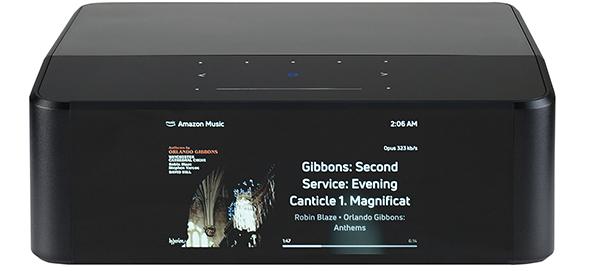

Bluesound is less of a HFN regular than sister brand NAD, but many hi-fi buffs looking to add streaming to an (older) amp or active speakers will have encountered the brand’s Node streamer. According to the company the Node is its best-selling product, outshining its wireless speakers and soundbars. Earlier this year, the Node received a fourth major update, expanding the lineup with a cheaper Node Nano and an upmarket £899 Node Icon (N530). For the brand, founded to rival Sonos, it’s the first foray into what you could call a ‘real’ hi-fi territory.
It’s likely that Bluesound created these additional Node models in response to shifts in the streamer market, with the Nano positioned to counter the intense competition from WiiM at the low-end and the Icon as an alternative to upstart new Chinese brands with products running modified Android software. But the Node Icon is certainly not a carbon copy of products like FiiO’s F15 or the Eversolo DMP-A6. The unit is more compact than most and it eschews a touchscreen or an app-based interface. Instead, the Node Icon plays its trump card: BluOS, tried-and-tested software with a plethora of streaming options, tying into a broader multiroom ecosystem.
Come closer
In terms of design the Node Icon is a step up from the functional Node. The 5in/125mm display is a first for the range, fronting a nicely finished aluminium chassis which on the side curves towards the screen. About two-thirds of the way, the top panel angles down, giving easy access to touch controls that light up when you bring a finger in range. Oddly, there are two 6.35mm headphone outputs driven by a THX AAA amplifier [see inside pic, below] – one port on each side of the unit. Why two? It seems Bluesound wasn’t aiming to please hi-fi couples nor to offer a balanced dual 6.35mm configuration. It’s purely for convenience’s sake, in case the unit is parked into a bookcase, for example.
It’s neater looking, but the software features of the Node Icon are carried over from the Node and other BluOS-compatible products. The way the platform is conceived, a lot of functionality is ingrained in the BluOS module, independently of the audio hardware. While BluOS encompasses AirPlay 2, Bluetooth (aptX Adaptive) and has Roon Ready certification, the Node Icon adds Dirac Live [HFN Jul ’24], though you’ll still need to purchase a Limited Bandwidth ($159) or Full Bandwidth ($249) license to use the advanced room calibration software. While this is optional, Dirac can be very effective in tackling room acoustics, making the Node Icon even more of an upgrade for a music system.
Dust off the zapper
It’s striking that every iteration has increased the Node’s versatility, making it a – pardon the cliché – hi-fi Swiss pocketknife. The Node Icon has even more to offer, including balanced XLR outputs, which make the most of the dual ES9039Q2M DAC set-up. Meanwhile, a pair of RCA inputs is useful for legacy analogue sources and the optical and USB digital outs can conveniently ‘stream’ to an external DAC.

QRONO d2a
Installing the Node Icon is painless – on first boot-up it displays QR codes, leading you to the relevant app to download. Relying on Wi-Fi – Ethernet requires even fewer steps – the BluOS app on my Samsung S24 Ultra smartphone quickly detected the unit, connected it to my home Wi-Fi and automatically retrieved the latest firmware. As BluOS is a multiroom platform, you can give the Node Icon a relevant name, such as ‘Living Room’ or ‘Office’.
Should you already possess a BluOS product, the Node Icon automatically copies logins to streaming services and your music library. Otherwise, you’ll discover that BluOS doesn’t automatically detect UPnP shares but requires you to enter a network path to an SMB share, including login and password.
Bluesound’s mothership, Lenbrook, acquired MQA in 2023. While it’s still unclear what the plans are with the company’s IP, the Node Icon is one of the first BluOS products incorporating what is called ‘QRONO d2a’. It can’t be switched off, nor can you select one of the standard ESS filters [see PM's Lab Report].
 Swept away
Using the Node Icon with a Hegel Röst integrated amplifier [HFN Jul ’17] shows its real-world appeal, as it brings modern streaming features like Roon and Tidal Connect to older amps that would otherwise miss out. Initially I opted to connect it to the Röst via balanced cables, with the output level fixed. Listening to Yussef Dayes’ Black Classical Music [Brownswood download; 48kHz/24-bit] via a pair of the 2024-2025 EISA Award-winning Monitor Audio Gold 300 6G [HFN Oct ’24] loudspeakers, I was struck by the airiness of the harp and the spatial placement of the effect-driven guitar on ‘The Light’. It’s a dreamy track with a strong funk vibe, showcasing the sophisticated jazz drumming of Dayes, which the Node Icon delivered with a great sense of flow. It wasn’t hard to get swept up in the intricacies of the percussion.
I also had the regular Node (with its single ESS DAC) on hand for comparison, including with this track. The Node Icon’s dual-DAC architecture proved superior, rendering the samples of the young child’s voice and his mother as distinct elements within the mix, while the rapid drumming was delivered with greater definition.
There’s something very relaxing about immersing yourself in the works of Arcangelo Corelli, evoking the wealthy courts of 17th century Italy. Berlin’s Akademie für Alte Musik – or AKAMUS – offers a captivating interpretation of The Corelli: Concerti Grossi Op.6 1-6 [Pentatone; 96kHz/24-bit], not by spotlighting a soloist but by delivering an energetic, ensemble-driven performance. The Node Icon didn’t fail in conveying the excitement of ‘Op. 6/1 V. Allegro’, with the violins sounding very smooth, even when hitting the high notes. Generally speaking, the Bluesound streamer managed to present the Corelli works with impressive clarity, enabling me to enjoy the interplay of the individual instruments.
I was enjoying listening to these collected works, but introducing the far more expensive Hegel D50 DAC [HFN May ’25] and using the Node Icon solely as a digital transport transformed the experience. Not only did this open up the tracks but there was a marked increase in resolution. That’s not to suggest the Node Icon underperforms – it doesn’t. Its real strength lies in its all-in-one versatility and capable DAC.
DAC decisions
Connecting the Node Icon over USB to the built-in DAC of the Hegel Röst amplifier meant bypassing its own dual-DAC stage, which is arguably the unit’s main feature. Using the BluOS app to switch between the streamer’s analogue and digital outputs, and playing the epic tunes on Daft Punk’s bombastic TRON: Legacy soundtrack [Walt Disney 05099907138355], the contrast in performance was striking, a sharp reminder (again) that one DAC can sound very different from another.
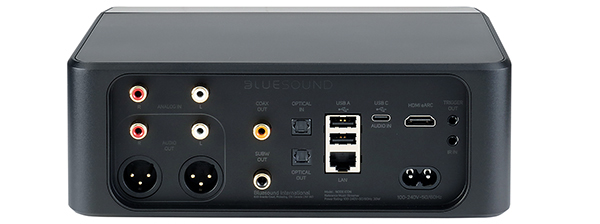
I was surprised at how well the Röst’s DAC stage held up, producing a focused, weighty presentation that suited the solemn synthesiser themes perfectly. However, switching back to the balanced output and the Node Icon DAC, the fast-moving ‘Derezzed’ was a lot less muddied, the increase in separation being palpable. So, when upgrading an integrated amp that has its own DAC stage, it’s worth comparing the two D/A converters on offer. A further plus for those planning to use Dirac is that room calibration works on both the analogue and digital outputs of the Node Icon.
As regards the headphone facility, I was glad the designers separated the headphone output’s volume control from that of the analogue outputs. I plugged in the EISA Award-winning Austrian Audio The Composer cans before realising the Node Icon was in fixed-output mode… Luckily, it defaulted to a safe level, saving drivers and ears.
The Composer is fairly analytical, so it was little surprise that ‘Water Under The Bridge’ from Thievery Corporation’s Treasures From The Temple [ESL224; 44.1kHz/24-bit] didn’t overwhelm me with its full-bodied portrayal. The THX AAA amp had ample muscle to drive the headphones, delivering taut bass and sprightly synthesisers against a dark backdrop, which quickened the pulse on the French pop inflections of ‘Voyage Libre’ or the slow-mo reggae of ‘Road Block’. A dedicated streamer/headphone amp, like the K17 from FiiO [HFN Jul ’17], would likely offer more drive, but for a unit with such a range of functions, the Node Icon’s headphone stage performed above and beyond.
Hi-Fi News Verdict
Like the cheaper Node, the slicker Node Icon streamer/DAC boasts a big bag of tricks to suit a myriad installations. It’s aided by the now very mature BluOS platform that embodies many streaming and multiroom functions. However, while the feature set is similar to other BluOS products, linking it with an improved DAC stage elevates the Node Icon to a very fine-sounding do-it-all streamer offered at a very reasonable price.
Sound Quality: 88%
 | |||||||||||

|
|
| |||||||||











 SPONSORED VIDEO






| Equipment Reviews | |
Music Reviews Awards | |
Latest News Features | |
Resources Newsletters | |
Subscriptions |
WHERE TECHNOLOGY BECOMES ENTERTAINMENT
 © 2026 Hi-Fi News
AVTech Media Ltd
All rights reserved