AVM Ovation CS 8.3 S streaming amp/player
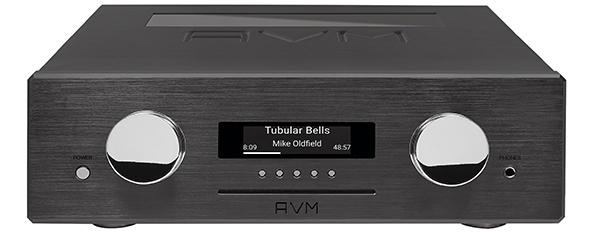

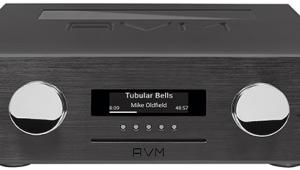
The latest in a long-running line of premium-priced all-in-one models, the £19,000 Ovation CS 8.3 S from AVM offers so many features that it almost defies categorisation. Its German manufacturer describes it as a ‘streaming CD receiver’, but even that doesn’t quite seem to cover a unit also carrying an MM/MC phono stage and headphone amplifier, while offering playback from CD and USB drives, and over Bluetooth.
Nor is the CS 8.3 S’s amplification particularly conventional, as it combines a Pascal Class D output module, rated at 2x550W/4ohm [see PM's Lab Report], with a tube-based line/preamp stage for extra ‘warmth and musicality’. Usefully, this power amp can be bypassed if you want to use the CS 8.3 S as a preamp into external power amps or active loudspeakers.
Also, while the earlier CS 8.3 and CS 8.3 Black Edition [HFN Dec ’22] units, replaced here, had single speaker terminals, the CS 8.3 S has switchable A+B outputs – the new amp’s crisp OLED display is another upgrade on the standard 8.3’s more prosaic screen. Other improvements in the amp, which is the first model to be released in AVM’s new flagship S series, are for the most part ‘under-the-bonnet’ though the standard black, natural aluminium and optional £19,900 ‘Cellini’ colourways, the latter in hand-polished chrome, are AVM staples.
Socket swagger
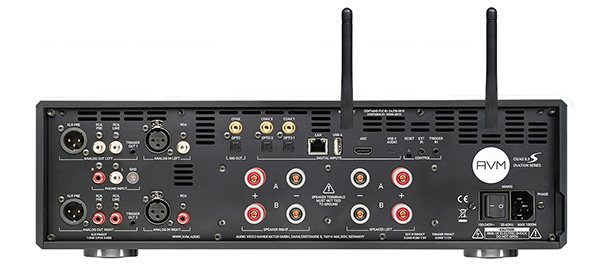
Starting with connections, the CS 8.3 S has gained HDMI ARC for TV audio, and a phono input supporting both MM and MC pick-ups with adjustable gain and impedance/capacitance loading. These, plus the second set of speaker outputs, have been added to a rear panel [see p85] already well stocked with digital and analogue connections, including USB-A and USB-C ports, and balanced XLR input/outputs. Network connection can be made via Wi-Fi or Ethernet, the former supported by a screw-in antenna, the latter using a standard RJ45 connection.
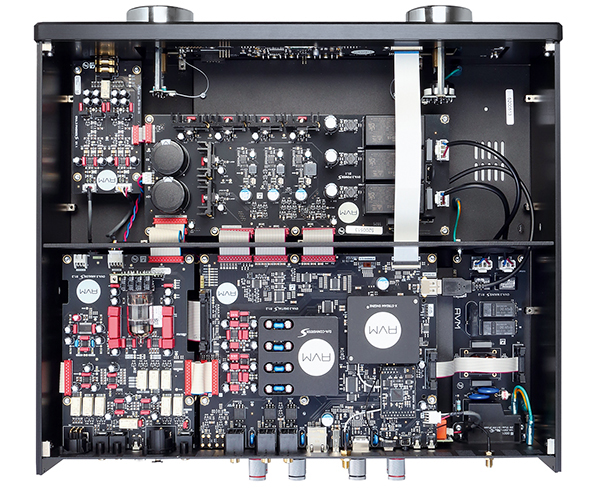
Also new is this amplifier’s ‘S-DAC’ digital/analogue conversion stage, based around the popular eight-channel ESS ES9038PRO chip – it supports PCM files to 384kHz/32-bit and DSD256 (the original CS 8.3 maxed out at DSD128). AVM’s managing director, Udo Besser, told [HFN] that its S-DAC module will also feature in a forthcoming PAS 8.3 S streaming preamplifier and AS 8.3 S integrated (sans CD playback) amplifier.
Further refinement can be found in the CS 8.3 S’s power supply architecture, where a new custom-designed PSU is said to ‘enhance’ the performance of the high efficiency Pascal Class D amplification.
Slot machine
The pre/power PSUs are now separated, reveals Besser, ‘so the sensitive preamp part is not influenced by the high current output stages’, while AVM has added an internal mains power conditioner to really lean into the amp’s all-in-one ethos.
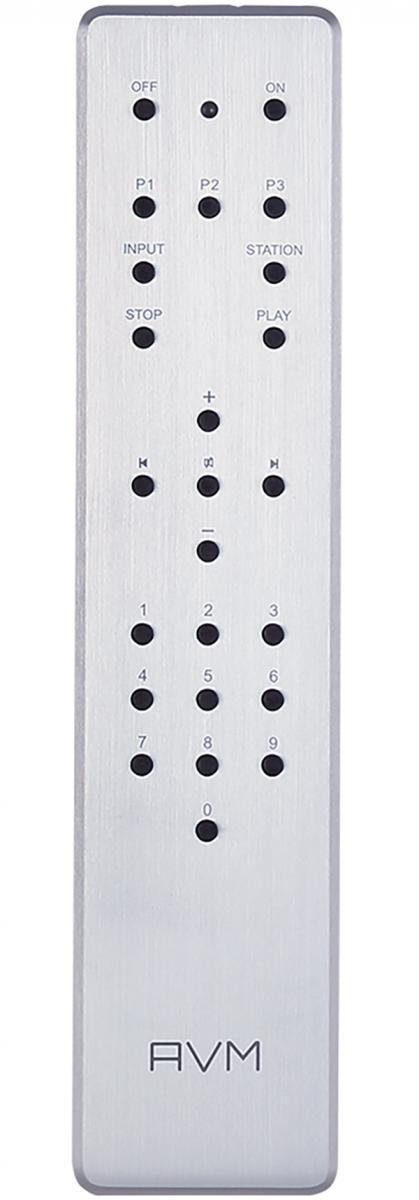
For CD (but not SACD) playback, the CS 8.3 S again boasts a ‘Pure CD’ drive, meaning one not engineered for PC use, although this is no longer sourced from TEAC. A slot-loader, it sits centrally within the amplifier’s front panel, below five small (and unlabelled) control buttons and the OLED display. To the left is a large rotary controller to select source, and to the right is another rotary for setting the unit’s all-new digitally-governed analogue volume control.
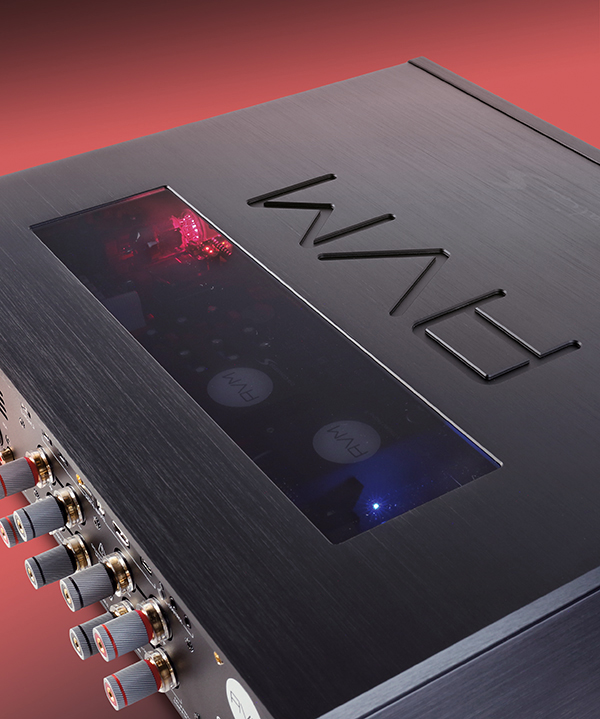
The function of those five buttons depends on what the amplifier is doing, with corresponding icons or text shown on the OLED screen. It’s impressive how much thought AVM has put into the menu structure and this on-screen interface, but many users will still opt for the brand’s bespoke control app [see boxout] – not least because this is the gateway to the full suite of networked features delivered by AVM’s ‘X-Stream Engine’. It’s also here that you can dial up any colour you want for the LED illumination around the CS 8.3 S’s triode tube, which is visible through a clear panel in the chassis top.
The S suffix on AVM’s new model stands for ‘Super’, while ‘CS’ equals ‘Compact Streamer’. Some might beg to differ as this amp is hardly bijou at 430x122x350mm (whd). But the switchmode PSU/Class D design keeps weight to 15kg, while the casework, with smart bevelled edges and no visible screws, exudes high-end charm.
 Grip trip
Right from the off, it’s clear that the Ovation CS 8.3 S is a cut above many ‘do it all’ units, thanks to the feeling of power and drive coming from its generous amplification. There’s a focused, hard-hitting side to the performance that adds weight to deep bass moments and impact to percussive transients. Used with speakers ranging from DALI’s Sonik 9 floorstanders [HFN Jun ’26] to the Wilson Audio Alexx Vfx in the [HFN] Reference Listening Room [HFN Yearbook ’25], it always kept a keen grip on the low-end. And while there’s an element of treble sweetening – likely a result of its tube stage – this doesn’t rob music of fine detail, nor divert it too far off the path of neutrality.
There’s scope for ‘sound seasoning’ here too, with AVM’s treble and bass tone controls being sufficiently granular to allow for modest adjustments either way (the Loudness tool is a blunt instrument). There are also filter and upsampling/bypass options to be investigated for digital sources. I preferred the Smooth digital filter [see PM's Lab Report] for the former and settled on having the CS 8.3 S upsample CD resolution material, as this delivered a slightly ‘fuller’ sound.
Via its balanced XLR input, AVM’s flagship all-in-one showed a uniform presentation, sounding powerful and precise with everything from The Rolling Stones’ new ‘In The Stars’ single, via Qobuz Connect [Promotone/Universal; 48kHz/24-bit], to the riff-laden ‘groove metal’ of Machine Head’s Unto The Locust CD [Roadrunner Records 1686-17702-2]. The mix on this 2011 album is tight and punchy, with prominent drums, and the CS 8.3 S delivered it with tangible speaker-driving power.
Finger food
This, it must be said, is the least one should demand from an amplifier pushing past 200W a side. This new AVM model further earned its keep when it came to its handling of the album’s acoustic guitar moments. The finger-picked introduction to ‘This Is The End’ was delicate and rich in small details, sounding crisp but not overly bright. There was also a good sense of the instrument within the wider acoustic, not to mention superb layering when the electric guitar harmonies arrived.
Diana Krall’s rendition of Bert Kaempfert and Milt Gabler’s jazz standard ‘L-O-V-E’ [Turn Up The Quiet, Verve; 192kHz/24-bit] offered more explicit detail and a greater variety of textures. Here were upright bass notes with a strong leading edge but plenty of body and tone, alongside gentle brushed drums and Krall’s sultry contralto vocals. The piano and guitar solos were well contrasted, the former more angular and rhythmic, the latter resonant and flowing.
Perfect storm
Playing Max Richter’s contemplative ‘On The Nature Of Daylight’ [The Blue Notebooks; Deutsche Grammophon 483 5014], the CS 8.3 S seemed to be under no strain at all as it built up the multiple string strands and eased into the piece’s languid flow. The highest of the violin notes avoided stridency, soaring above deep, long cello sounds. Much more thunderous was the 2012 Saito Kinen Orchestra/Daniel Harding recording of Strauss’s Alpine Symphony [Decca; 96kHz/24-bit], where the amp’s robust presentation made for a free-flowing, brilliantly dynamic rendition of ‘Gewitter und Sturm, Abstieg’. The rolling timpani and blasts of brass enjoyed both scale and clarity.
Lean machine
What the CS 8.3 S studiously avoids is over-emphasising the low-end or coating the midrange in warmth and bloom. As such, the instrumentation on Alice In Chains’ ‘Got Me Wrong’, from the band’s Sap EP [Columbia 44K74182], had a slightly dark and lean tint, as did Lynyrd Skynyrd’s ‘Freebird’ from the band’s 2CD Greatest Hits compilation [Universal 9830565]. Yet this aspect of the AVM amp’s sound is part and parcel of a clean, transparent disposition that remains unfatiguing as the volume level is pushed higher.
What we have here then is an amplifier that combines the features of four or more separates in a single, neatly designed package. There’s so much going on in the CS 8.3 S that one thinks it’s surely about to drop the ball. But as I listened to Allen Collins’ epic double-layer guitar solo closing out the Skynyrd track, all I could think was how involving, convincing and – yes – powerful it sounded. Who said convenience and quality couldn’t mix?
Hi-Fi News Verdict
AVM should be applauded for its commitment to the all-in-one amplifier cause. The Ovation CS 8.3 S is possibly the most comprehensively specified unit we’ve yet encountered, and it impresses not just for its long list of sources, inputs and settings. Its Class D power plant will grip any likely partnering speaker, while its clean, detailed and dynamic sound casts a fully panoramic view over your music collection.Sound Quality: 87%
 | |||||||||||

|
|
| |||||||||









 SPONSORED VIDEO






| Equipment Reviews | |
Music Reviews Awards | |
Latest News Features | |
Resources Newsletters | |
Subscriptions |
WHERE TECHNOLOGY BECOMES ENTERTAINMENT
 © 2026 Hi-Fi News
AVTech Media Ltd
All rights reserved