MoFi UltraPhono Pro phono preamplifier
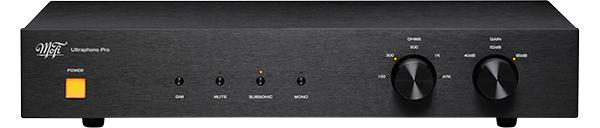

With a gap of over £5000 between MoFi's UltraPhono [HFN Mar '20] and flagship MasterPhono [HFN Dec '23], it was only a matter of time before the US brand inserted a third model between these two phono preamps. On the surface, the new UltraPhono Pro (£2499) looks to be a stripped-down version of the MasterPhono [see boxout], effectively halving the price for a full-size, function-rich MoFi unit.
MoFi kicked off its phono stage adventures with two tiny but fully loaded models with design input from the late Tim de Paravicini, both hardly bigger than a VHS tape (remember those?). Differences between the StudioPhono [HFN Mar '20] and the UltraPhono, which cost an additional £200, included the latter's headphone socket and output level control, allowing it to drive a power amp directly. Otherwise, both featured subsonic filters and mono buttons, measured 100x30x170mm (whd) and were powered by outboard AC adapters.
There were other design variations that might have informed MoFi's decision to create the UltraPhono Pro. For example, both the StudioPhono and UltraPhono included 12 DIP switches on their underside, the former to select four impedance settings and three gain levels, the latter using the switches to supply four gain options – with an extra 6dB at the highest position – and a useful nine impedance settings.
(Note: It seems that while the StudioPhono is still available, the original UltraPhono has disappeared from the catalogue. If so, then it has entered the category of 'Grab one while you can, before other audiophile bargain hunters realise what a steal it is'.)
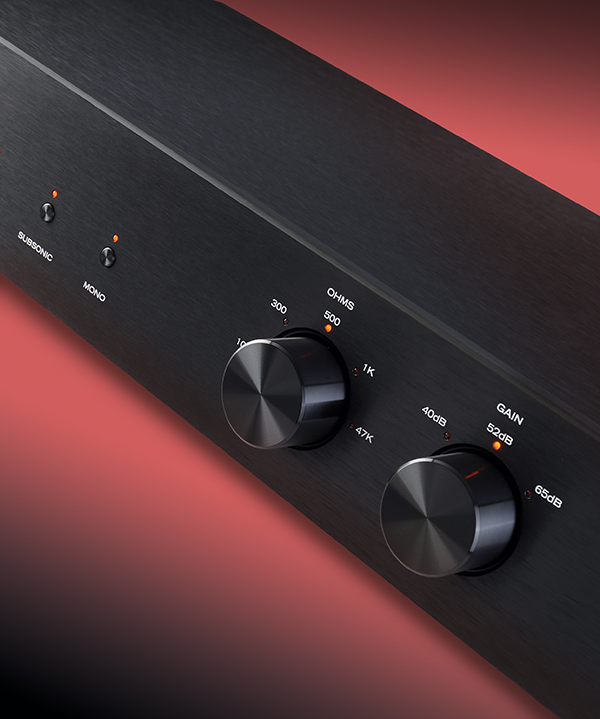
Above: The most obvious external change is the removal of the VU meters, but you still get orange LEDs
Enter the UltraPhono Pro. Ordinarily, an uprated model sporting a 'Mk II' or 'Improved' suffix would inhabit the same form or chassis. This is not the case with the UltraPhono Pro, which has little in common with the UltraPhono beyond the name. Because the original's chassis is no bigger than a paperback novel, there isn't much room for the levels of improvement or extras that might justify a £2499 price tag.
Instead, while the UltraPhono Pro employs a box similar in size to the MasterPhono, it is visually distinct with its thinner black bonnet and absence of wood trim. The most obvious external change is, however, the removal of the VU meters, although you still get orange lighting.
Value added
As regards the name, MoFi has arguably done itself a disservice. Whoever is in charge of product titles at the US company should have named this the MasterPhono Lite or Two or even MistressPhono, because it's closer to the dearer MasterPhono in performance and sound quality than the less expensive UltraPhono.
This, of course, is good news if you've been lusting after the globally raved-about MasterPhono but cannot afford to buy one. What you're sacrificing beyond the VU meters are the current input, the remote control handset, the ability to support more than one turntable and a few more impedance and gain settings.
Meanwhile the sonic gains over the still-incredible UltraPhono are such that the reduction to three gain and five impedance values here won't matter, as they are surely enough to satisfy the majority of cartridge requirements. You also acquire a balanced XLR output, which regular readers will know I prefer and not just for the potential 6dB gain. Balanced is better – end of.
 Easy listening
As I suspected, MoFi's UltraPhono Pro was installed in ten minutes. If sacrificing the MasterPhono's plethora of options or even the added settings of the UltraPhono means an easier life because of limited choice, some decisions are made simpler. I had two completely different MCs working ideally into 100ohm with the maximum +65dB gain setting while two MMs were perfectly at home with 47kohm loading and +40dB gain. What surprised me was the subsonic filter, which is not something I normally bother with, as opposed to the mono facility which is always useful with mono LPs. I have a number of small, ported two-way speakers and with certain types the filter actually improved the sound and tightened the bass with no adverse effects. For whatever reasons, a set of LS3/5As showed little audible change.
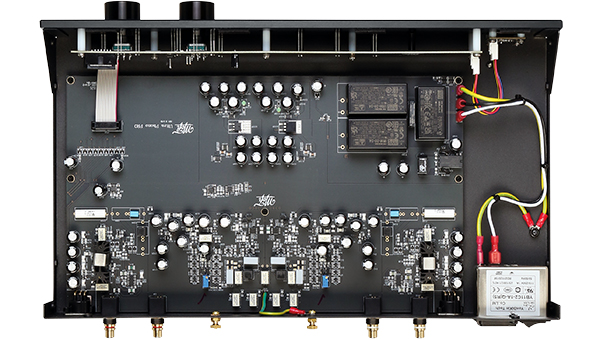
Above: Switching/regulator-based PSU [top right] feeds input stage, with switchable gain and loading [bottom centre], and balanced output buffer [bottom L/R] following the passive RIAA network
Because I lived with the MasterPhono and use an UltraPhono as my budget reference phono stage, I have learned to appreciate one particular quality possessed by the two MoFi models. If I wanted to slip down the rabbit hole, I would spend hours trying to assess the sonic preferences of de Paravicini versus the MasterPhono/UltraPhono Pro designer's biases. Whatever MoFi engineer Peter Madnick might consider his sonic signature, the UltraPhono Pro retains the delicacy I cherish in the original UltraPhono. This is one sweet-sounding, refined phono stage.
Small club, big impression
Songbook, from Allen Toussaint [Craft 0888072741669], is a double LP of recordings in a small club, just voice and piano. I had to keep tapping the keys on my wife's upright piano to make certain I wasn't imagining the exquisite timbre, the correct resonances, the sounds of the hammers – and that was over the LS3/5As.
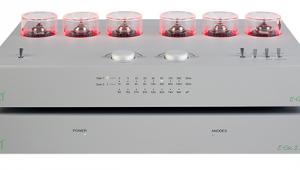
Moving to the huge Franco Serblin Accordo Unica [HFN Jul '26], which categorically did not need the subsonic filter, added even greater authenticity as the lower registers acquired more mass. As for Toussaint's vocals, the closing track – 'Southern Nights' – involved a fabulous monologue so I could compare speaking voice to singing. His voice exhibits a clarity that the UltraPhono Pro reproduced with a complete absence of grain. There was also (to my delight) a touch of warmth more in keeping with the EAR Phonobox [HFN Dec '19] and EAT E-Glo 2 [HFN Jan '25] – both all-valve phono preamps. And the sound was ultra-quiet to boot, as in 'ghostly'.
Songbook was proving to be a true audiophile recording, rich with the subtleties that speak of a system's refinement. As staggeringly graceful as it sounded through the UltraPhono, the 'Pro opened the soundstage a bit, adding even greater veracity to the notion of a pianist in my listening room.
It sounded demonstrably larger, too, and if that sounds like I just described the £6k MasterPhono, that's because the two are so close that the only difference I could describe is a feeling of more weight when Toussaint tickled the keys to the left. How much of that would be attributable to the MasterPhono's superior power supply or to its finer adjustments I cannot say, but I wasn't missing the current input as much as I thought I might.
Good times bad times
Still with a live album, I needed something positively nasty (in a good way, that is) to counter this incredible display of pure finesse. George Thorogood & The Destroyers' The Baddest Show On Earth [Craft 0888072757257] is a fresh way to do a 'best of' album: it contains live performances of the band's most popular numbers, culled from gigs between 1978-2024. Here the UltraPhono Pro exceeded the slam and transient attack of the smaller UltraPhono model, while coming so close to the MasterPhono that it creates a dilemma.
Typically, audiophiles think first of price, then sound quality, then price, followed by looks, then price, then features, then price. The rawness of Thorogood's voice, the snarl of his guitar on 'Bad To The Bone', and the mix of venues such that you could hear the differences in the halls, theatres and ballrooms, were recreated with such authority that I could only imagine the MasterPhono bettering the UltraPhono Pro if using its current input with a very low (coil) impedance MC.
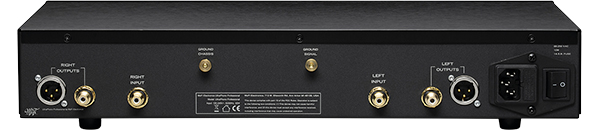
Above: MoFi's UltraPhono Pro hosts separate chassis and signal ground posts, one set of single-ended (RCA) inputs and both RCA and balanced XLR outputs
This then posits that the main reason beyond sound for considering the extra fee for the MasterPhono, as the two are so close, is the worth of that which has been sacrificed. Meters and deluxe two-compartment chassis aside, MoFi has done such a good job with the UltraPhono Pro that the main gains in buying the MasterPhono are the current input and extra settings to facilitate a more solid, more confident sound with certain cartridges. Make no mistake: as close as the UltraPhono Pro is to the MasterPhono, the latter has a few tricks up its (wooden) sleeve that its less-expensive sibling cannot claim.
But that's a moot point. The UltraPhono Pro really is less of an UltraPhono on steroids and more a MasterPhono on Ozempic. It has such command that the Thorogood LP exhibited impressive forcefulness even through small speakers, thanks to the controlling influence of the subsonic filter (speaker-dependent, that is) and the generous +65dB gain with MCs. Which reminds me: this phono preamp loved Ortofon's high-output 2M series cartridges, if MMs are your preference.
World champion
Turning to something equally chaotic but fecund with sound effects, hip-hop-level bass, wicked dynamics and female vocals amidst the sampling, horns and other effects, Deee-Lite's World Clique album [Mobile Fidelity MFSL 2-609] has so much going on that I was wondering if the UltraPhono Pro could process the myriad elements pouring through it. Yet the way it balanced the textures, tempos and transients reminded me again of its costlier stablemate. Yes, MoFi, you messed up: the UltraPhono Pro preamp is a MasterPhono minus any excess. And for that I thank you.
Hi-Fi News Verdict
As expected, MoFi has filled the massive gap between the original UltraPhono and widely acclaimed MasterPhono with consummate flair, despite the necessary cost-cutting. At the price, I cannot think of a single phono stage that betters the UltraPhono Pro for sound quality, only for facilities. So, if you aren't predisposed toward freaky cartridges critically in need of odd loading, this model sets the benchmark.
Sound Quality: 89%
 | |||||||||||

|
|
| |||||||||











 SPONSORED VIDEO







| Equipment Reviews | |
Music Reviews Awards | |
Latest News Features | |
Resources Newsletters | |
Subscriptions |
WHERE TECHNOLOGY BECOMES ENTERTAINMENT
 © 2026 Hi-Fi News
AVTech Media Ltd
All rights reserved