CH Precision L10/M10 pre/power amplifiers
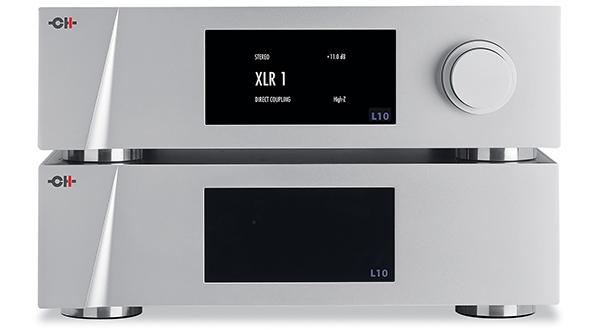

We’re all familiar with the idea of ‘trickledown’, where the R&D of a flagship product then informs the development of a brand’s more affordable models. But what we have here, in CH Precision’s L10 preamplifier and M10 power amp, is a case of ‘trickle-up’. The Swiss marque has taken the designs of its 1 Series amplifiers [HFN Sep ’25], with which it carved its high-end reputation, and comprehensively upgraded them to birth a new top-flight package.
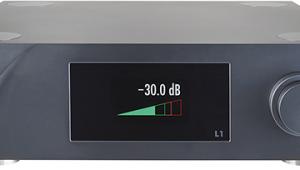
CH Precision hasn’t yet announced any models below the 1 Series, so that range remains its ‘entry-level’ option. Those inverted commas are necessary because the L1 preamplifier sells for £30,100 and the M1.1 power amp for £49,500. Pricing of the flagship hardware is, naturally, even more eye-opening. The L10 and M10 are a combined £165,600, or £173,600 for the Satin Gold or Anthracite finish rather than the standard silver of our review pair.
Only way is up
Nor is this the end of the story. The stereo power amplifier, rated at 2x300W/8ohm and ticketed at a standalone price of £95,600, is offered in monoblock form, for £181,200 a pair. It can also be configured to run in bi-amp mode or with a bridged output. This all feeds into what the manufacturer calls the 10 Series’ ‘scalable system topology’, where potential set-ups reach a ‘true monaural’ package, for use with two speakers and two passive subs, utilising no fewer than two L10 preamps and four M10 power amps.
Additionally, since late 2025, the 10 Series amps have been joined by 10 Series source components in the form of the D10 CD/SACD transport and C10 DAC (both £79,000), with T10 external 10MHz clock (£22,900), plus the P10 phono preamp (£70,000). There’s further upgrade potential here, too, as the C10 can be augmented with an external ‘Conductor’ unit so its D/A conversion and digital processing stages become separate.
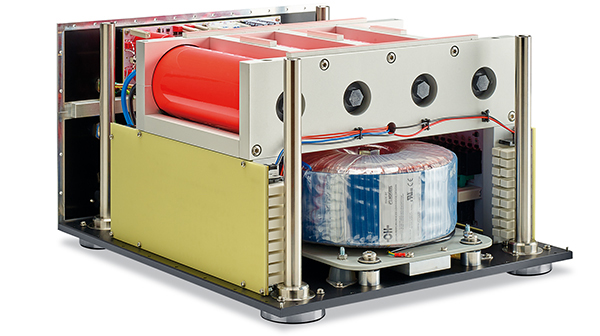
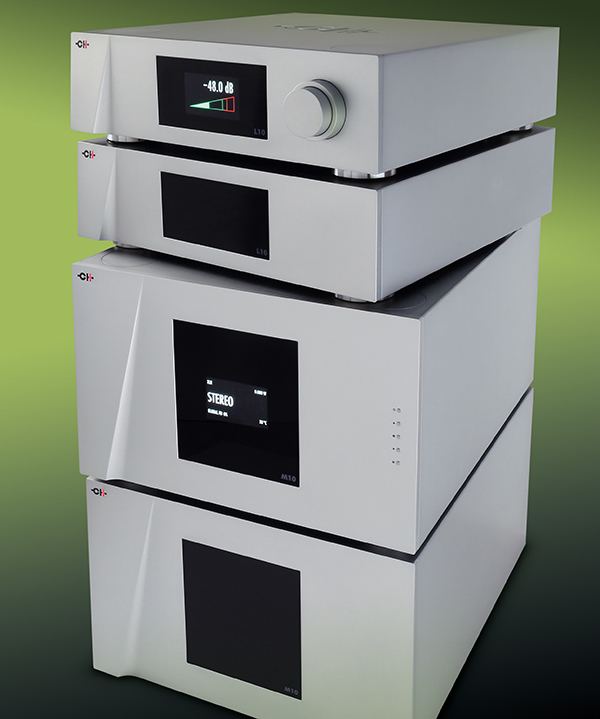
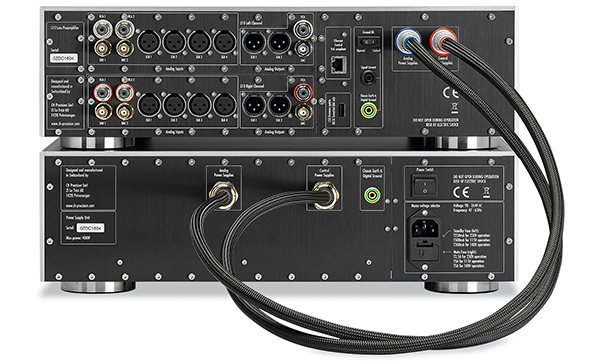
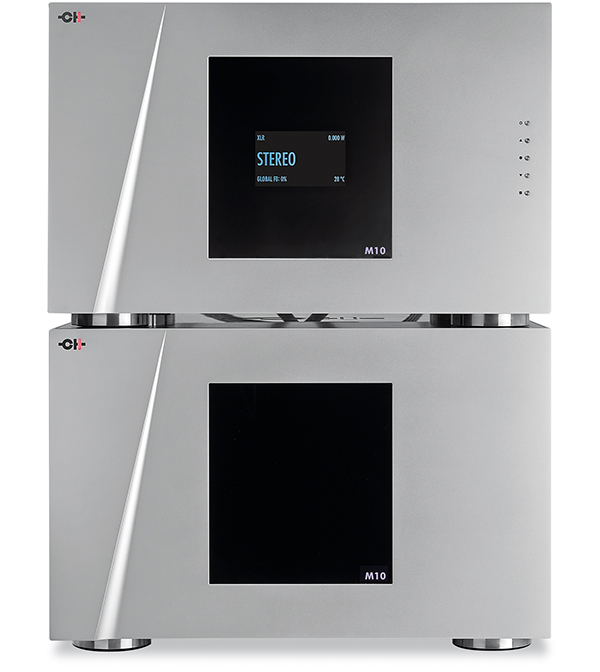
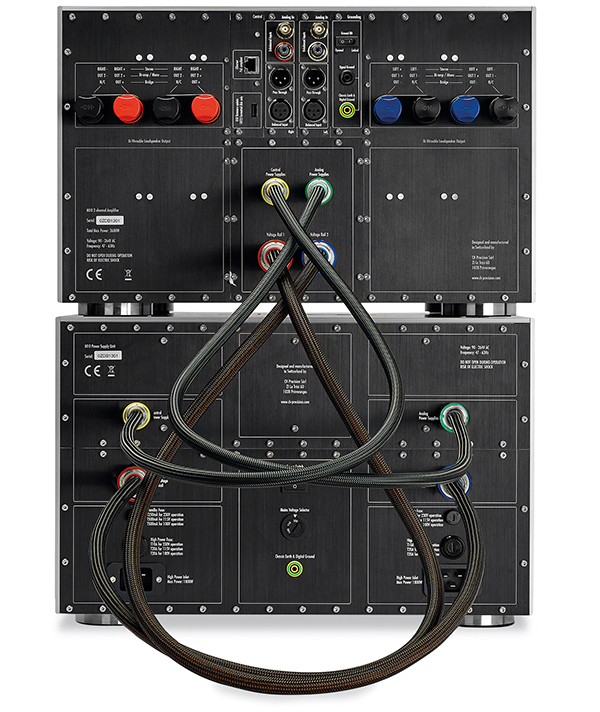
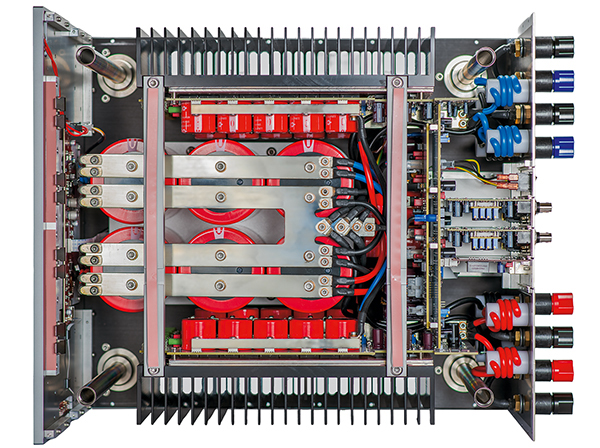
All the 10 Series components, excluding the T10 clock, are two-box designs with external PSUs in matching chassis. This results in the M10 amplifier weighing in at a total of 131kg. Its two chassis are designed to be stacked, making use of the same through-bolt installation previously seen on the L1/M1.1 system. The two boxes of the L10 can also be secured this way, and – if you wanted – you could stack all four parts of the L10/M10 combination. Note that this will result in a ‘unit’ standing almost a metre high.
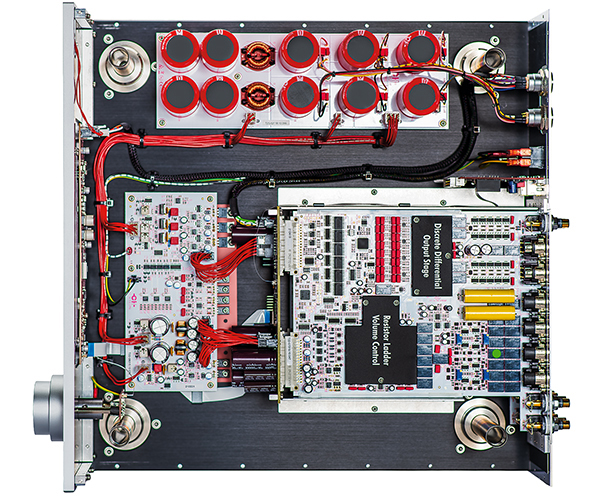
The addition of outboard PSUs is a key part of CH Precision’s upgrade of its 1 Series models, alongside a wide-ranging under-the-hood overhaul. Of the L10 and M10, the manufacturer says ‘every circuit has been reconsidered [and] every circuit board has been re-laid’, while each component has been assessed and replaced if a performance gain could be achieved. At the same time, the amplifiers’ supremely linear topologies, as described in our L1/M1.1 review, are essentially unchanged from the originals.
Feedback flexibility
The L10 preamplifier, therefore, is once again an all-analogue, line-level design, with balanced XLR (x4) and single-ended RCA (x2) and BNC (x2) connections. Its software-driven R-2R ladder volume control operates in current mode, after a bipolar input buffer, followed by an I-to-V stage.
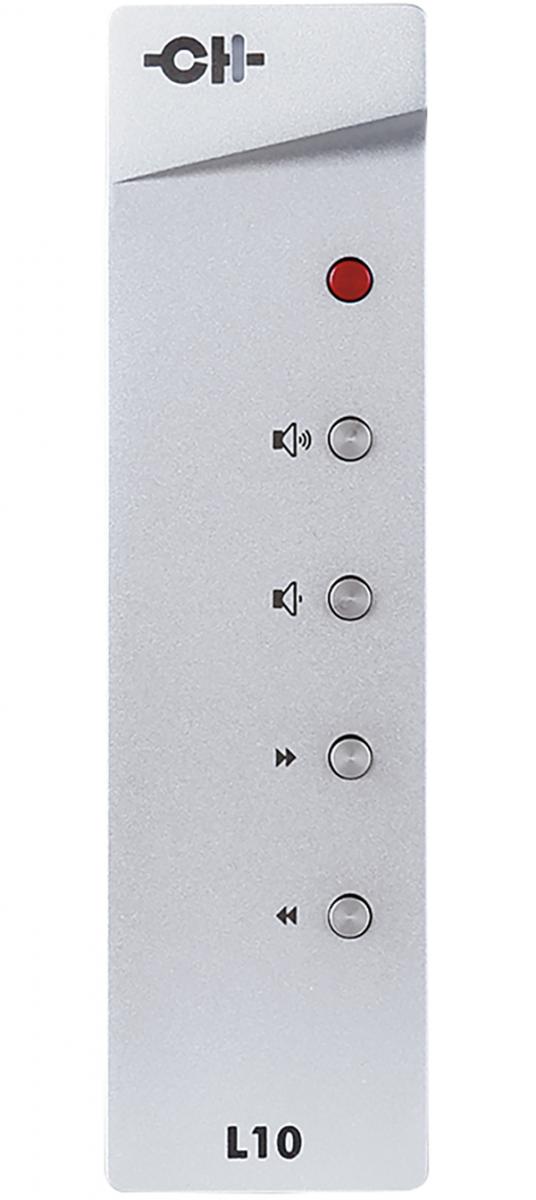
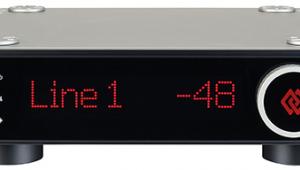
That same front panel rotary can also be used to adjust menu settings shown on the unit’s AMOLED display. Options include DC offset calibration of the L10’s individual inputs by measuring the connected source/cable; adjustable input gain settings; DC or AC coupling; and maximum volume, etc.
Because both the preamp and power amp have Ethernet connections, their features (excluding the L10’s DC offset calibration) and volume are also managed through CH Precision’s excellent ‘Control App’. Originally only available for Android devices, this software should soon be available to owners of Apple products, too. Internet Protocol (IP) control, for custom installers, is also supported.
A new feature of the L10, in addition to the external power supply that claims increased regulation and ‘massively increased capacity’, is user selection of either global or local feedback within its Class A circuitry. This tuning tool brings it into line with the Class AB M10 power amplifier, which itself offers a user-definable level of global feedback, from 0-100%. In a change over the M1.1, this can be set in 1% rather than 10% steps.
Double punch
Such granular control is impressive, especially as the M10’s level of feedback (compensation) may be adjusted ‘on-the-fly’ using the app. And while it’s true that most listeners will find a preferred setting and stick to it, CH Precision’s global feedback control will be useful should there be a change in the partnering loudspeakers or listening room. Additionally, in bi-amped set-ups you have the option of establishing different settings for a speaker’s low- and high-pass arms. Or maybe you just love to tweak…
The manufacturer’s in-a-nutshell description of the M10 is ‘twice the size of the M1.1, 50% more power’. Helping achieve this [see PM's Lab Report]is the new multi-stage PSU, which brings a doubling in capacity through its dual 1.8kVA transformers and four large, proprietary electrolytics. Further PSU conditioning is facilitated by local reservoir caps and regulation in the M10’s main chassis. Finally, the dual-mono design of the amplifier is carried all the way to twin mains sockets on the (soft-start) PSU so as to ensure complete separation.
Switch on, and there’s a pause as the L10/M10s show an animated battery graphic with the words ‘charging power supply’ (a similar ‘discharge’ graphic appears when the units are powered down). The display text colour can be changed, and on the M10 you can choose between a main status screen, operating temperature or dynamic power meters.
The screens on the M10 and L10’s power supply boxes, however, are made from Plexiglass and aren’t displays. Their inclusion is solely for aesthetic reasons – CH Precision’s global sales director Kevin Wolff reveals the manufacturer made units without them, but they ‘just didn’t look right’. A red status LED on both PSUs can be turned off if desired. This is even possible through the app, as the PSU umbilicals running to the networked-connected amps also carry a data link in return.
 Premier league
The two-box M10 was installed in the HFN Listening Room [see HFN Yearbook ’25 and p41] between Wilson Audio’s Alexx Vfx speakers while the L10 preamplifier was housed on the Artesania rack at the rear – all cabling was by Transparent. Completing this well-to-do system was dCS’s Varèse, now with CD/SACD Transport [HFN Feb ’26] as well as its networked DAC. The L10’s remote remained mostly unused, as I preferred to make volume changes using CH Precision’s app, this also being regularly used to adjust feedback settings. Prior to listening, the preamp’s XLR 1 input was calibrated for any DC offset.
PM’s Lab Reports [see L10 Lab Report] and [M10 Lab Report] reveal the technical differences between these 10 Series models and the L1/M1.1 pre/power, while our listening demonstrated that while the systems share common traits, the L10/M10 is leagues ahead in many key areas. This flagship pairing offers a more refined sound, with imaging that’s even more holographic and precise than the already superb-sounding L1/M1.1. There’s clearly extravagant power available, as evidenced by the way the amps charged into massive orchestral recordings and a ‘guilty pleasures’ session with Black Sabbath, but it comes without any side-order of glare, grit or ragged exuberance. The purity and transparency of their sound is as much a calling card as anything else.
Finger licks
‘Under Redwoods’, from Dave Holland’s Emerald Tears [ECM; 96kHz/24-bit], finds the British jazz musician doing wondrous things with his double bass, fingers dancing around the neck to blend low notes with twangy higher-octave bends. It’s a simple, intimate recording that didn’t push the CH Precision amplifiers to dig deep, but still showed their revealing nature. The sound was completely natural, free of any sense of constraint. Each note was full of subtle character.
Holland’s set was useful in establishing a preferred setting for the M10’s global feedback control. At the full 100%, the sound was crisp and exquisitely etched, but perhaps a little dry in character, particularly in the bass. Lowering the amount of global feedback softened the low-end, delivering what could be called a more ‘organic’ overall performance through the big Wilson Audio speakers.
Hair raising
This really is a powerful tool, especially when added to the choice of local/global feedback on the L10 preamp. Listening to ‘The Wind That Carries Dreams’, from Andrejs Osokins’ new Where Light Begins album [Prima Classic; 96kHz/24-bit], I was surprised by how much scope there was to ‘tune’ the sound of his piano against the gentle string background, the instrument becoming more fluid and resonant as I nudged the feedback down, at the expense of some HF incision.
The production on Osokins’ tracks is mostly centre focused, and a little hazy around the edges. Far wider, and more defined, is Joe Hisaishi’s orchestral soundtrack for the Studio Ghibli animation Princess Mononoke [Symphonic Suite… Live; Universal Music 96kHz/24-bit]. These live recordings showed off the amp system’s full hair-raising potential. The New Japan Orchestra was rendered as a large, vibrant force, with finely layered strings, weighty brass and crashing percussion.
On ‘II. Ta Ta Ri Gami’, the orchestra gets into a terrifying groove, the music coming from the speakers like a stampede, and the temptation is there to whack up the volume and really drown oneself in the music. I did just that, and the L10/M10 retained its mix of power and complete control even at levels that could be described as ‘thunderous’.
Pop perfection
One issue – if you can call it that – with this amp pairing is the sheer scale and drama of the performance attainable with some tracks can make others sound rather ordinary. I enjoyed the clarity and position of the synth effects, and the breathy vocals of ‘Sexy Boy’, the chart-topping hit from Air’s Moon Safari [Parlophone; 192kHz/24-bit], but this Swiss pre/power combination was ruthless in its depiction of the track’s narrow stereo image and rather humdrum production quality.
By comparison, the first and second parts of Pink Floyd’s ‘Another Brick In The Wall’ [The Wall; Pink Floyd Records; 96kHz/24-bit] displayed everything the L10/M10 can do – a massive, deep soundstage with pin-point imaging, and a thrilling mix of glittering detail, not to mention an easy-on-the-ear tone.
Well-recorded and well-mixed pop also sounds magnificent. Billie Eilish’s ‘Lunch’ [Hit Me Hard And Soft; Interscope 44.1kHz/24-bit], sounded huge thanks to its insistent drum track and bassline. The latter, staying well clear of being overbearing or bloated, did indeed ‘hit me hard’ as the M10 slammed it out with glee. Cut from a similar cloth is Koan Sound’s ‘Infinite Funk’ [Dynasty EP; Owsla download], which lulls with funky synths and slap bass, before exploding with angular beats and snappy low frequency effects.
Pinned tight
My enjoyment of the track ‘You & Me’ by Muete [Tumult; 44.1kHz/24-bit download] was more about instrumental detail – the reedy, textured nature of the saxophone, and the way it emerged out of thin air, dead centre between the loudspeakers. Then came slabs of brass and bass, ringing bells, and all manner of percussive elements set far into the background. The L10/M10 combo builds musical pictures unlike any system I’ve heard.
In fact, this track sounded so good that I’d recommend any CH Precision dealer add it to their playlist. The problem is, so did many others. ‘Sour Grain’, from Humble Pie’s Rock On [A&M; CD res], offered powerful drums with exemplary decay, and electric guitars stretching to the edges of the room. And with John Williams’ ‘Raiders March’, from Spielberg’s Raiders Of The Lost Ark [Walt Disney Records], the amplifiers got right into the high-frequencies, stopping the mass of strings from becoming a smoothed-over lump.
I have listened to this piece countless times yet through the L10/M10 it was as if I was hearing it fresh, pinned to the seat and admiring the transient attack on the brass, the crystal-clear percussion detail, and the tremendous weight of the bass and timpani. These amps sound as remarkable as their size and price will have you imagine.
Hi-Fi News Verdict
CH Precision enters the world of ‘cost-no-object’ hi-fi with a flagship pre/power system that’s astonishing in both its ambition and execution. This four-box amplifier maintains the forward-thinking technologies of the brand’s 1 Series, but pushes the performance envelope even further. Powerful yet poised, and able to extract every drop of emotive detail from your music, the ’10s are simply stunning.Sound Quality: 92%
 | |||||||||||

|
|
| |||||||||











 SPONSORED VIDEO






| Equipment Reviews | |
Music Reviews Awards | |
Latest News Features | |
Resources Newsletters | |
Subscriptions |
WHERE TECHNOLOGY BECOMES ENTERTAINMENT
 © 2026 Hi-Fi News
AVTech Media Ltd
All rights reserved