Philips AH 606 stereo receiver
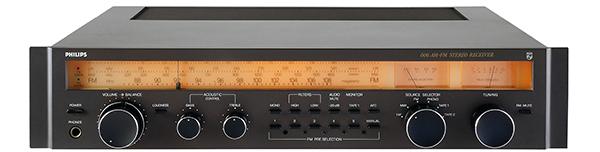

In its hi-fi heyday, Philips was one of those audio brands that seemed to delight in being unconventional. Be it in styling or engineering, its products were usually distinctive, which delighted some but confused just as many. Neither is it necessarily an advantage when the equipment has to be combined with units from other brands to form a system. Philips receivers in the early 1970s, often made in the firm’s factories in Finland, were difficult to build a system around if you wanted to use anything other than Philips source components and loudspeakers.
Change in direction
As the decade wore on the problem was addressed by sourcing units from Japan, badged as Philips but having little or no European content. This approach also lacked appeal so another idea was tried – European equipment built for the international market but with a look and feel that met Far East competition head on.
The AH 606 seen here was the top model in a five-part series introduced in 1980. Each step in the range was met with increasing facilities and output power, along with the choice of silver or black (actually a dark brown) fascia. And even though it was made in Belgium from mostly Philips’ own components, the AH 606’s user interface and connections were largely conventional – this was a real change in direction from the sometimes outlandish designs of the past, such as the decidedly odd-looking RH 762 receiver of 1976.
Interest in hi-fi hardware within the Philips organisation during this period seemed to be cyclical, with surges of creativity and enthusiasm sandwiched between long spells of apparent indifference. The AH 606 was clearly designed during one of those peaks and includes many points of technical interest.
Packing a punch
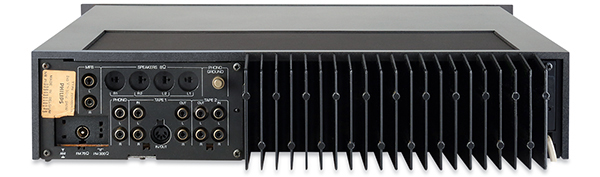
To begin with, it is uncommonly powerful for a Philips amplifier [see PM's Lab Report]. The company had anticipated that buyers expecting high output levels would choose its active Motional Feedback (MFB) loudspeakers and so limited most of its conventional amplifiers and receivers to about 30W/8ohm. The AH 606 doubled this figure and could have been built for higher power still, as its Motorola output transistors were rated for amplifiers of up to 100W. One pair per channel of these transistors were mounted on an oversized die-cast heatsink, custom-made for the AH 606. The amplifier was DC-coupled to the loudspeakers and powered from a high-quality C-core mains transformer, an expensive component in itself.
Extensive use was made of modular construction, with sections such as the power amplifier’s driver circuit being mounted on a separate – and easily replaceable – PCB. Other blocks of circuitry were constructed on ceramic substrates using the thick-film method, as also seen in the DSP/DPA-200S amplifiers from DPA [HFN Mar ’24], for optimum stability and performance.
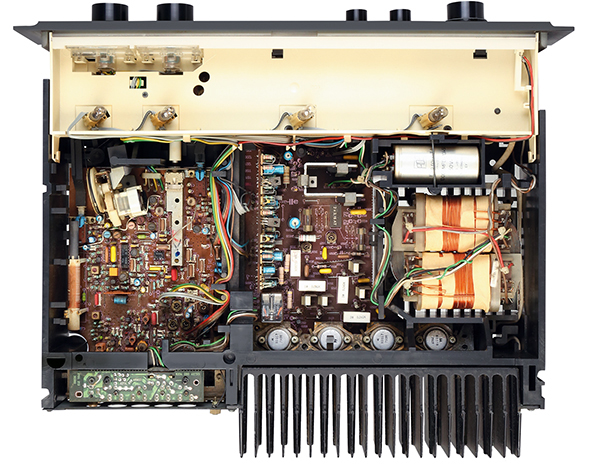
These thick-film hybrid circuits were used in the AH 606’s FM stereo decoder, a small unit containing the logic for the AFC lock and muting functions, and the complete MM phono stage. The latter combined gain and RIAA EQ in a tiny unit mounted directly behind the rear panel connectors with signal paths kept short to minimise pickup of stray hum and noise. The cabinet was also intriguing, being mostly made from thick resin castings. When Trio/Kenwood did this at around the same time with its KA-900 amplifier it made a big thing of the ‘non-magnetic chassis’. Philips didn’t even mention it!
Restrain yourself
Philips put real effort into ensuring the AH 606 looked and felt ‘normal’ in operation. Compared to previous models such as the aforementioned RH 762 receiver and the RH 551 preamplifier [HFN Aug ’21], the styling is restrained almost to the point of blandness, the colour and finish of the fascia not dissimilar to NAD amplifiers of the period. The only obvious flourish is a stylised pair of rack mount ears, cast into the heavy resin fascia. They are, of course, purely decorative since they lack any screw holes.The amplifier’s controls are largely conventional and operate as one would expect them to, the only obvious oddity being that the bass and treble knobs are labelled ‘Acoustic Control’ rather than simply ‘Tone’. Look closer and you’ll see that the AH 606’s Tape 1 input can be selected either as a normal source or as a tape loop and this applies to both the RCA connectors and the duplicate five-pin DIN socket, even though off-tape monitoring shouldn’t be possible if the DIN standards are followed to the letter. Loudness compensation is included but fortunately it can be switched out. There are also low-pass (scratch) and high-pass (rumble) filters, a mono switch and a –20dB attenuator, making Philips’ AH 606 as well equipped as any of its Japanese rivals. It’s a shame that another feature of some Japanese middleweights has been carried over, though – click stops on the volume control rotary to make it feel like a proper switched attenuator (which it isn’t).
The AH 606’s tuner section offers full coverage of the FM band as well as MW and LW. There are five preset stations on FM, which are tuned by a small crosshead screw underneath each relevant button – the scale for these is a meter at the end of the tuning dial. Another meter shows signal strength while two miniscule indicators show stereo reception and AFC lock.
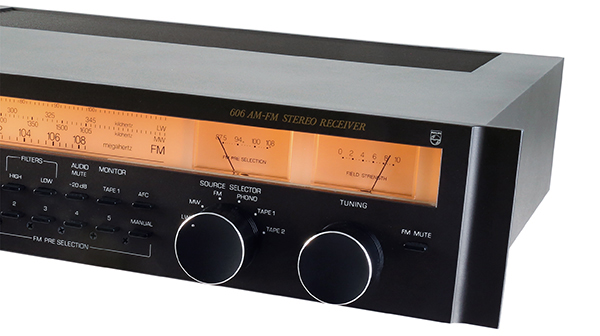
Inter-station muting is also provided, making the AH 606’s tuner both complete and comprehensive. An honourable mention must also be made of the orange-hued illumination, which is perhaps the best I’ve come across and well worth the elaborate internal arrangements required to achieve it.
Connector conundrum
Connections are a mixture of European and Japanese standards, with DIN types used for the loudspeakers, the aerials and Tape 1 loop. RCA connectors are used for all the sources, and the supporting circuitry has clearly been optimised for these.
There are two pairs of speaker sockets but no manual switching. Instead, inserting the plugs into Speakers 2 breaks the circuit and puts them in series with Speakers 1. As a result, if you plug your speakers into ‘2’ by mistake the result is silence, a situation made more likely by the confusing layout of the sockets themselves.
Again, following Japanese practice, a comprehensive electronic protection system with a muting relay has been fitted so delicate or expensive loudspeakers can be used with confidence. Outputs are also provided for Philips MFB loudspeakers, these too are RCA types to suit the then current third-generation models such as the AH585 [HFN May ’24]. Note that this isn’t a true preamp output, it is simply the output of the main amp potted down by a simple resistor network. Other supporting equipment to make an all-Philips system of matched components included the N5430 cassette player and AF877 ‘Direct Control’ turntable [HFN Jun ’19].
 Tim listens
Despite the launch of CD – by Philips and Sony – being imminent, there were no special provisions in this model made for the new ‘2V line source’. However, the receiver’s Tape 1 input, when used in Monitor mode, provides a good place to connect a player since some of the internal preamp circuit is bypassed. This is how I configured the unit during listening tests.
The power and heft of the AH 606 gives it a ‘big amp’ sound, something which successful designs rated over 40W should be able to manage. This manifests as an impression of muscular flexibility and a sense that, at normal listing levels at least, the amplifier is not the limiting factor in the system. The character of the sound is, as one might expect, smoother and more fluid than the Japanese norm, the trade-off being that the perception of musical focus is not quite as sharp – when using the line level inputs it was necessary to advance the treble control to achieve a subjectively balanced top end. As for the high- and low-pass filters, these were both a bit obvious in their action, although it remains useful to be able to add a comprehensive low-bass roll-off if arm/cartridge resonances are a problem with your turntable, aggravated by poor LP pressings or the proximity of a big, reflex-loaded loudspeaker!
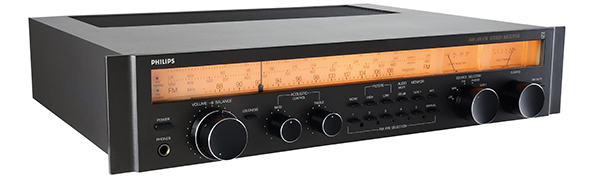
With loudspeakers of average sensitivity there is enough power to recreate just about any musical experience at a realistic level in a listening room of reasonable size. The descent into aural chaos as the amplifier runs out of headroom is gradual rather than abrupt, and accompanied by a rhythmic dimming of the dial lamps, showing that the power supply is the limiting factor. The AH 606’s gain has been calculated so that almost all of the arc of travel of the volume control is usable, so it doesn’t become hopelessly overloaded just past the 12 o’clock position.
Let’s dance
Listening to Fleetwood Mac’s Tango In The Night [WB 925 471-2], I found this Philips’ amplifier would create a subtle presence lift, giving vocals a slightly exaggerated prominence and hardness. It was consistent at all volume levels and especially noticeable during the track ‘Seven Wonders’. This is unusual as, during the 1970s and ’80s, European designers often favoured a presence dip (similar to the effect of the loudness contour) for mass-market equipment, as it flattered the performance of small and basic loudspeakers. Larger speakers with a full, extended bass response are therefore recommended for use with the AH 606.
Changing styles, Handel’s Sonata No 2 [DG 419 245-2] sounded smooth and expansive. Vivid but without glare, the brass was rendered with lustre and power. The differentiation of fine detail set a high standard too, everything seeming to find its place in the overall spread of sound. Other amps may offer more excitement but, for this type of music, the AH 606 strikes the right balance.
Compared to its other inputs the FM section sounded a little thin but otherwise it was up to standard. Tuning was easy and the AFC lock accurate, so it was simple to pull in a wide range of noise-free stereo broadcasts. My unbreakable Sunday afternoon appointment with Alyn Shipton for Jazz Record Requests on BBC Radio 3 (90.3MHz) proved to be a success, although the pieces played could have benefitted from a touch more warmth. Against this the stereo soundstage was both broad and coherent, suggesting accurate performance from the decoder.
Nothing heard during my listening tests detracted from my general impression that the Philips AH 606 is a well-made and well-engineered piece of equipment, and one that swaps the Philips penchant for quirkiness for a more conventional approach. It is easy to build a system around and sounds impressive when used with the right supporting components – it’s just a shame that Philips didn’t produce more units to this formula.
Buying secondhand
The full range of these receivers was offered by Philips in the UK but a combination of poor marketing, and the strange ambivalence to the Dutch company by many British audiophiles, means they can be difficult to find, although on the continent the situation is much better. They are sturdy units made from high-quality components – reliability standards approach those set by the top Japanese brands.
That said, the traditional Philips bugbear of poor-quality soldering causes a fair few problems, especially in the power amplifier. The modular construction means there are many connections between this unit’s preamp/driver circuit and the bias controls and output transistors – poor contacts in this maze of tracks and soldered joints can spell disaster. The muting relay also causes its fair share of problems, although it is at least easy to access and clean.
The AH 606’s preamplifier and tuner circuits are better, with the three thick-film modules proving to be largely trouble-free in service. Excessive noise, usually worse on one channel or the other, will normally be the fault of a defective transistor (so leave those capacitors alone!). Finally, when replacing the internal display lamps ensure the correct types are used or the surrounding plastic parts may be damaged by the heat.
Hi-Fi News Verdict
An almost forgotten model from a little remembered series, Philips’ AH 606 stereo receiver is still a fine example of European audio engineering from an era on the cusp of the CD revolution. A sober design with plenty of proper audiophile thinking, it arguably deserved greater recognition when launched. An interesting choice for those wishing to avoid the obvious, the AH 606 deserves another chance.Sound Quality: 80%
 | |||||||||||

|
|
| |||||||||











 SPONSORED VIDEO






| Equipment Reviews | |
Music Reviews Awards | |
Latest News Features | |
Resources Newsletters | |
Subscriptions |
WHERE TECHNOLOGY BECOMES ENTERTAINMENT
 © 2026 Hi-Fi News
AVTech Media Ltd
All rights reserved