Halcro Equinox preamplifier
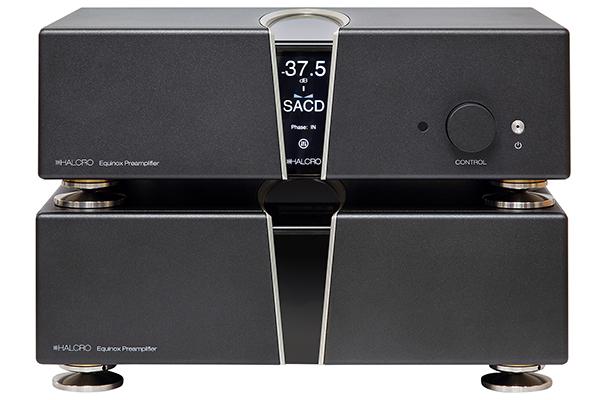

There’s boutique hi-fi and then there’s boutique hi-fi. Halcro, the famed Australian marque, at present has just three models in its catalogue – and one of those is the mono sibling of its Eclipse Stereo power amplifier [HFN May ’23]. Its only other offering is this new Equinox preamp with pricing to match the Eclipse, both selling for the same £44,000 in Halcro’s standard powder-coat finish, or a cool £50,000 for one of the ‘Signature’ premium paint versions.
To briefly recap, Halcro was founded by Cambridge-educated ‘physicist and inventor’ Bruce Candy around the turn of the millennium and was a feature of the premium audio scene with its dm series amplifiers [HFN Apr ’02]. Yet when Candy’s other work in metal-detection devices led to his main brand, Minelab Electronics, being acquired in 2008 by a military comms company, the audio business was mothballed. It was only in the early 2020s, when hi-fi distributor Magenta Audio acquired the Halcro name, patents, tooling, etc, that the brand was resurrected, with ex-Halcro engineer Lance Hewitt onboard.
Split decision
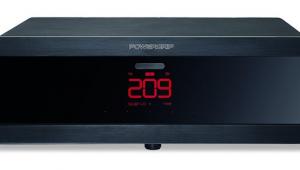
Halcro’s Equinox follows the high-end trend for two-chassis solutions, but this is not simply a case of a preamp with an outboard power supply. Instead, the two units, both measuring 450x156x300mm (whd), are designated the ‘Control’ box and ‘Audio’ box. The former houses the preamp’s custom switchmode power supply, touchscreen interface and processor circuits – including the logic to drive the R-2R volume control in the Audio chassis. The latter contains the Eclipse’s inputs, outputs and audio circuitry, with both chassis joined by a single, multicore umbilical carrying PSU and logic lines.
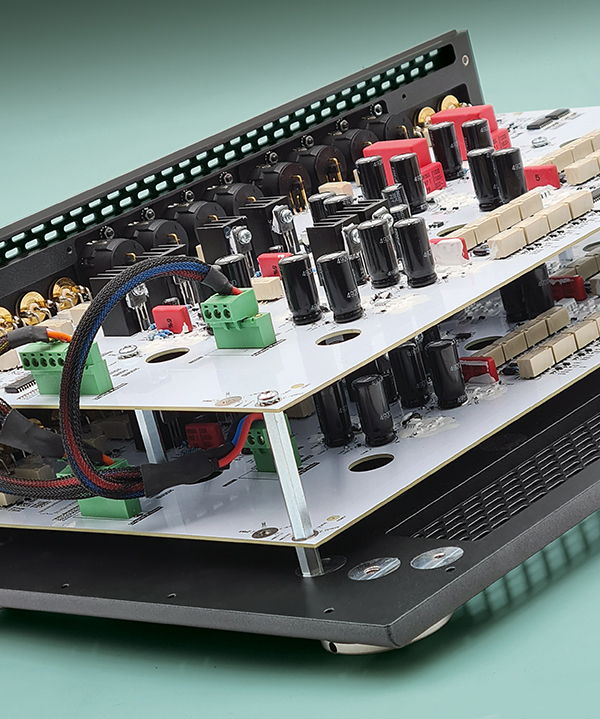
This physical separation of power, control and audio stages is a Halcro methodology also seen in the two sections of the Eclipse Stereo [see boxout]. Yet it stresses its pursuit of signal purity doesn’t end there as both the 200kHz switchmode PSU and microprocessor circuits are heavily filtered to suppress EMI. Moreover, the Equinox’s audio design borrows less from the original dm58 preamp than the differential voltage-to-current input stage, current mirror and voltage line stage of the latest generation Eclipse power amp.
Secret source
This Audio half of the two-box Equinox is a dual-mono design with separate left/right four-layer PCBs, one stacked above the other. Again, as with the Eclipse, some components have been given a white epoxy coating to obscure their origin. Whether this makes future servicing more complicated than it needs to be remains to be seen. Both boxes are fashioned from 16mm-thick machined aluminium, internally braced to keep those large PCBs securely fixed and vibration-free. You can also stack the Control and Audio boxes using the supplied sets of height-adjustable feet and location discs while Halcro’s umbilical cable is also just long enough to facilitate installation of the units side-by-side.
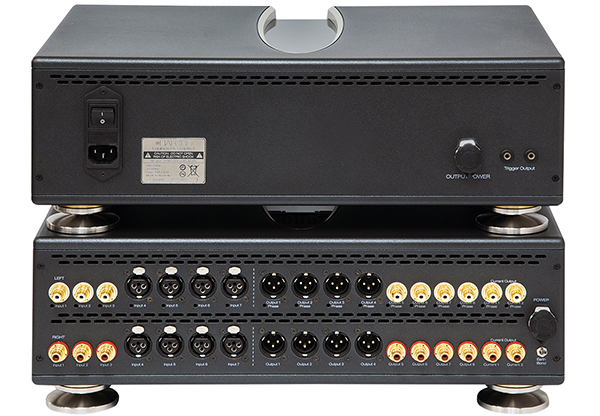
Connectivity is all-analogue and very generous, unless you believe a preamp of this stature should integrate an MM/MC phono stage. Neatly arranged on the rear of the Audio box are four sets of balanced XLR inputs and outputs, plus three unbalanced RCA inputs, four unbalanced RCA outputs, and two sets of ‘current-mode’ (aka balanced voltage) outputs, also on RCAs. The Equinox’s configuration menu also allows pairs of outputs to be set in-phase and out-of-phase, enabling the preamp to drive one stereo power amp per channel in bridged mono mode.
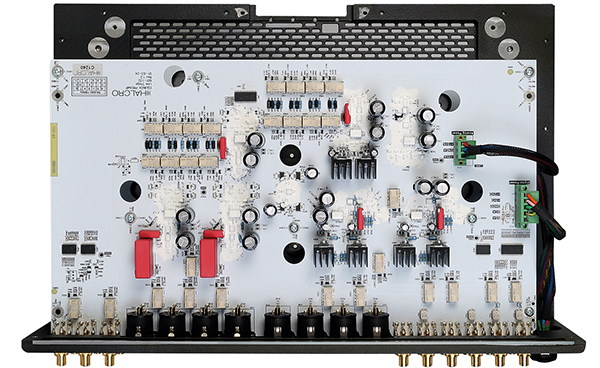
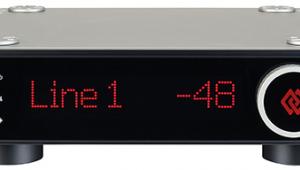
Also on offer via the touchscreen menu are a balance control, input renaming (from a preset list), display brightness adjustment and configuration of the preamp’s 12V trigger outputs for system automation. Should you have no need of the Equinox’s absolute phase settings, you may find this display and the front-panel volume rotary remain untouched, as source selection, balance and level (from –60dB to +20dB in 0.5dB steps) can also be set from the amp’s remote [see PM's Lab Report].
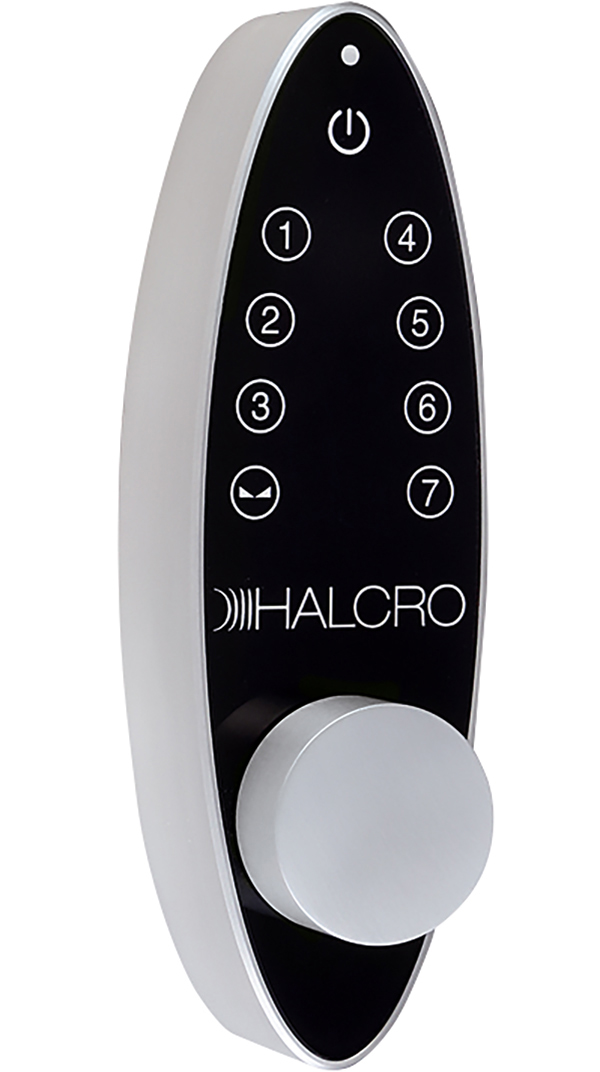
This has its own rotary to adjust volume and is designed to sit on a table, the preamp within view of the listening position as its IR ‘window’ is quite narrow.
 Open world
The Equinox was paired with Constellation Audio’s Revelation 2 power amp [HFN Jan ’25] as well as Halcro’s Eclipse Stereo in the HFN Listening Room [HFN Yearbook ’25], and its sonic ‘footprint’ was light enough to not obscure the different attributes of the two. Detail retrieval proved superb, aided by the sheer quietness of its backgrounds. Information that gives music its spatial and timbral qualities was fully uncovered, whether with a widescreen image or a focused, intimate recording. As for its own ‘demeanour’, the Equinox combined refinement with a punchy, rocking side when required.
‘La Romanesca’, from cellist Sol Gabetta’s set of works by Lise Cristiani [Sony Classical; 96kHz/24-bit], isn’t about slam and snarl, being a wonderfully recorded recital that pairs her with violin accompaniment. Heard through the Equinox, the contrasting weight and timbre of the two instruments was as startling as the smooth, grit-free presentation. Yes, Halcro’s preamp opened up the piece for close inspection, but never to the detriment of a natural, organic sound. The juxtaposition of muted piano and sinewy cello on Gabetta’s performance of Rossini’s ‘Une Larme, Thème Et Variations’ was equally striking, the latter carving through the air between the speakers.
Here the Equinox sounded brilliantly fluid and dynamic, its low noise floor benefitting the ‘in-the-room’ feel of the recording. It repeated this trick with the more layered, and deeply stylised, cover of Led Zeppelin’s ‘Black Dog’ by Troy Everett [Sunset Sound; 44.1kHz/24-bit], which segues from sustained vibrato strings and big, weighty piano notes to slashes of jazzy guitar and crisp, tight percussion. The clean, clear delivery of this mélange of elements, with their different resonances and locations in the stereo spread, was almost dizzying.
Big reveal
Staying Led Zeppelin-adjacent, Robert Plant’s ‘As I Roved Out’, from his recent Saving Grace album with British singer Suzi Dian [Nonesuch; 96kHz/ 24-bit], further revealed the Equinox’s ability to draft a convincing soundstage as it set the drums back behind the folksy instruments and dual vocals. Small details flitted around the edges of the image, such as a finger sliding on a guitar string, or the tiniest, tinkle of percussion. Precision and transparency were on offer here, but so too was a rich, voluptuous low end, in particular the slow bass on the track ‘Soul Of Man’.
Through Halcro’s Equinox preamp, the pounding beats and stabby synths of Taylor Swift’s ‘The Fate Of Ophelia’ [The Life Of A Showgirl; 48kHz/24-bit] were writ large but still well defined, creating a massive backdrop to the breathy, floating depiction of her vocals. And the preamp had the resolution to reveal that the production on this album’s opener, which presumably wasn’t knocked up in an afternoon, sounds markedly thinner during the chorus than in the verses.
Sonic sleuth
There are no such worries, of course, with the self-proclaimed ‘audiophile edition’ Blue Coast Records release of Jenna Mammina’s ‘You Can Close Your Eyes’ [Close Your Eyes; 192kHz/24-bit], which is a simple voice-and-piano ballad of exquisite clarity. The Equinox relaxed into the gentle backing and brought out the slightly nasal quality of Mammina’s voice. Once again, I was left marvelling at the preamp’s pristine but natural handling of whatever you throw at it – the following track, ‘Watching The Detectives’, upped the tempo with a funky bassline and the finest of hi-hat rhythms, and sounded just as immaculate.
Would all-out rock throw it off course? Firebird’s ‘Blue Flame’ from their album Grand Union [Rise Above Records] has the analogue vibe of a 1970s recording, despite it having been cut in 2009. On guitar, somewhat bizarrely, is Bill Steer, also the axe-shredder of death metal outfit Carcass, who here puts grinding riffs to one side in favour of bluesy melody. All the fuzz and warmth and one-take nature of the track came shining through the Equinox, albeit with plenty of detail to season the chaos.
Voice message
And given Metallica’s ‘Halo On Fire’ from the group’s tenth studio album Hardwired… To Self-Destruct [Blackened Recordings; 44.1kHz/ 24-bit], this preamp ensured that vocalist James Hetfield wasn’t buried beneath the guitars and room-shaking bass, even when the mix was shown to be quite centre-focused and narrow. The Thin Lizzy-style harmonies in the mid-section sounded superb and – for the first time – I heard a distant voice right at the end of the track, just as the last cymbals fade away. The Equinox, as its price tag suggests, leaves no stone unturned.
Hi-Fi News Verdict
Halcro says it designed its new preamp to be ‘a component that would complement any high-end audio system’, and the Equinox is exactly that. Whatever the genre of music, its superb clarity and transparency brings tone and character to the fore, all in service of getting the most from your partnering power amplifier. Naturally, Halcro has an ideal match in mind in the form of the Equinox Stereo or Mono!Sound Quality: 89%
 | |||||||||||

|
|
| |||||||||











 SPONSORED VIDEO






| Equipment Reviews | |
Music Reviews Awards | |
Latest News Features | |
Resources Newsletters | |
Subscriptions |
WHERE TECHNOLOGY BECOMES ENTERTAINMENT
 © 2026 Hi-Fi News
AVTech Media Ltd
All rights reserved