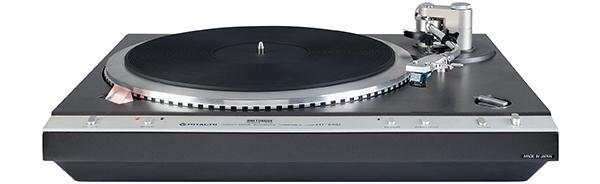
Hitachi HT-660 turntable

Although we might conveniently ‘pigeonhole’ turntables into idler-drive, belt-drive and direct-drive types, there are subdivisions within each category. For example, idler wheels come in different orientations and might drive the outside, the inside or even the underside of the platter. Belt-drive decks can use DC, AC or induction motors and spin the platter through a flat, square or round belt, a nylon thread or even, in one example, a triangular belt!
Talk the torque
Similarly, while all direct-drive turntables use a low-speed motor and ‘bearing’ to directly turn the platter, the technology typically differs from manufacturer to manufacturer. Sony, for example, used a brushed DC motor in its PS-6750 deck, before swapping to a brushless, slotless, linear type (BSL) for its later designs. Speed was regulated using a magnetic imprint on the underside of the platter read by what was effectively a tape head. Bang & Olufsen used a similar set-up for its Beogram 8000, but here the speed was regulated using a tacho disc and optical sensor. And Hitachi? Well, it went for the impressive-sounding ‘Unitorque’ motor.

Hitachi is one of those famous names that seems to have faded into audio history despite the brand remaining a huge global force. Founded in 1910 in Tokyo by engineer Namihei Odaira, the company’s mission statement was to ‘contribute to society through the development of superior, original technology and products’. To say ‘job done’ is something of an understatement, for while competitors like Yamaha possessed large product portfolios, they typically paled against Hitachi. As well as audio, video and hi-fi equipment, Hitachi made its mark as an international supplier of electronic components, computers, semiconductors, industrial equipment, excavators, trains and even reactors for nuclear power stations.
A star is born
Innovation has always been a key company ethos and, as a result, when it came time to implement direct-drive technology into its turntables, Hitachi went back to first principles. An OEM motor from fellow countryman Matsushita (Technics), for example, just wouldn’t cut it. The Unitorque motor devised by Hitachi’s engineers is very neat, being based around a compact and flat commutator-less DC servo motor. Hitachi even claimed that 15 patents had been applied for during its design. The name came from the arrangement of the flat, star-shaped coils with no slots or cores, which Hitachi claimed resulted in ‘constant output torque so there is very little vibration and the platter rotates smoothly’ [see PM's Lab Report].

Rotor speed monitoring was achieved via a pair of Hall sensors and, again, Hitachi claimed ‘high reliability is yielded by the small number of parts used’. The company released a generic Unitorque motor service manual in 1977 giving a good explanation of the motor and its design. The motor initially made its way into Hitachi’s turntable range in the mid-1970s. Decks such as the PS-38 and PS-48 provided fine performance and typical 1970s elegance in their wooden plinths sporting shiny S-shaped tonearms.
Stepping up
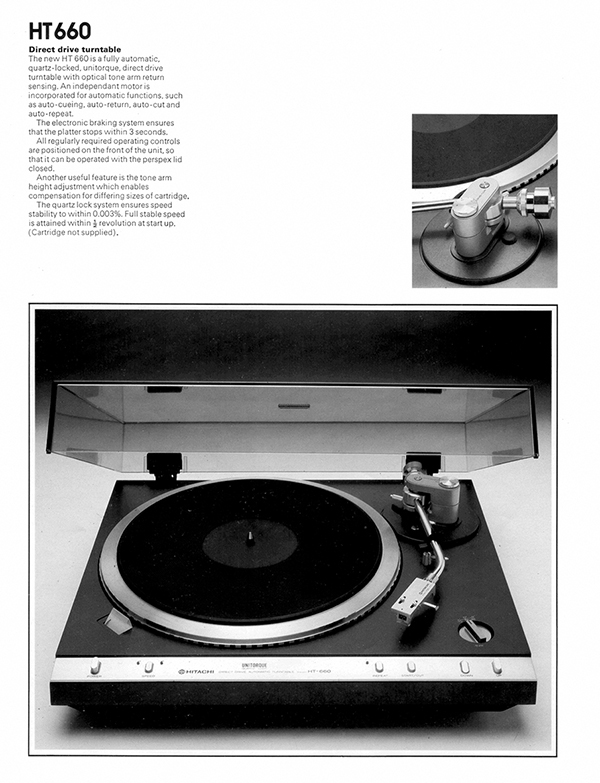
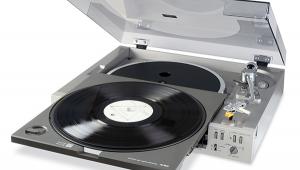
However, it was in 1977 that Hitachi decided to style things up a bit with the launch of the HT-550. This semi-automatic design appeared in a sleek grey plinth and added a quartz lock to the Unitorque motor’s drive circuitry. The HT-660 arrived two years later and advanced Hitachi’s turntable technology a step further. Resplendent in an equally sleek and equally grey plinth, the HT-660 boasted a redesigned tonearm and control system. The HT-550’s quartz lock circuitry was retained and, although the oversized 330mm platter still had strobe markings and a neon lamp by way of illumination, adjustable speed was not offered.
Sensor savvy
Fortunately, Hitachi fitted a very effective over-current and stall detection circuit, which stops the arm drive motor promptly if anything goes awry. Good job, too – the motor is a powerful affair and could likely tear into the plastic gears if left unchecked. End-of-record sensing was also carried out optically, requiring no physical interaction with the arm’s movement.
In use, the HT-660 is a delight, with the auto operation precise and relaxed. It’s a little noisier than usual, thanks to that chunky directly-coupled motor, but an effective muting circuit ensures nothing reaches the output. The only other operational quirk is that manual operation is not effected by simply moving the arm over the platter to start its rotation. Instead, the arm is moved to the desired point on the record and the ’Start’ button pressed to begin play.
Once running, two cueing buttons allow the arm to be raised and lowered as required. Although they look identical to the Start and Repeat buttons, they are not electrical but instead act mechanically on the cueing system. This becomes apparent the first time you jab the ’Up’ button too firmly and watch the arm fly into the air – a gentle touch is required!

The HT-660 remained in Hitachi’s lineup for just two years before being replaced as the flagship model by the HT-860 in 1981. This was similar in concept and appearance but added digital front panel displays for speed, the number of repeat cycles selected and a display of the reintroduced pitch control. It also offered automatic record size selection through optical sensors and motorised arm movement through front panel buttons. All of this was operated by ‘4-bit microcomputer control’, which was quite a thing back then.
 Adam listens
Equipped with an Audio-Technica AT-110E cartridge and connected to my regular Yamaha C/M-5000 amplifiers [HFN Aug ’20] and PMC twenty5.24 loudspeakers [HFN May ’17], it was difficult not to be smitten by the Hitachi HT-660. The deck has a big, bold, enveloping sound that projects superbly out of the loudspeakers and brings the action well into the room.
This means a soundstage that can be startlingly vivid at times. While the deck doesn’t quite highlight individual performers as sharply as a more modern design, it somehow matters little. The HT-660 brings performances together so effortlessly that you’re more likely to be absorbed in the music than concerned with where in the studio each performer was standing.
As a result, the live version of ‘Dallas’ from 10,000 Maniacs’ MTV Unplugged [Rhino Records 603497823932] had a great sense of atmosphere and really filled my listening room with the performance. Natalie Merchant’s vocals projected superbly while each instrument was easy to follow, the overall experience being truly captivating.
As a direct-drive design, the HT-660 has a very capable low end that is deep, rich and tuneful. It is also blessed with a slight hint of warmth that adds a lovely resonance to acoustic material. Stringed instruments sounded particularly realistic, ensuring that ‘Tarantella’ from Antonio Forcione’s Touch Wood LP [Naim Records LP 097] was a delight. Here the acoustic guitar and cello complement each other beautifully and the HT-660 easily captured the essence of both. In practical terms, the motor is torquey and silent in operation, so background noise levels were pleasingly low, and rhythmic swing was absolutely spot on. While it is well able to rein in any exuberance on more thoughtful and softer material, when punch and impact are needed, the HT-660 delivers magnificently.
Platter power
This presentation meant ‘Leave That Thing Alone’ from Rush’s Counterparts album [Atlantic 7567-82528-1] enjoyed fantastic pace and drive. Geddy Lee’s bass line was a delight, and the sheer weight of Neil Peart’s kick drums was perfectly judged. The HT-660 never held back in its delivery, yet it never overemphasised the low bass or let drum strikes overstay their welcome. Its bass performance is both well balanced and impressively controlled. In fact, the only real weakness I found in the HT-660 was in the midband. The deck reproduces voices and instruments exceptionally well, capturing their natural character very effectively. That said, it can occasionally show a slight tendency toward midrange stridency.

This was most noticeable on vocals, meaning that, depending on the source material or the singer’s style, things could sometimes sound a little ‘edgy’. Harriet’s voice was divine on her version of ‘Sailing’ from the Trying To Get The Feeling Again LP [Bright Star Records 060955 402323] and she sounded realistic while being presented tightly centre-stage. However, Sade’s voice was slightly huskier-sounding than expected on the crescendos of ‘Why Can’t We Live Together’ from her Diamond Life album [CBS 01-026044-20]. This was surprising, given that Ms. Adu is renowned for a voice that rarely strays from ‘warm honey’ on the smoothness scale.
Switching to an Ortofon OM20 cartridge helped somewhat, but in doing so some of the impact and drive of the AT-110E – which had paired so well with the HT-660 – was lost. Ultimately, there is room for fine-tuning the sound, though it may involve a minor compromise between midband smoothness and overall dynamics.Buying secondhand
The HT-660 is neither particularly rare nor especially common. Many examples turn up in Japan under the ‘Lo-D’ badge, which was Hitachi’s high-end domestic brand, comparable to Sharp’s ‘Optonica’ or Toshiba’s ‘Aurex’. Sourcing one this way can be convenient, but you’ll need to factor in import duties and the 100V AC power requirement of Japanese-market models.
In terms of durability, the HT-660 has proven to be a reliable beast. The motors are generally trouble-free while the quartz lock system is largely composed of discrete components rather than ICs that are application-specific. That said, some of the integrated circuits employed are now long out of production, and replacements can be difficult to obtain should failure occur.
The strobe neon presents another potential issue. As it operates at different frequencies for each speed, it endures greater strain than a conventional mains-fed lamp and may eventually fail. Fortunately, suitable replacements remain readily available. A more significant concern is the automatic mechanism, where old grease can harden over time, eventually causing the system to seize. If you are able to check over a deck in person, listen for any telltale ‘grinding’ noises.

Fortunately, as mentioned earlier, the motor drive circuitry has good overload protection, so damage may not have taken place. However, the only solution here is to strip the entire mechanism, clean off all the old grease, inspect, and then apply fresh lubricant. It’s a fiddly job that requires de-soldering the tonearm wires to dismantle the drive motor assembly, but everything comes apart and goes back together in a logical, straightforward way.>
Hi-Fi News Verdict
The Hitachi HT-660 is a capable turntable, illustrative of the era. Hitachi’s work on its ‘Unitorque’ motor design means that the deck turns in a good performance and is reliable, with minimal maintenance requirements. Add in a fine tonearm with a good range of adjustments, convenient automatic operation and a sleek appearance, and you have a turntable that will grace any system, be it vintage or modern.
Sound Quality: 80%
 | |||||||||||

|
|
| |||||||||










 SPONSORED VIDEO






| Equipment Reviews | |
Music Reviews Awards | |
Latest News Features | |
Resources Newsletters | |
Subscriptions |
WHERE TECHNOLOGY BECOMES ENTERTAINMENT
 © 2026 Hi-Fi News
AVTech Media Ltd
All rights reserved