Teac VRDS-25 CD player
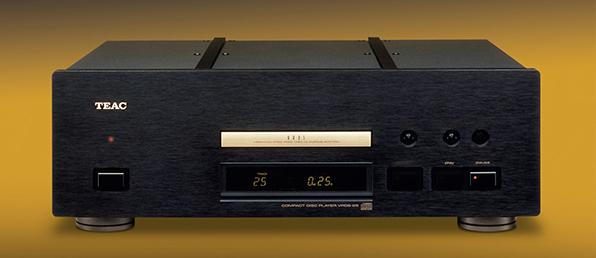

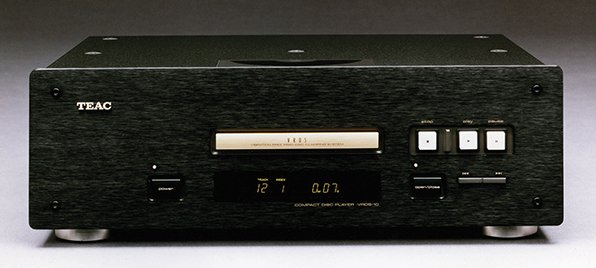
Appearances are almost always deceptive. Take Teac’s new £1300 VRDS-25. Here’s a CD player that looks rather like the established VRDS-10 and VRDS-7 [see below], featuring the CMK3 version of its VRDS transport with wafer-thin drawer mechanism, elegant orange-coloured display and basic range of onboard controls.
As ever, a huge variety of track/index skip, repeat, program and fade options remain available on the matching remote control. Around the back you’ve the choice of balanced (XLR) and unbalanced (RCA) outputs plus both coaxial and optical digital ports to service future upgrades.
Under the lid, however, Teac’s VRDS-25 has abandoned the bitstream technology of its siblings in favour of an advanced 20-bit topology lifted straight out of the exceedingly high-end X-1s player.
Double DAC
Complementing its VRDS mechanism to the full, the manufacturer has also drafted in two pairs of mono, 20-bit AD1862N converters, all addressed by a 25-bit resolution SM5843AP 8x oversampling filter from NPC. The latter yields a minimum stopband attenuation of 105dB.
These sophisticated DACs are designed to compete with Burr-Brown’s popular 20-bit PCM63P. Their internal architecture is rather different, however, as every sample is offset at the 4th Significant Bit to ensure that all signals below –18dB are shifted away from the nominal zero-cross point. Consequently, any non-linearity at this offset zero-cross point will be 8x less significant (216/213) than the same error at its true MSB (Most Significant Bit).
This is a fine idea, for though it cannot replicate the monotonic behaviour of a true 1-bit system, at least the ensuing modulation noise (a source of audible roughness) is reduced to +9dB. By way of comparison, bitstream converters usually hover around +5dB while conventional multi-bit schemes typically reach +12dB to +14dB. Indeed, Teac’s VRDS-25 is one of the very, very few multi-bit CD players to maintain a consistently low THD from 0dB through –30dB to –60dB.

At peak output, distortion measures a steady 0.0014% and is primarily 2nd/3rd harmonic in nature while, at –30dB, there is a small increase to between 0.005-0.01% that is attributable to noise rather than discrete harmonics. Most 18- or 20-bit players suffer an increase in distortion to around 0.06% at –30dB, resulting in a huge change in the player’s ‘character’ over the uppermost 30dB of its dynamic range.
Number crunching
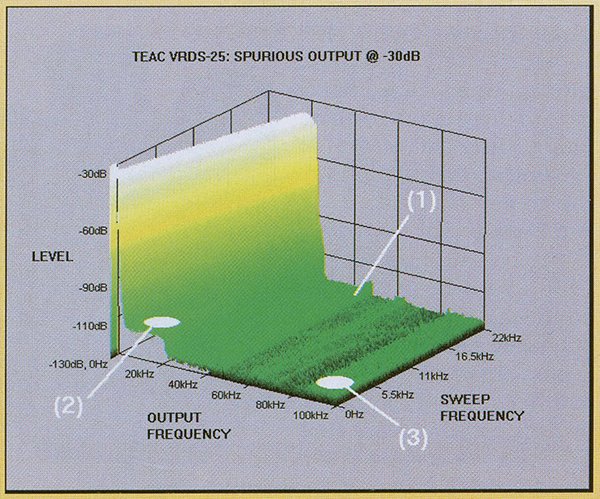
For the VRDS-25, the only spurious signal to emerge on the –30dB 3D plot [see Fig 1, below] is a ‘leaky’ sample tone that seems closer to 48kHz than 44.1kHz [1], leaving the audio band [2] completely free of distortion and the level of ultrasonic noise [3] very low indeed. This suggests the VRDS-25 should enjoy a very consistent performance with a wide choice of amplifiers even though its 1.2kohm output impedance is perhaps a little high.
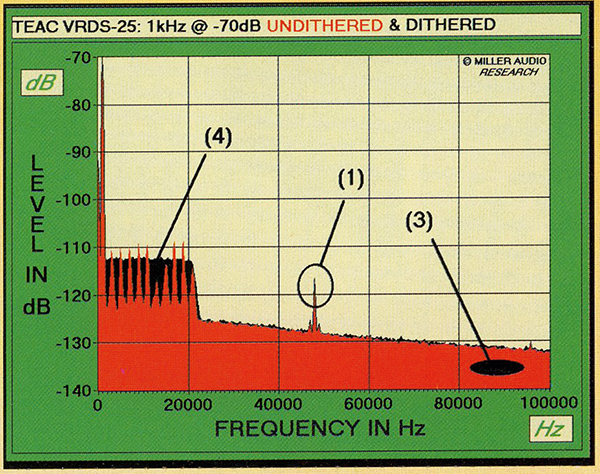
Furthermore, Teac has separated the VRDS-25’s 20-bit mono DACs into differential pairs for both L and R channels in a further effort to reduce noise, distortion and improve linearity. This, plus the dithering action of Teac’s ZDII circuit, is realised in the wide dynamic range (equivalent to an S/N of 110dB) and freedom from distortion visible on the –70dB plot [Fig 2, below]. Deviations in low-level resolution, meanwhile, are held within ±0.5dB over the first 100dB of this range!
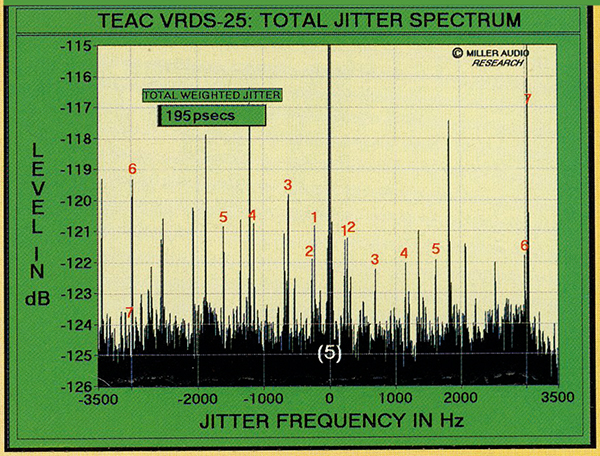
A total measured jitter of 195psec peak-to-peak is slightly higher than the very best (though significantly better than most two-box players) while its spectrum shows this is a combination of data-induced and complex (that is, unknown) jitter patterns, rather than hum or PSU-induced jitter.
On Fig 3 [below] note the broadening of the central peak [5], which reflects a certain amount of low-rate (sub-40Hz) jitter which, in turn, is known to compromise the focus of stereo images.
 Twists and turns
At a time when so many of Teac’s VRDS players are opting for a thoroughly genial yet somewhat faceless and idle sound, it’s a genuine delight to discover a player that retains the spark of individuality.
Like the flagship X-1s before it, the new VRDS-25 strikes a chord with its sheer unpredictability, introducing subtle twists and turns that throw new light on old and cherished recordings. Its strong and meaty-sounding bass captures the weight and momentum of grand classical pieces with great confidence and this, in turn, helps maintain the sort of ‘walk-through’ ambience rarely entertained by CD players these days. Then again, there is a rustic ‘bloom’ about the VRDS-25’s performance, a euphony that typically makes for glorious if not entirely realistic listening.
Mood music
Andrzej Panufnik’s Concerto for Timpani, Percussion and Strings [Conifer Classics CDCF 217] provides a case in point as the festive resonance of the chimes seems to fill the room with wave after wave of shimmering harmonics. Once these are joined by the slow slides of pedal timpani, glockenspiel and vibraphone, one is launched headlong into a deep cavern of exceedingly colourful and dramatic music.

Viewed somewhat dispassionately, the overall effect, while thoroughly entertaining, is quite obviously larger-than-life. Voices, too, typically adopt this grand presence – with the likes of Canadian soprano Loreena McKennitt now sporting a husky warmth that’s more than reminiscent of Christy Moore! And yet, despite this embellishment it’s difficult not to be carried away on the VRDS-25’s tide of enthusiasm or bowled over by its flair for the musically dramatic. So Teac’s player has a strong Machiavellian streak, but it remains thoroughly friendly to the core.
Conclusion
In essence, the massively constructed VRDS-25 insists on painting with bold daubs of colour where mere pastel shades might perhaps have sufficed. This is a player that takes more than a little artistic licence with the music at hand and yet succeeds, where a more neutral player might fail, in bringing a smile to the lips or a shiver to the spine. What it does, it does well and with consummate flair, and for that the VRDS-25 comes highly recommended.
Hi-Fi News Measured Specifications:| Maximum output / Impedance | 2.20Vrms / 1.15kohm |
| A-wtd S/N ratio | 110.5dB |
| Distortion (20Hz-20kHz, 0dBFs/–30dBFs) | 0.001-0.0015% / 0.005-0.01% |
| Frequency response (20Hz-20kHz) | +0.02 to –0.03dB |
| Channel separation (20Hz-20kHz) | 109 to 141dB |
| Stopband suppression (24.1kHz re. 20kHz) | >105dB |
| Low-level resolution (1kHz re. –90dB/–100dB) | –0.5dB / –0.4dB |
| Digital jitter | 195psec |
| De-emphasis accuracy (1kHz/5kHz/16kHz) | 0.0dB / +0.1dB / +0.2dB |
| Track access time (99) | 2.2secs |
| Dimensions (WHD) / Weight | 442x153x344mm / 16.5kg |
















 SPONSORED VIDEO






| Equipment Reviews |  |
Music Reviews Awards | |
Latest News Features | |
Resources Newsletters | |
Subscriptions |
WHERE TECHNOLOGY BECOMES ENTERTAINMENT
 © 2026 Hi-Fi News
AVTech Media Ltd
All rights reserved