Pierre Lurné J1/SL5 turntable/arm
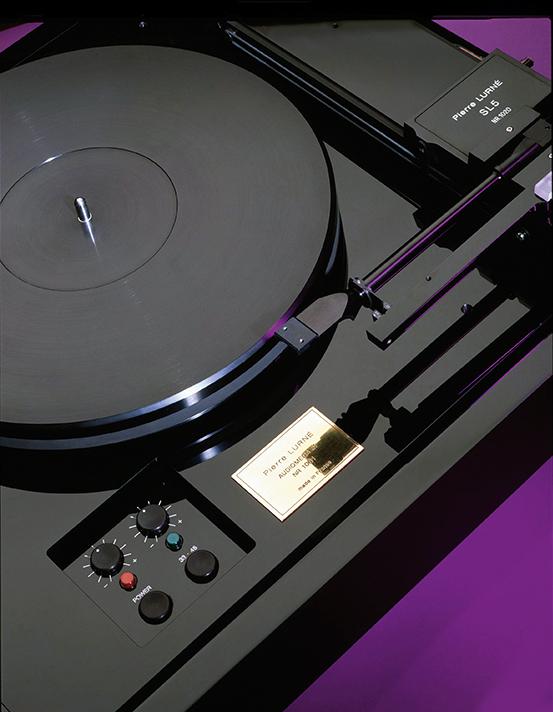

In the UK, the turntable market has been dominated for a number of years by Linn’s LP12 – now well-priced by audiophile standards. Many attempts have been made to produce and sell better and more costly models, but it turned out that a far higher price had to be paid to achieve a genuine sound improvement. Enter the French products of Pierre Lurné – a turntable lineup which has enjoyed success for some years on the continent, but has only recently become available here.
Originally there was a connection between Lurné and Goldmund, since Lurné engaged in design and production for other manufacturers before embarking on its own designs. Its first tonearms were designed as early as 1979, with production commencing in 1981, the range including sub-contract manufacture of the Goldmund T3. Lurné also developed the Goldmund T5 tonearm, building 500. Yet when Goldmund withdrew that model, Lurné released it as the SL5 to match its £1800 Audiomeca J1.
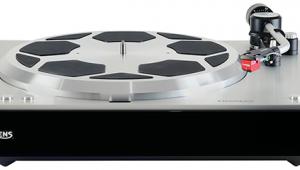
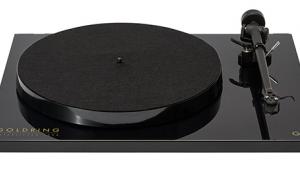
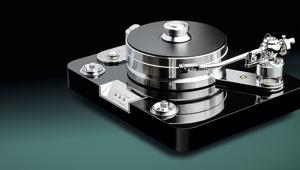
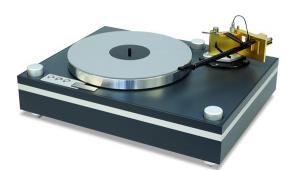
This is a massive turntable built predominantly from black acrylic and featuring a clear fabricated acrylic lid. A three-spring sub-chassis is incorporated, while the drive is via a resilient cord from an electronically controlled two-speed motor which includes independent, fine variable adjustment for both speeds.
The SL5 arm is an elegant parallel tracker, with optically coupled servo-controlled traverse, and touch-action, micro-switch-actuated power cueing. It offers a versatile set of alignments, including azimuth, and viscous damping.
Other tonearms may be fitted to the turntable and acrylic mounting plates are available to take them; for example the SME V, which we tried as an alternative to the SL5. Separately powered, the SL5, which sells for £1200, can also have an independent existence. It may be fitted to several other motor unit designs provided that sufficient space is available for the mounting.
Smooth mover
Parallel tracking tonearms are not the easiest models to design and their appearance and ergonomics often leave something to be desired. But the SL5’s appearance is excellent, with smooth-acting and straightforward ergonomics once it has been correctly aligned. The main beam has a decent effective length of 200mm and is robustly constructed in a tapered aluminium alloy. It comes fitted with a massive and optimally shaped headshell cartridge-carrier, with an easy adjustment for overhang via two sliding surfaces, those latter having precision ground interfaces firmly clamped by the cartridge fixing itself. The beam and cartridge are counterbalanced by a partially decoupled lead-composition weight located very close to the pivot point, thus minimising inertia and resonance while maximising stability.
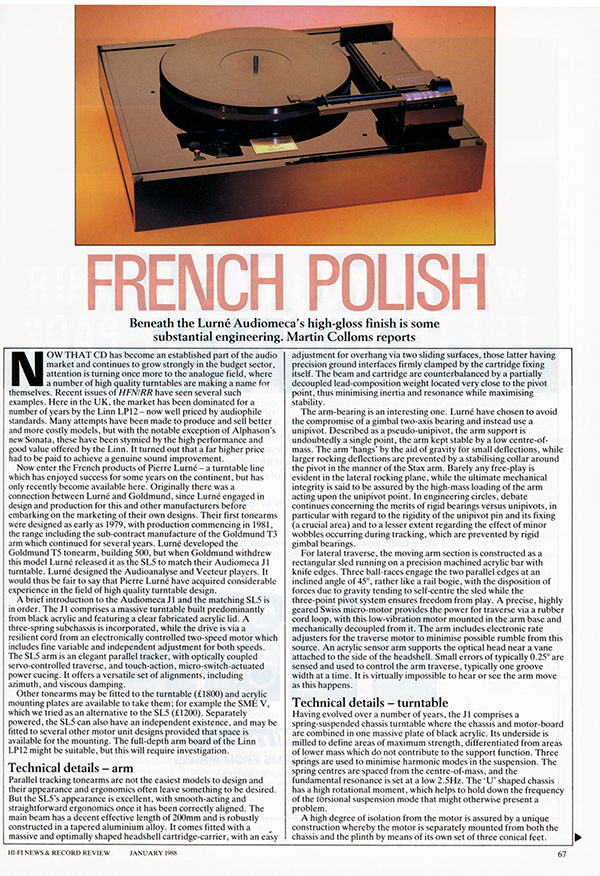
Original opening page from Martin Colloms’ review of the J1 turntable and SL5 tonearm in HFN Jan ’88,
The arm-bearing is an interesting one. Lurné has chosen to avoid the compromise of a gimbal two-axis bearing and instead uses a unipivot. Described as a pseudo-unipivot, the arm support is undoubtedly a single point, the arm kept stable by a low centre of mass. The arm ‘hangs’ by the aid of gravity for small deflections, while larger rocking deflections are prevented by a stabilising collar around the pivot. Barely any free-play is evident in the lateral rocking plane, while mechanical integrity is said to be assured by the mass loading of the arm acting upon the unipivot point.
For lateral traverse, the moving arm section is constructed as a rectangular sled running on a precision machined acrylic bar with knife edges. Three ball-races engage the two parallel edges at an inclined angle of 45o, rather like a rail bogie, with the disposition of forces due to gravity tending to self-centre the sled while the three-point pivot system ensures freedom from play. A precise, highly geared Swiss micro-motor provides the power for traverse via a rubber cord loop, with this low-vibration motor mounted in the arm base and mechanically decoupled from it. The SL5 arm includes electronic rate adjusters for the traverse motor to minimise possible rumble from this source. An acrylic sensor arm supports the optical head near a vane attached to the side of the headshell. Small errors of typically 0.25o are sensed and used to control the arm traverse, typically one groove width at a time. It is virtually impossible to hear or see the arm move as this happens.
Maximum strength
The J1’s chassis and motor-board are combined in one massive plate of black acrylic. Its underside is milled to define areas of maximum strength, differentiated from areas of lower mass which do not contribute to the support function. Three springs are used to minimise harmonic modes in the suspension. The spring centres are spaced from the deck’s centre of mass, and the fundamental resonance is set at a low 2.5Hz. The ‘U’ shaped chassis has a high rotational moment, which helps to hold down the frequency of the torsional suspension mode that might otherwise present a problem.
A high degree of isolation from the motor is assured by a construction whereby the motor is separately mounted from both the chassis and the plinth by means of its own set of three conical feet.
Self-vibration of the motor is controlled by its incorporation into a 3kg lead block. Drive is taken via a synthetic rubber cord to the inner drum of the platter, a scheme which can result in a resonance involving cord compliance and platter mass – controlled in this model by an idler pulley stationed on the opposite side of the platter from the motor pulley. By this means, lateral forces on the platter due to belt tension are also eliminated. The electronic two-speed control unit feeding the high-torque synchronous motor is built into the plinth and actuated by soft touch-buttons.
Two-part platter
A disc clamp system is included, comprising a concave platter surface used in conjunction with a locking centre-clamp having an acrylic under-surface. The latter improves the mechanical termination. The LP bears directly on the finely ground top surface of the acrylic platter – an impedance-matching technique pioneered in the UK by Pink Triangle some eight years ago. But where the Pink Triangle platter is a single 1.7kg component, the Audiomeca J1’s combines a three-ply laminate of acrylic with a centre layer of lead-plate, for a total mass of 8kg – one of the heaviest platters in the business.
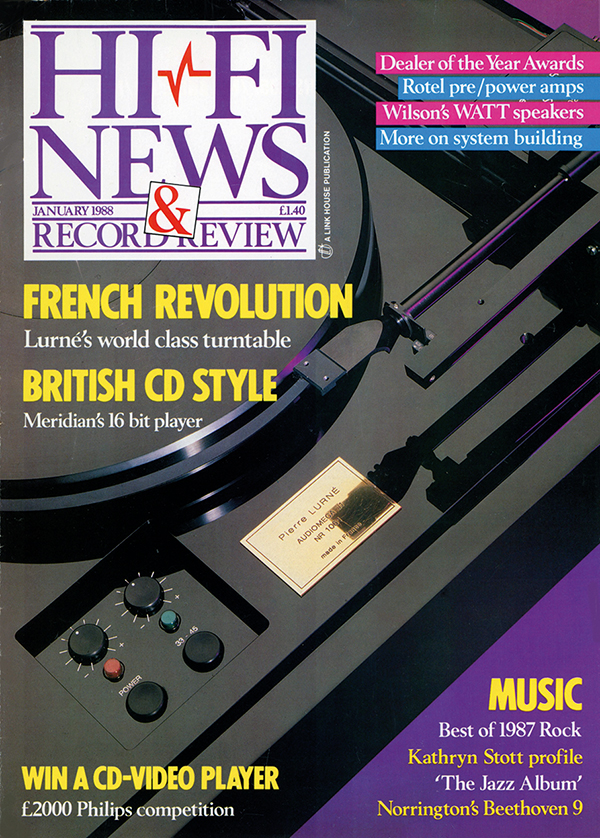
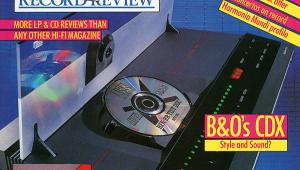
Cover of HFN Jan ’88 featuring the J1/SL5 turntable
The main bearing here is inverted, with the point of rotation set at the centre of gravity of the platter, allowing it to rotate almost independently without the need for any restraint. By minimising side contact with the bearing housing, one cause of rumble is held in abeyance. Point-contact is obtained by a tungsten-carbide ball in conjunction with a steel thrust-plate. The spindle is stainless steel, while the housing sleeve is fitted with a Delrin liner to reduce noise and friction. An oil-well is incorporated which, if filled, improves the speed control/damping. Other features include adjustable three-point cone feet (hard plastic is available as an alternative) and easy levelling of the main suspension.
 Hi-fi highs
Primary auditioning was undertaken with the J1 player used as supplied, fitted with the matching SL5 tonearm. First impressions were of high-quality sound with exemplary sweetness and clarity in the upper-mid and treble registers. Backed by the fine performance of the motor section, that impression remained throughout testing and proved to be an innate characteristic of the tonearm. This combination provided a big, spacious soundstage, associated with a fine representation of ambience and orchestral weight.
In general terms the sound was restrained, showing relaxed perspectives and proving well mannered throughout the frequency range. Good bass extension was apparent, but as the listening progressed the player revealed a weakness in a broad region lying between the upper bass and the midrange. This could be called the low-mid – ie, 150-600Hz. Here the sound suffered from a thickening, a degree of congestion and an emphasis which detracted from stereo focus and transparency. Vocal articulation was impaired, while bass transients and the dynamic quality were adversely affected. This lower-mid ‘flaw’ was not particularly serious, and should not rule out consideration of the player, but given the fine performance obtained in other areas it is something of a disappointment.
Arm swap
Other cartridges were tried without significant change, and in an effort to track down the problem we fitted an SME V tonearm as an alternative. This proved to be an interesting exercise, as it illustrated some of the strengths and weaknesses of both arms. In particular, the lower-mid phenomenon was clearly attributable to the SL5, the SME V providing a clean dynamic quality in the bass, reaching through to the upper-mid. It was at this point in the frequency range that the Pierre Lurné arm began to sound superior – more open and transparent as well as more precisely focused and revealing of the finer subtleties of treble detail. Fine as the SME V undoubtedly is, in its admittedly uneven way the SL5 shows that a still better result is possible.
Given the well established performance of the SME V, it was possible to characterise the Audiomeca J1 itself. There was a significant resemblance to the Pink Triangle PT Too, perhaps due to the common use of an acrylic platter. The J1 clearly benefits from its high-mass platter and delivers a well-founded sound, highly stable in pitch and entirely free from audible wow, flutter, or rumble. If equipped with good suspension systems, turntables built on this scale can provide a sense of power and stability that is lacking in smaller, lighter designs, and that is the case here.
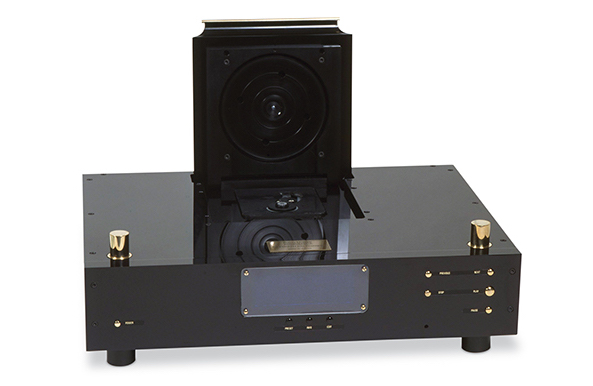
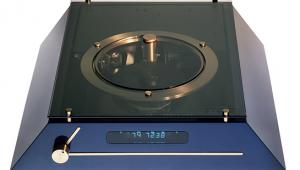
Pierre Lurné entered the CD transport market in the early 1990s with the Audiomeca Mephisto. Based around a Philips CDM9 disc/laser mech, it allowed for levelling of its front feet via two top-mounted adjustment knobs
The disc support is clearly well damped in terms of good record termination, and allowed the better recordings to show considerable stage depth together with very good clarity. Ultimately, the motor unit was felt to sound slightly ‘heavy’ and ‘slow,’ this of no audible significance on classical recordings but detected after comparative auditioning using fast-driving rock material. Under these conditions the J1 did not reach the very top standard for timing and articulation in the bass. Put simply, it did not appear fast enough on its feet.
Conclusion
Summarising the listening tests, it was clear the J1/SL5 was a fine disc player, but with characteristics which suit classically biased enthusiasts more than someone committed to rock or a combination of both types of music. That said, it is sufficiently good to justify serious interest and a personal audition if you are shopping for a model in this price range – and you may find that you cannot live without that delightful top end.












 SPONSORED VIDEO






| Equipment Reviews |  |
Music Reviews Awards | |
Latest News Features | |
Resources Newsletters | |
Subscriptions |
WHERE TECHNOLOGY BECOMES ENTERTAINMENT
 © 2026 Hi-Fi News
AVTech Media Ltd
All rights reserved