TAD A1000 integrated amp

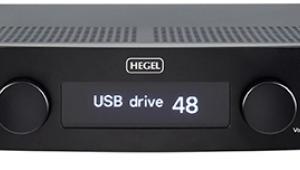
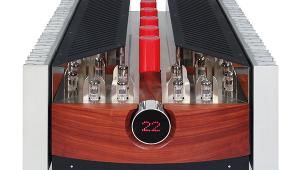
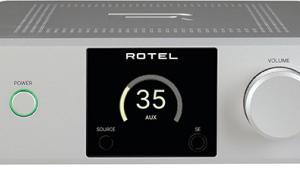
Flying in the face of received hi-fi wisdom that presumes absolute sonic purity is best achieved with separate pre/power amplifiers, integrated amplifiers are having something of a renaissance. Aside from the entry-level and mid-market, where one-box amplification has always been the go-to choice, there’s now a good selection of high-end models from the likes of Rotel’s Michi X3 S2 [HFN Jan ’24], starting from just under £6000, to the massive Dan D’Agostino Momentum MxV [also HFN Jan ’24], yours for just short of £100k when fully loaded with DAC and phono modules.
Pioneer spirit
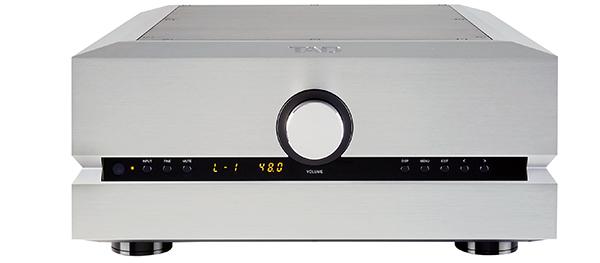
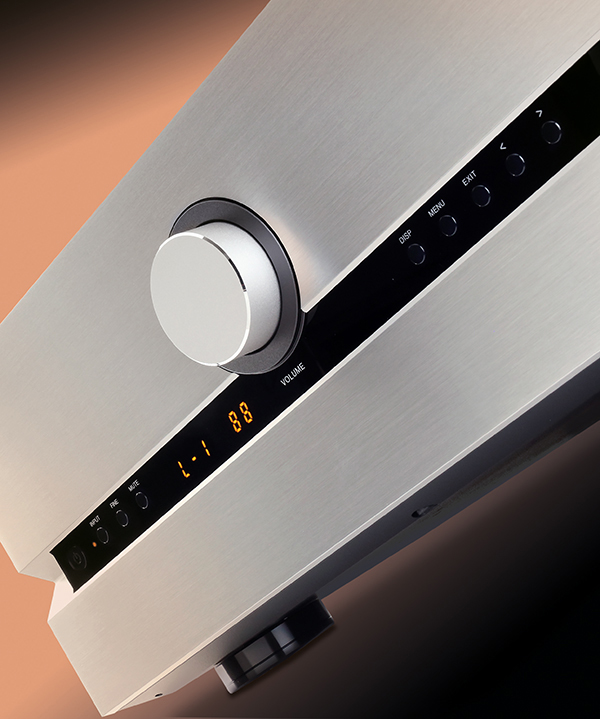
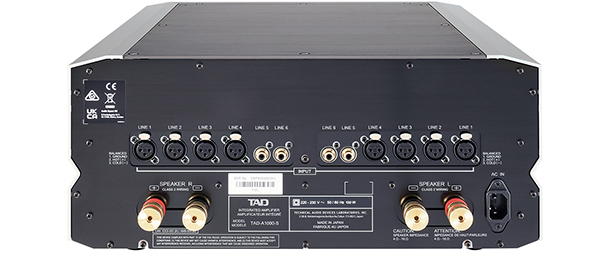
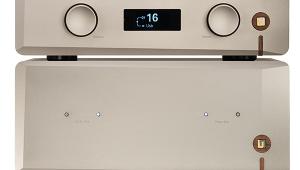
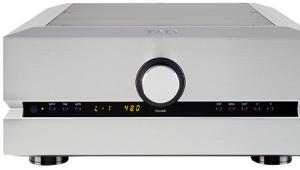
Stepping into this arena we have the latest arrival from TAD, the £27,995 A1000, an all-analogue heavyweight delivering a claimed 250W/4ohm a side from its Class D power amplification [see PM's Lab Report]. This is a straightforward design, from its input provision – four balanced line ins on XLRs, and two unbalanced on RCAs – to its fascia styling, which has just a narrow black strip and a prominent volume control dividing an all-silver aluminium cliff-face. Well, all-silver is the version we have here, which is technically the A1000-S. As an alternative, and on a built-to-order basis, there’s also the A1000-K, the suffix standing for ‘kuro’, Japanese for black.
Yes, Japanese, and yes, that TAD, which some with long memories will recall was started as an offshoot of Pioneer [see PM’s interview sidebar p45], focused on making high-end loudspeakers. Technical Audio Devices was the full name when it began back in 1975, and the move was logical, given that Nozomu Matsumoto had founded Pioneer in 1937 as a speaker company. Starting as a driver manufacturer, and gaining a following in the pro audio market, TAD has now been making complete speakers for consumers for the better part of a quarter of a century.
Not that moving beyond speakers is anything new for the company. In 2007 it renamed itself Technical Audio Devices Laboratories, Inc., and has been making amplification and digital products ever since, based on some of the technologies from Pioneer’s – mainly Japan-only – high-end models. Our late colleague, John Bamford, reviewed the D600/C2000/M2500 disc player/DAC, preamp and power amp, then making their European debut, some 14 years ago [HFN May ’12].
Wind forward to the present day, and the TAD A1000 clearly draws on the design of those components, sitting as it does in the company’s Evolution lineup, one rung below the Reference series. This range also offers a disc player, a DAC, a preamp and power amplification, plus a choice of partnering loudspeakers, but the A1000 remains the only integrated in the company’s entire catalogue.
Hide and seek
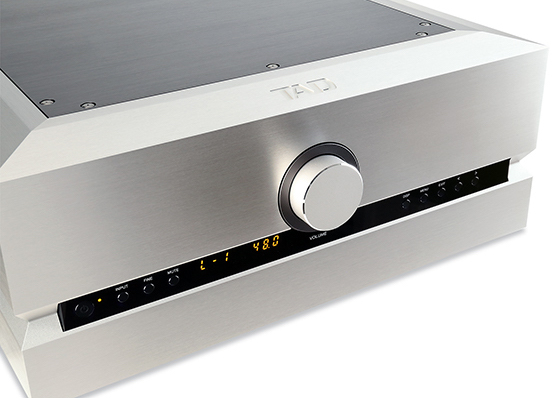
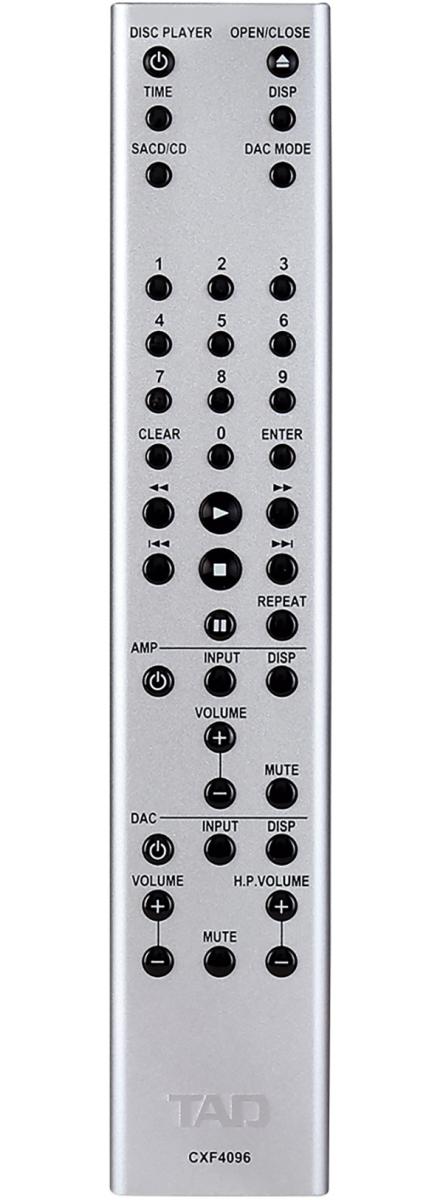
Anyway, what we have here is an amplifier so simple that its main complexity is found in the remote handset [pictured below], a ‘universal’ control designed for a complete system including home cinema add-ons. Aside from that vestigial display in the black band cutting a line across the fascia, the only controls here are the large rotary set above, with smooth ball-bearing operation to guide a resistor-ladder volume circuit, and some small buttons all but hidden by their black-on-black design.
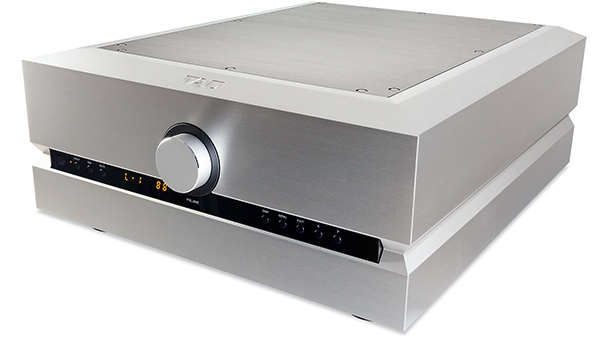
These allow the user to cycle through the inputs, switch the volume from single to half-steps for fine adjustment, switch the display off, and enter the menu, when two further buttons allow for scrolling. The menu is limited: you’ll find no more than balance, input trim (–10 to +20dB), and an ECO mode allowing a 20-minute standby switching. This is set ‘on’ by default in EU models, and ‘off’ for those destined for the ‘drill baby drill and back to V8s’ US market.
Top and bottom
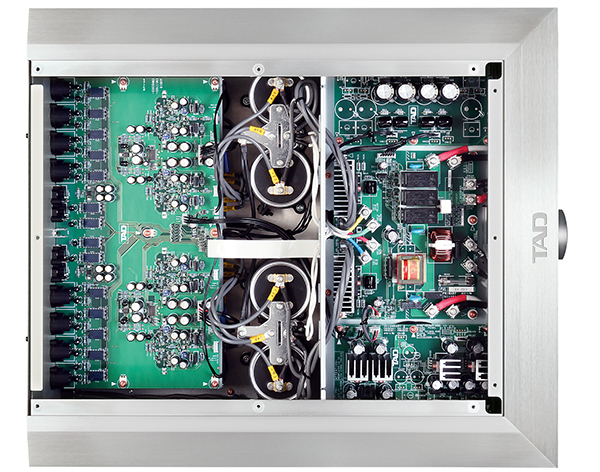
The A1000’s rear panel is similarly no-nonsense. Inputs are ranged across the top, and chunky terminals for a single pair of speakers sit below, reflecting an internal layout in which the preamp section sits above the in-house-designed Class D power amplification, the latter configured as bridge-tied load (BTL). Going its own way with this power amp technology has long been a TAD trait [see boxout], and it has stuck with it despite the more recent arrival of high-quality Class D amp modules from third-party suppliers.
Power is from two substantial toroidal transformers and four large 33,000μF smoothing caps, all proprietary designs. There’s nothing tricksy here – just logical, symmetrical layouts and no-nonsense engineering with the PSU, control circuit, single-stage current-feedback preamp and power amp all physically separated in distinct chambers within the braced alloy chassis. It looks and feels massive, though the all-up 29kg fighting weight would probably have been far higher if this were a traditional Class AB amplifier.
The A1000’s FET preamp section is leveraged from TAD’s Reference series preamps while the cool-running Class D power amp stage removes the need for conventional heatsinking, keeping the industrial design clean. Underneath, the amp sits on three isolating feet with internal inverted spikes, protecting your surfaces. Two other feet, slightly shorter, sit at the back to ensure the A1000 will not tip should you lean on a rear corner while plugging/unplugging cables. Its engineers are nothing if not thoughtful!
 Gentle giant
If the design of the A1000 is clean and simple, so is the sound – a classic amplifier style that’s slightly warm and sweet at low levels, opening up and gaining more impact as volume levels are raised. Used between the dCS Varèse streamer/DAC [HFN Feb ’25] and Wilson Audio’s Alexx Vfx floorstanding speakers in the HFN Reference Listening Room [HFN Yearbook ’25], the TAD A1000 was by no means outclassed by either, delivering a clear view of the qualities of the digital front-end while driving the speakers with grip and conviction.
The abundance of power is obvious in highly dynamic music, and not just tracks with thump and punch. This is a gentle giant of an amplifier, as made clear with Vaughan Williams’ evocative ‘In The Fen Country’ [Haitink/London Philharmonic; Warner Classics 5567622]. There was fine detailing here, and a sound sweeter and more fluid than aggressively in your face. That’s just right for this dramatic but essentially pastoral music, written by the composer recalling his cycling trips while a student at Cambridge. TAD’s amp also had plenty in reserve for VW’s occasionally over-exuberant dramatisation in this account of the flat, bleak landscape, and the sense of open soundstaging was excellent.
With the more overt drama of Wagner’s Tannhäuser overture [Georg Solti/Vienna Philharmonic; Decca 4832507], the signature Wagnerian brass had just the right combination of power and ‘blare’, rising above the tight chords being played by the rest of the orchestra. True, there was not as much bite as some more forward-sounding amps, but there was no shortage of warmth as the A1000 drove the speakers to magnificent effect.
The joyous Walton ‘Portsmouth Point’ overture from the recent Warner Classics Bravo! release celebrating Sir Adrian Boult [2685460381] saw the A1000 rendering the orchestra with speed and attack, particularly in the percussion. The prog rock of ‘Nous Sommes Du Soleil’, from Yes’s remastered Tales From Topographic Oceans album [Rhino R2 728280], offered something completely different – a grandiose production, with all that noodling on guitars and keyboards underpinned by chunky bass and drums. Yet TAD’s amplifier proved equally at home here, fast and insightful, and able to go seriously loud while keeping everything under control for those most intense of moments.
Character building
Dialling things back with the Chet Baker Quintet’s Coming On With… [Craft Recordings, 192kHz/24-bit download], and ‘No Fair Lady’ had a lovely easy swing, the flugelhorn and trumpet soloing up above the piano, drums and bass, all of which were superbly resolved. This 1967 mono recording sounded as fresh as the proverbial daisy.
This amp can power along, sounding gutsy with the version of ‘When Love Comes To Town’ from Joe Bonamassa’s B.B. King’s Blues Summit 100 [Keeping The Blues Alive Records, via Qobuz]. The guitar clanged and howled, and the rhythm section hit home in infectious style. But then it was just as captivating with Eric Bibb’s stripped-down ‘Crossroads Marilyn Monroe’, from his atmospheric One Mississippi album [Repute Records RRLP001]. As with the Bonamassa set, the blues guitar was fabulously characterful, with each note having good leading-edge attack and a luxurious decay.
The A1000 was punchy and attention-grabbing even with Kula Shaker’s ‘Charge Of The Light Brigade’, from the recent Wormslayer album [Strange F.O.L.K Records; STRANGCD8]. Boy, this mix is dense, but TAD’s amp just kept on punching through in unstoppable style, even when running hard into the Wilson Audio speakers. This isn’t the world’s best-sounding album, but its semi-psychedelic oddness was handled deftly by the A1000.
Sketch show
On the subject of ‘odd’, the unusual instrumentation and atonality of Moldavian violinist Patricia Kopatchinskaja’s recording of Márton Illés’ ‘Sketches For Solo Violin And Live Electronics’ [Bowed Spaces; Alpha ALPHA1221], would challenge any system – and probably more than a few listeners. Yet TAD’s integrated amplifier opened up the recording to deliver a compelling, otherworldly soundscape, at once intriguing and unsettling. The solo violin was tightly defined amidst all the swirling electronica of the SWR Experimentalstudio des Freiburg.
With those last two recordings, I began to get the feeling I was playing chicken with the A1000, trying to find music to unsettle it, and lose its way due to that underlying warmth. Having failed to do so, I fell back on something altogether more refined and glorious. Having just seen the excellent film The Choral, written by Alan Bennett and directed by Nicholas Hytner, I settled for the recently released version of Elgar’s The Dream Of Gerontius by the Huddersfield Choral Society and the Opera North orchestra.
Timed to coincide with the film, this Hyperion set [CDA68461/2] mixes drama with warmth and lushness. The TAD A1000’s easy-going but rewarding presentation did an excellent job of taking me straight to the heart of the piece, sounding grand and impressive while still delivering fine insight into both playing and singing.
Hi-Fi News Verdict
While perhaps not sating the appetite of the ‘red in tooth and claw’ brigade, keen to have every last iota of a recording hurled at them, the A1000 remains a remarkably well-judged ‘big integrated’. Combining the power to drive very serious speakers with a magnificently listenable and informative sound – missing only the hi-fi histrionics – the listener is left free to immerse themselves in the music.Sound Quality: 86%
 | |||||||||||

|
|
| |||||||||










 SPONSORED VIDEO






| Equipment Reviews | |
Music Reviews Awards | |
Latest News Features | |
Resources Newsletters | |
Subscriptions |
WHERE TECHNOLOGY BECOMES ENTERTAINMENT
 © 2026 Hi-Fi News
AVTech Media Ltd
All rights reserved