Quad Platina Integrated amplifier
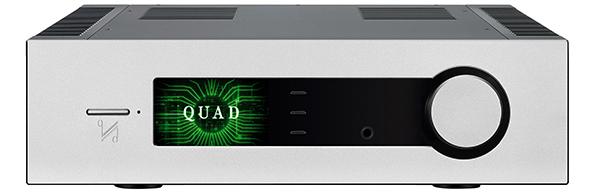

Trust me on this: Quad is definitely on a roll. In rapid order, it has delivered the reborn 33/303 pre/power [HFN Jan ’25] and Quad 3 entry-level integrated [HFN Sep ’25], the ESL 2912X electrostatic speaker [HFN Feb ’26], and now this absolute honey of an integrated amplifier. The Platina is billed by Quad as the best integrated amp it’s ever delivered, a claim certainly justified.
Let’s qualify the boast, though, as I am partial to the all-valve Quad II Classic [see boxout], by altering it to ‘best solid-state integrated’. Here’s why. First and foremost, at £3499 the Platina Integrated adheres to the Quad tradition of being incredible value for money. This gives you a claimed 200W/8ohm and more facilities than most people will ever use. I cannot think of a single omission.
Screen gem
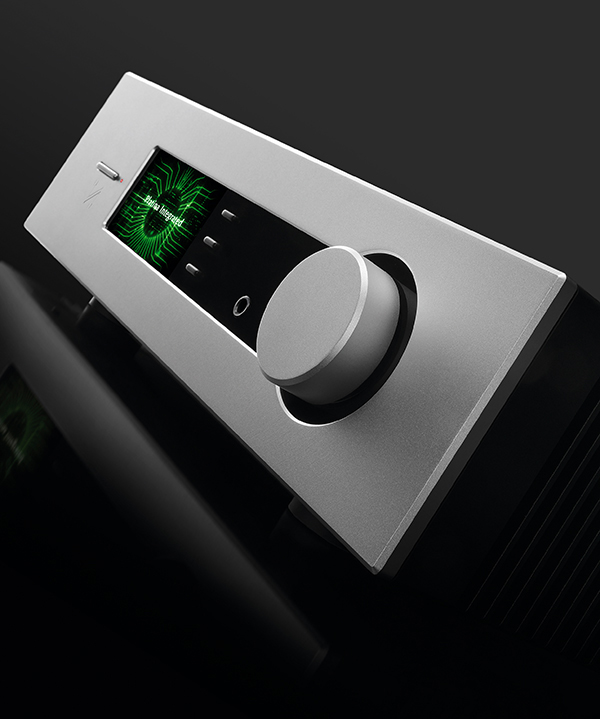
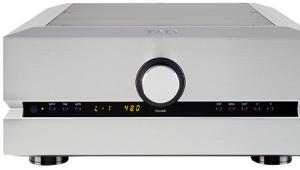
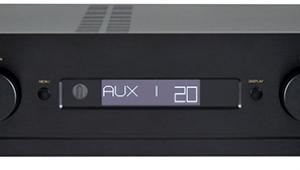
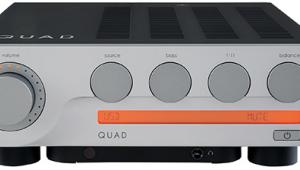
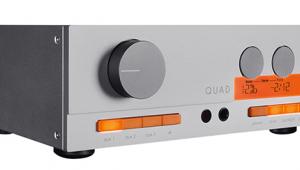
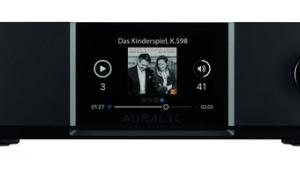
Its looks are clearly derived from the recent modernisation of the fascia style first defined by the original Quad 22 preamp of the 1950s [Vintage Review, HFN Mar ’14], with a single large volume rotary and the necessary switches, one of which turns on the unit from standby. An LED to its right glows red when in standby mode (if you leave the power on at the back), which you can access either by pressing the button or using the remote [see below]. This extinguishes the red LED, and the gorgeous IPS LC display takes over. Three small buttons next to the display select sources by scrolling up and down, while the bottom button selects the functions.
Make no mistake: this is categorically a 21st century, all-digital (sans streaming), all-singing, all-dancing unit, but it also respects legacy hardware. It has an adjustable MM/MC phono amp, a front panel headphone socket (which mutes the speakers when used), and enough analogue and digital inputs and outputs to ensure that everyone, including home theatre enthusiasts, will be accommodated.
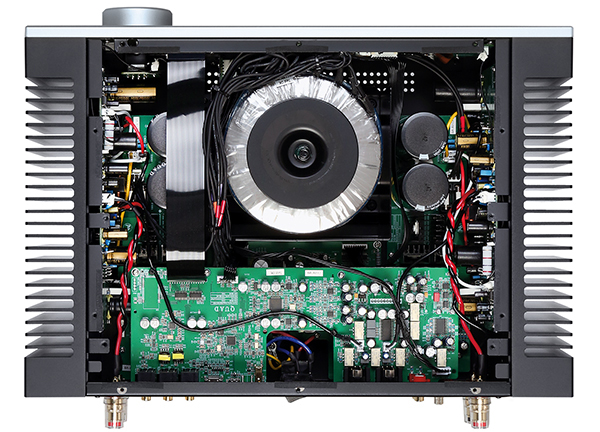
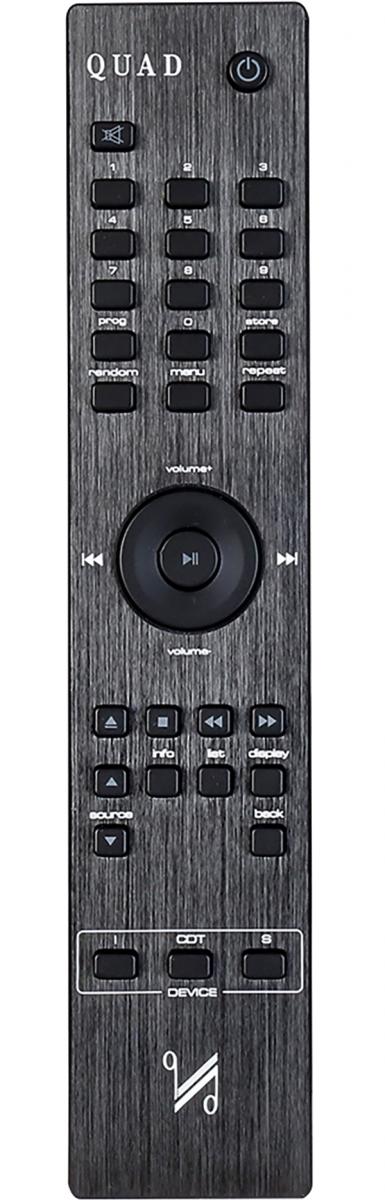
Everything is pretty much accessed from the remote control, while the multifunction rotary also serves up volume, muting and menu navigation. As self-explanatory as Quad’s remote may be, before you do anything with the Platina Integrated you should probably take one step backward, pour your favourite beverage and sit down with the owner’s manual. This ranks among the most lucid yet dense that I’ve handled, simply because the product is so facility rich.
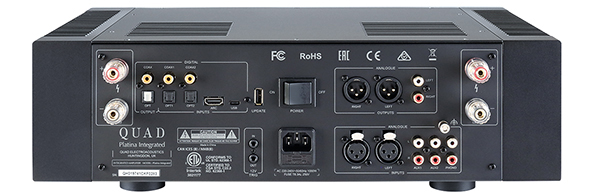
Just look at the roster of inputs and outputs [see p83] where, at either end of the rear panel, are superb multi-way binding posts. The lefthand side (looking at the back) hosts coaxial and optical digital outputs and two each of coaxial and optical digital inputs, an HDMI ARC input for television connection and, most usefully considering the lack of streaming, a USB-C socket for connection from a PC.
Ready to serve
There are balanced (XLR) and single-ended (RCA) line outs should you wish to use just the preamp section. Speaker outputs are muted in this mode – an obvious requirement but one overlooked in the engineering of many integrated amps. Below the outputs are balanced XLR and three unbalanced RCA inputs – two line-level and the MM/MC phono. With this array it’s possible to service up to four analogue and six digital sources.
Two practical aspects deserve mention. The first is that at the bottom of the remote control you will see three buttons labelled ‘I’, ‘CDT’ and ‘S’, for switching the operation of the remote between Quad’s Platina Integrated, its partnering CD transport, and the Platina Stream network player. Secondly, this amplifier is a substantial beast. It weighs just over 17kg, thanks mainly to its 630VA PSU transformer and solid alloy casework, and occupies 445x135x348mm (whd). Tyre kickers will love it.
Regarding compatibility with your existing sources, the Platina Integrated’s S/PDIF inputs operate up to 192kHz/24-bit while the USB-C input is compatible with files up to 768kHz and DSD512. Quad has, quite sensibly, selected just five of the ESS DAC’s inbuilt digital filters [see PM's Lab Report] and there’s a default ‘upsampling’ mode, to 352.8kHz and 384kHz, by way of bypass.
Back in the world of analogue, the phono stage provides gain options of +46dB, +52dB and +60dB. Other settings include an adjustable power-on volume limit, various display options including brightness level and a choice of graphics should you not want to use the Quad logos. These include linear digital colour bar displays and analogue meters – you can guess which ones I set for my viewing pleasure, especially when I fed the amp from reel-to-reel tape.
 To boldly go...
Despite the surfeit of instructions, I had the Platina Integrated up and running in ten minutes – and that included configuring it for the SACD/CD transport and cartridge I was using. PM had left the unit in ‘preamp mode’, which confused me for about 30 seconds, but having digested the manual via Quad’s website, to all intents and purposes it worked straight out-of-the-box.
Because the Platina does not use the old Quad 405 [HFN Apr ’76] current dumping technology, and because I had spent much time with the new generation Quad 3 and 33/303, I was hoping for, expected and received scaled-up versions of the two. Indeed, the sheer boldness and bottom-end of the Platina Integrated should justify its purchase for those who value mass and force and are not averse to cranking up Led Zeppelin or Van Halen. In fact, I used both during my listening sessions – the Brit band’s Led Zeppelin debut [Atlantic R1-535224] and Van Halen’s Diver Down [Mobile Fidelity UD1S 2-036] – to make sure that I wasn’t simply willing this amplifier to sound like its physical presence: big and butch.
But more of that anon. My kick-off title was possibly the coolest pop rock release of recent years, The Heavy Heavy’s 2024 album One Of A Kind [ATO Records ATO076]. This incredible British duo owes much to the 1960s Beatles/Kinks/Who triumvirate and the power pop of the 1970s/ ’80s, so I wasn’t making it easy for Quad’s Platina Integrated. This is all jangly chords and snappy percussion, but the title track also features some incredible echo effects that showed off a particular skill of the amplifier: astounding front-to-back depth.
All gain, no pain
What might have been a recipe for disaster given the all-solid-state nature of the beast proved remarkably fatigue-free. If you haven’t heard this duo, the sound is raw in the best it-should-be-on-a-45rpm-single-on-a-cheap-record-player manner. Instead, it was nothing of the sort. The raw energy came across in spades, while the aggression required was there too. Despite this, at no point did any semblance of distortion cause my teeth to grind. I wish I could say the same about the sound from my TV set.
Puppy power
Again not willing to go too easy on the Platina, I popped in ‘Good Times Bad Times’ from Led Zeppelin and felt like the guy in the old Maxell tape ad, blown back in my chair by John Bonham’s drumming. Confirming what PM described for the overall behaviour of the power amp section, this baby had no problem tormenting Wilson Audio’s The WATT/Puppy [HFN Sep ’24]. If anything, I had to back off the volume control to avoid upsetting the other residents, chez Kessler.
Which reminds me: those of you who love truly precise level setting will be pleased to know that the first 60 or 70 degrees of the Platina Integrated’s volume control arc provide only a portion of the volume. It really kicks in when the control is twisted to what would be 3 o’clock on the graphic display.
This superb performance continued with two of Van Halen’s finest cover versions, ‘Where Have All The Good Times Gone’ and ‘Oh, Pretty Woman’. Here the Quad amp showed breathtaking speed on Eddie’s guitar leads while reproducing all the nuances of David Lee Roth’s vocals. You could almost see him smirk. As with The Heavy Heavy and Led Zeppelin tracks, the percussion was massive, powerful and – had I removed the grilles to see it – pumping a lot of air.
But on to subtlety. Linda Ronstadt’s Prisoner In Disguise [Mobile Fidelity MFSL 2-608] is a go-to album for vocals. What I wasn’t expecting, though, was the same powerhouse drumming, even on tracks like ‘Love Is A Rose’ which is inherently gentle. Ronstadt’s voice was sibilance-free, detectably warm and even reminiscent of Quad valves. Whoever engineered this clearly had Quad Classic valve equipment to hand, also emulating their three-dimensionality. I had to keep reminding myself there wasn’t a tube in the audio chain.
Blast from the past
Modernity notwithstanding, I couldn’t resist playing something that was a contemporary of the original Quad II. Yep, open-reel tape with Martin Denny’s Quiet Village [Liberty 7122]. Unusual, exotic percussion and image height that defies the laws of physics – this half-track tape from 1959 is the equal of any audiophile LP you can name. The Platina amp presented it with a realism that would have blown Quad founder Peter Walker’s mind had he heard it this way 67 years ago.
Hi-Fi News Verdict
Instead of looking at the Quad Platina as costing £3499, I think of it as £0.00. Why? Because its DAC and phono stages are a match for many separate £1500-£2000 units, so the rest is effectively free. Operationally, I cannot fault the Platina, the screen is a joy to observe, the power seemingly limitless. In other words, this is a bargain. If it sounds like I’ve fallen in love with this amp, well, call me smitten.Sound Quality: 89%
 | |||||||||||

|
|
| |||||||||










 SPONSORED VIDEO






| Equipment Reviews | |
Music Reviews Awards | |
Latest News Features | |
Resources Newsletters | |
Subscriptions |
WHERE TECHNOLOGY BECOMES ENTERTAINMENT
 © 2026 Hi-Fi News
AVTech Media Ltd
All rights reserved