PS Audio PMG Signature SACD Transport/512 DAC Boxout
While PS Audio’s 1-bit ladder DAC may be operated at a maximum DSD512 (DSD 8x or 22.58MHz), upsampled inputs may also be scaled back to DSD256 and DSD128. In practice it’s this choice of operating rate that has the biggest impact on the behaviour of PS Audio’s three digital filters and how they are likely to be perceived in listening comparisons. The ‘SpectraWave 64-tap sequencer’ offers Linear Phase Fast (F1), Linear Phase Short (F2) and so-called ‘Circular’ filter (F3) coefficients, the latter not unlike the FIFO/moving-average method seen in the Topping D900 DAC [HFN Feb ’26]. However, while PS Audio’s literature suggests SpectraWave differs from typical filters which ‘introduce artifacts like pre-ringing...’ all three of its options are, in fact, similar linear phase types with equal pre- and post-ringing. Moreover, all three offer the same 94dB stopband rejection regardless of DSD128, DSD256 and DSD512 sample rates. Neither is the 108.5dB A-wtd S/N ratio (20Hz-20kHz, re. 0dBFs) affected by filter or DSD rate.
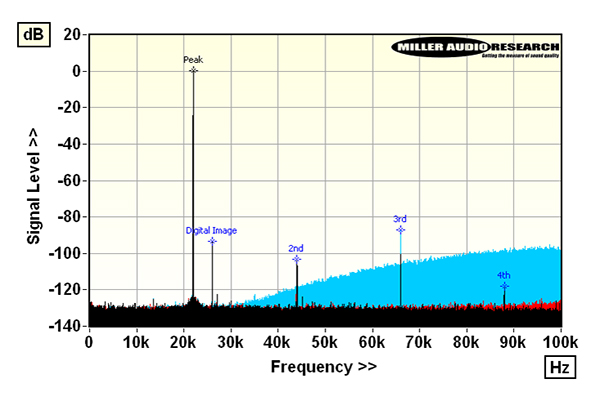
What is influenced, however, are both frequency response and the ‘shaping’ of ultrasonic requantisation noise [see above Graph: F1 filter – black, DSD512; red, DSD256; cyan, DSD128]. The F1-3 filter responses differ most in DSD128 mode, rolling away to –10dB/80kHz, –7.4dB/80kHz and –28dB/80kHz (and –0.7dB/20kHz) with 192kHz files, respectively. At the highest DSD512 upsampling rate, the HF responses of all filters are far closer at ±0.03dB/20Hz-20kHz, –1.4dB/45kHz and –9.4dB/90kHz with 48kHz, 96kHz and 192kHz files, respectively, although the ‘shape’ of the roll-off differs slightly. Put simply, the effect of filters F1-3 becomes progressively less evident the higher the DSD rate. PM
 | |||||||||||

|
|
| |||||||||











 SPONSORED VIDEO






| Equipment Reviews | |
Music Reviews Awards | |
Latest News Features | |
Resources Newsletters | |
Subscriptions |
WHERE TECHNOLOGY BECOMES ENTERTAINMENT
 © 2026 Hi-Fi News
AVTech Media Ltd
All rights reserved