Pro-Ject Debut Reference 10 turntable

It’s hard to say how many turntables Pro-Ject has launched since its birth in 1991, but you could always rely on a Debut deck being part of the lineup. The inaugural model did not mark the brand’s beginning [see boxout] but it was the turntable that allowed the Austrian company to fan the flames of analogue replay before the ‘vinyl revival’.
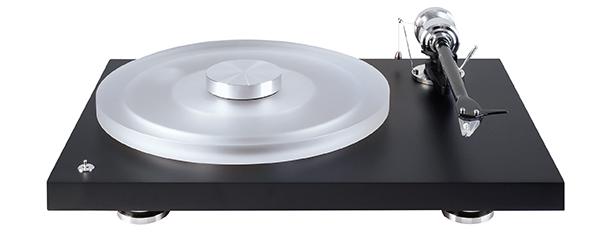
The Debut Reference 10 is the latest addition to this perennial range – an accessible entry into ‘true’ hi-fi territory – with a dollop of modern design language. This is a particularly ambitious flagship Debut model, boasting a larger footprint than Pro-Ject’s lower-tier Debuts and introducing a new 10in carbon-aluminium tonearm. On top of that, the Reference 10 adds a balanced output, an acrylic platter and a diamond-cut aluminium sub-platter. In the past, some of these elements would have been reserved for the next-tier X range [HFN Mar ’23], making the £999 Debut Reference 10 something of dark horse in the Pro-Ject universe.
Any colour, as long as it’s...
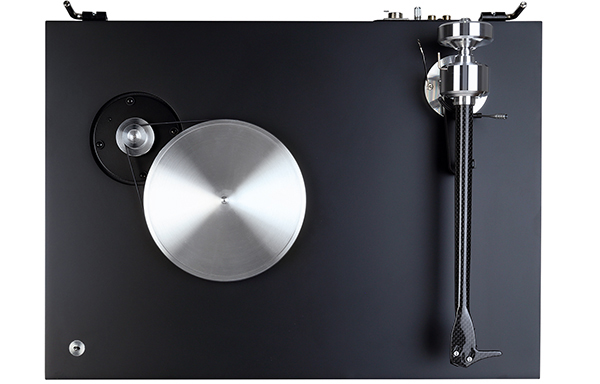
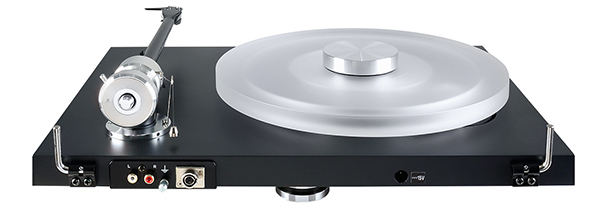
Nevertheless, the turntable’s minimalistic styling is familiar – the satin black finish and the speed select toggle are very reminiscent of the Debut PRO [HFN Sep ’21], and as with that model there are no other colours yet available (Pro-Ject later introduced a striking all-white edition for the PRO). You don’t expect the underside of a deck to be visually interesting but here there are three height-adjustable TPE-damped feet that serve to decouple the Debut Reference 10 from incoming vibration. Their shiny aluminium finish adds a touch of class to the design, too. At 462mm wide, this is an over-sized model by Pro-Ject standards, although CEO Heinz Lichtenegger suggests this is much preferred by today’s vinylistas.
Made from MDF, the 2.5cm-thick plinth appears quite solid. And it is, as Pro-Ject only mills out the minimum required for the placement of motor and wiring, keeping the chassis infills well damped to minimise vibrations. This is distinct from many budget decks, which occasionally have more air than solid material inside.Clocking in at 6kg (including the sub-platter and platter), the Reference 10 is far from the costliest mass-loaded Pro-Ject deck, however, that crown going to the mighty, range-topping Signature 12.2 [HFN Jan ’26] at 37kg.
The sturdy feel of the unit is only reinforced by the semi-transparent acrylic platter. It’s a solid choice with surprising qualities – I often play discs without a mat on platters made of this material with good results. Some thought has gone into its implementation too. There’s a slight circular depression in the middle, creating space for the label on the bottom of an LP. This is particularly useful when using the bundled 190g Record Puck E, flattening the disc without stressing it.
Simply does it
You will not need the manual to figure out how to operate this turntable. There’s exactly one control, a toggle switch with three positions: ‘33’, ‘OFF’, and ‘45’. Power is from an external 15V DC adapter, which Pro-Ject augments with an AC drive synthesiser inside the deck itself.
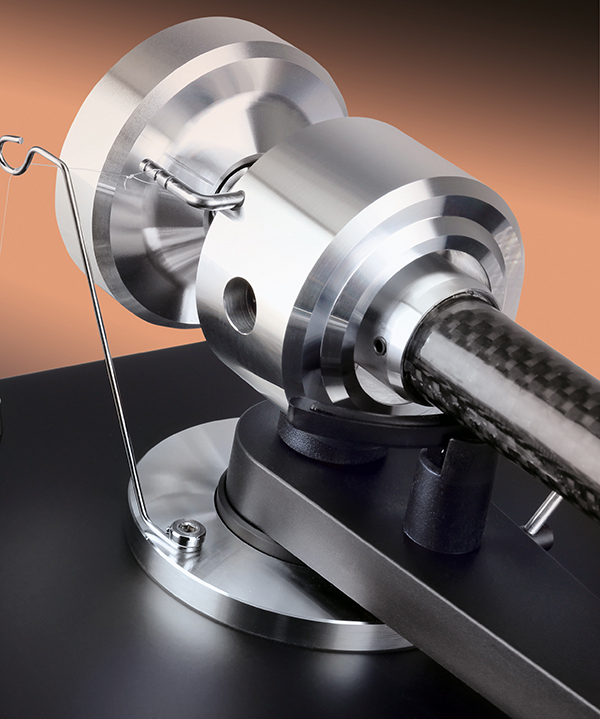
Against the plinth’s black backdrop, the one-piece tonearm certainly stands out with its polished aluminium elements [see opposite]. While it’s not clear if the carbon-aluminium wand is new, Pro-Ject’s ‘premium’ bearing block certainly is. The latter includes grub screws in the tonearm flange, allowing for VTA and azimuth adjustments – making the Debut Reference 10 upgradable with a wide range of carts. Pro-Ject is an advocate of fixed headshells, believing this offers superior performance, so changing cartridges here requires a bit more work than on a tonearm fitted with a detachable headshell.
The Reference 10’s new tonearm has a rear screw thread for the counterweight, which is an improvement over the smooth finish of previous Debut arms. As it requires some force to mount and adjust it, you’ll need to be careful not to accidentally shift the position of the arm and damage the stylus. On the upside, once set, the counterweight’s TPE insert holds it securely and maintains the desired downforce.
A little goes a long way
Otherwise, setting up the Debut Reference 10 is about as easy as it can be while still retaining audiophile capabilities, such as the adjustable tonearm and decent sub-platter/platter construction. Over the past years Pro-Ject has refined its packaging and manuals, adding little tweaks to ensure that getting the turntable ready to play is not a challenge. Okay, it’s just a small thing, but putting all the ‘bits and bobs’ in an envelope instead of secreting them within parts of the packing material means an end to time-wasting games of ‘spot the anti-skating weight’.
There are two belts supplied with the Debut Reference 10: a flat one for regular 33/45 use, and a glued round-section belt for anyone still hoarding 78rpm shellacs. The bundled Pick it PRO B cartridge is mounted and set up at the factory – a quick check with a protractor confirmed this was good to go.
 Ten of the best
I used the Debut Reference 10 in a system way above its pay grade, with a Musical Fidelity M8x Vinyl phono stage [HFN Mar ’25] between it and a Primare PRE35/A35.8 amp system [HFN May ’22], driving a pair of DALI Epikore 3 standmounts. The MF and Primare units have balanced connections so I didn’t use the Connect it Phono E RCA supplied with the deck, but my own dual-XLR Connect it DS cable.
The Debut Reference 10 delivers a lively and crisp sound, with relatively tight bass and no distractions from the hardware itself to hinder the depiction of fine details. It’s not over-delicate either, which makes it suited to both audiophile fare and less refined recordings. I enjoyed how it showcased the plucked strings in ‘Blinding’ on Florence + The Machine’s 2009 Lungs album [Moshi Moshi 2709106], giving them a distinct position in the soundstage without removing the focus on Florence Welch’s vocals.
‘Dog Days Are Over’ and ‘Rabbit Heart’ offered more of the same, the Debut Reference 10 giving an exciting, rhythmically solid rendition of these ‘baroque pop’ compositions. The bass was perhaps slightly tauter than I prefer, but I appreciated how Pro-Ject’s new Debut turntable handled the layers of instrumentation and vocals – there was certainly no ‘muddiness’ here.
‘Ruins’, from American band Sleater-Kinney’s The Center Won’t Hold [Mom + Pop Music 7790841], brought distorted guitars and vocals, and the Debut Reference 10 struck a fine balance between creating a wall of sound and delivering plenty of musical detail. This isn’t easy with this kind of alternative/indie rock, where a lot of big, chunky sounds vie for your attention and blur into a whole – such a sound can be enjoyable in its own way, but often falls flat on audiophile turntable/cartridge combinations.
The following track, ‘Love’, was arguably more up the Debut Reference 10’s street, allowing it to create a wider soundstage within which synth and guitar appeared perfectly placed. It’s hard to say if this was due in part to the balanced connection, but the sense of bountiful resolution against a dark background was excellent.
The right stuff
While making hay with grand set-pieces, the turntable also proved itself a strong, involving performer with the simple orchestrations on Cunningham Bird [Loma Vista LVR04544], the track-by-track homage to the 1973 Buckingham Nicks set by Lindsey Buckingham and Stevie Nicks – and one of my go-to demo discs. The instrumental ‘Stephanie’ was one highlight, with its rich cello contrasted against nimble acoustic guitar, but it was ‘Without A Leg To Stand On’ where the Debut Reference 10 really flaunted its audiophile upbringing.
Here were delicate details galore, all part of a coherent, enticing picture that, tonally, found the deck and cartridge hitting all the right notes. A hint of treble roll-off served to keep the duet singing of Madison Cunningham and Andrew Bird sweet, but didn’t deprive string instruments of their authentic character.
Miles Davis’ Quiet Nights album, his last collaboration with Gil Evans, has been re-released many times since it debuted in 1963, but Music On Vinyl’s 180g pressing from 2023 [MOVLP2675] is one of the best – a delicious rendition, full of tonal and textural nuances to expose Davis’ artistry. The Debut Reference 10’s penchant for an energetic but also detail-packed delivery was well suited here, ensuring the simple tick of the percussion to the right of the soundstage in ‘Aos Pés Da Cruz’ wasn’t buried in the mix.
The album was recorded at 30th Street Studios, New York, with a star-studded cast, but is all about Miles Davis’ playing. Pro-Ject’s deck gave me nothing to complain about, presenting his trumpet (and the supporting brass) in a powerful yet fluid manner, highlighting but never overstressing the highest notes. It was enthralling to listen to, the Debut Reference 10 making more of this high-quality recording than almost any other £1000 vinyl package I might name.
Hi-Fi News Verdict
True to the original mission statement of the Debut line, the Debut Reference 10 is an excellent ‘next step’ for vinyl lovers in search of a turntable offering audiophile qualities – without making their discs with ‘fun’ music unpalatable. It’s more than a simple upgrade, though. As the flagship Debut deck, it’s a complete package with features you’d expect on more expensive models, making it a bit of a steal.Sound Quality: 89%
 | |||||||||||

|
|
| |||||||||











 SPONSORED VIDEO






| Equipment Reviews | |
Music Reviews Awards | |
Latest News Features | |
Resources Newsletters | |
Subscriptions |
WHERE TECHNOLOGY BECOMES ENTERTAINMENT
 © 2026 Hi-Fi News
AVTech Media Ltd
All rights reserved