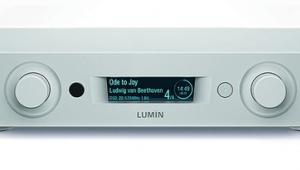
Lumin X2 network-attached DAC
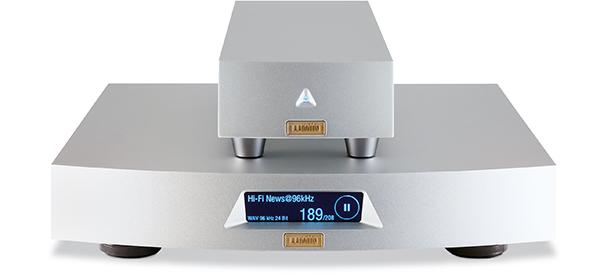

Here’s one in the eye for anyone still convinced that hi-fi is being taken over by unknown brands bringing in cut-priced equipment. Not only is Lumin very well-established, having launched its range back in 2012, it’s been expanding that lineup ever since to cover a wide range of market sectors. Lumin now has a half-dozen network players, three music transports, two dedicated music servers and an all-in-one player/amp system – while continually developing its in-house technologies.
It’s a trend becoming increasingly common as brands that once entered the market as disruptors, challenging the status quo, are now expanding their offering and becoming ever more ambitious. So, while the Lumin range may start below £2000 with the U2 Mini network transport, it now extends all the way up to the X2 player here, at a decidedly upmarket £12,995.
Fresh technology
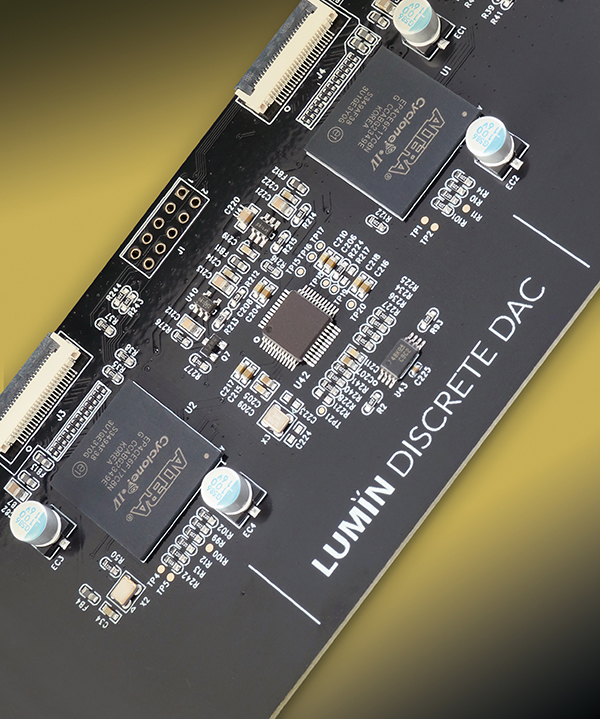
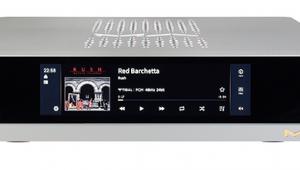
Yes, it still has the compact form-factor that’s a Lumin hallmark, with the milled-from-billet alloy casework just 35cm wide, and the company’s in-house operating system complete with a matching app for control, but much here is new. Fresh technology starts with an upgraded processing core and runs through to the company’s own discrete DAC, designed and implemented on high-speed FPGAs [see picture, below] rather than adopting one of the popular third-party solutions found in many a rival player.
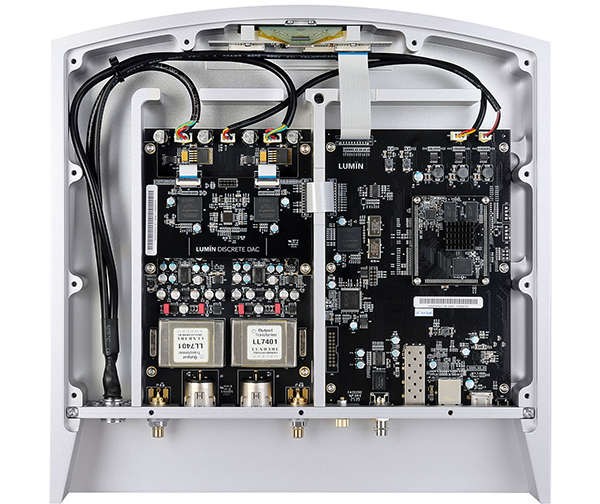
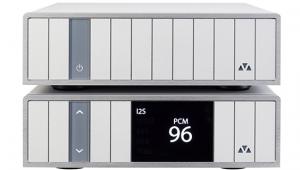
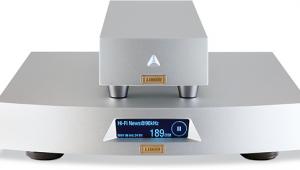
What is the X2? Well, it’s a complete network playback solution, powered from an off-board PSU housed in a slender second chassis, just under 11cm wide and linked to the main unit via a multicore umbilical cable. In an enclosure of thick aluminium, just like the main player, the power supply uses dual toroidal transformers to deliver separate feeds to the analogue and digital sections of the X2. The whole system is available in either black or raw (silver) anodised finishes, and the main player section sits on isolating feet from IsoAcoustics.
Freed from the need for, and potential disadvantages of, an internal power supply, the X2 player uses Lumin’s usual ‘upside down’ layout, in which the baseplate forms the ‘lid’, and all the circuitry within is hung from that substantial one-piece aluminium case. The custom DAC endows the player with the ability to handle file formats all the way up to 768kHz LPCM and DSD512, making it pretty well future-proofed for anything the user may choose to play. Data flow is governed by dual ‘Femto clock oscillators’ and the output from Lumin’s ultra-high-speed FPGA DAC flows through a similarly bespoke, dual-mono analogue buffer stage with, unusually, a Lundahl transformer-coupled output.
Ringing endorsement
If that mix of in-house digital technology and artisan thinking wasn’t enough, the X2 also offers an MQA-developed Qrono d2a filter option. This digital filter, with its own noise-shaping, uses what are described as ‘specialised minimum phase filters to eliminate time-domain distortion and ringing to improve sound quality’. PM delves deeper [see boxout], but I’m not too sure what it’s doing in this player, given Lumin’s claims for its own digital processing and conversion. Still, Qrono is there if you want to give it a try.
The X2 also allows upsampling to a maximum of DSD256 or 384kHz for all files, accessed via the Lumin control app, which is available for Android, Apple iOS on handheld devices and Macs, and Google Chromebooks. Compatibility here includes UPnP, Amazon Music, the Connect versions of Qobuz, Spotify and Tidal, TuneIn Radio and AirPlay. The player is also Roon Ready and Audirvana-friendly.
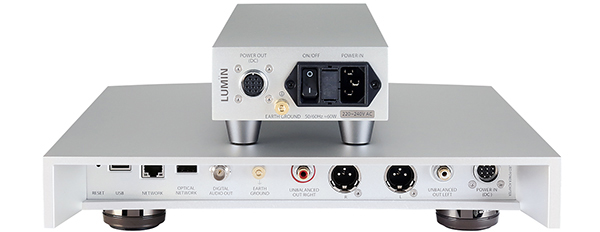
Networking is via Ethernet, either using conventional or fibre connections. A USB-A port, to which storage devices can be connected, also doubles as a digital audio output, should you feel the need to use the X2 into an external DAC. There’s also an S/PDIF digital output on a BNC connection.
Analogue outputs on both unbalanced RCAs and balanced XLRs deliver either a fixed level for use into a preamp or integrated amplifier, or variable using the familiar Leedh digital volume solution.
 Nothing to see here
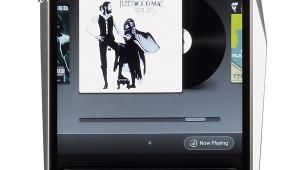
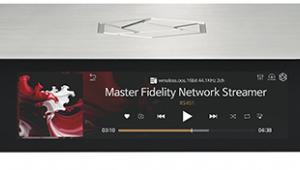
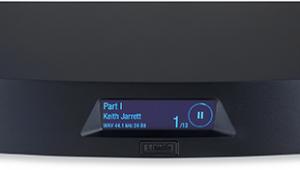
The Lumin app makes setting up the player simple and using it a pleasure. Indeed, while an IR remote is offered as an extra, the app is a must-have as the X2 itself only has a no-frills blue on black display set into its thick front-panel.
The sound is also remarkably simple, in that it’s simply remarkable. The X2 is a classic ‘get out the way of the content’ device, so with high-quality recordings it can sound absolutely stunning, while with so-so or poor engineering and/or mastering, it takes no prisoners.
For example, with Leif Ove Andsnes’s glorious recording of works by Norwegian composer Geirr Tveitt [Simax Classics PSC1418], the scale of the piano and its presence in a well-judged acoustic were wonderfully realised. The sound had warmth but also a level of definition that was almost nonchalant – it was just there, without any sense of the player making a song and dance of how well it’s doing.
Even with the occasional roughness of the monumental Wings Over America live set from 1976 [MPL/Capitol UICY-80472/3] – think ‘Live And Let Die’ with everything turned up to 11 – the ability of this Lumin player to present the music with total conviction proved hard to resist. And that was as true with the belting ‘we’re a rock band, honest’ numbers as it was with the cutesy but crowd-pleasing retro-Beatles sequence, including a clean and simple version – could it be otherwise? – of ‘Blackbird’.
No fear
The resolution offered by the X2 was also clear to hear with the prog/jazz fusion of Soft Machine’s recently released Thirteen [Dyad Records DY034]. Yes, it may be a half-century since the band was formed but their sound remains vibrant – the powerhouse drumming, tight, funky bass and soaring guitar (plus a whole lot more) clearly held no fears for this Lumin player. It got into the groove while giving the listener a clear view into the complexities of the tracks.
Fed with something seemingly simpler but perhaps even more challenging – the vocal intricacies of the Tallis Scholars ensemble on their new set of compositions by Nico Muhly [No Resting Place; Linn Records CKD790] – the sense of the X2 relishing the sheer quality of the recording was almost palpable. The 11 voices intertwined deliciously in the reverberant space of the Chapel of Merton College, Oxford, captured in exemplary fashion by Philip Hobbs, and the result was as spine-tingling as the promise of the album’s chilly cover image of a wall of ice.
Best of Britten
Striking, too, is the power and passion of the 1965 Britten/Richter recording of Schubert piano duets, recorded in Aldeburgh’s Jubilee Hall for Decca and re-released, remastered, in 2000 [466 822-2]. Here, the Lumin X2 positively shone in its depiction of the playing and mastery of the two performers. Maybe the recording is just a little too close-up, but it’s hard not to like the intimacy of the music-making in this relatively compact venue.
Similarly, Japanese/American singer Hikaru Utada’s Live Sessions From AIR Studios 2022 set [Sony Music Labels, Inc., via Tidal] sounded totally radiant. The stripped-back ‘Beautiful World’, at first ethereal and luminous then slipping into a relaxed groove with a tight bassline, was splendidly handled by this assured digital player.
Transparency aside, this isn’t one of those hi-fi products that’s entirely dependent on state-of-the-art recordings – though it sounded magnificent with Truls Mørk’s reading of Kodaly’s Sonata For Solo Cello [2L-177; 352.8kHz/24-bit].
Instead, the Lumin X2 proved capable of working its magic with everything from streams of BBC Radio 3’s Music Map series to the warm glow of Sinatra’s 1961 Ring-A-Ding-Ding! album [UMG 0602527800394]. The voice, the lush arrangements and fine musicianship were all so easily rendered here that it was hard not to make this the jumping-off point for a deeper dive into the Sinatra catalogue – which I think equals very much ‘job done’ for the X2.
Filter feelings
After several days of auditioning the player, and confident of its qualities, I allowed myself briefly to be distracted by the MQA Qrono d2a filter option. Its impact was not consistent across all recordings – more a case of ‘different’, rather than the revelatory experience some commenters seem to find it. Arguably, the basics of the X2 are so good that this kind of ‘fiddle factor’ is rendered superfluous. Frankly, the best approach here is to hook up the player (I found the fibre optic connection from my router to the Lumin X2 offered marginal gains in transparency over conventional wired Ethernet), sit back and enjoy.
So that’s what I did, taking in the dark drama of Sondheim’s musical Assassins in the original 1991 off-Broadway cast recording [RCA/Victor RD60737]. And yes, through Lumin’s X2, it sounded twisted, ominous and unnerving – perfect.
Hi-Fi News Verdict
Undoubtedly brilliant but equally unashamedly expensive? That’s one way of viewing this flagship player from Lumin, but the former consideration more than justifies the latter, at least in a suitably revealing system, so transparent and entirely musical does it sound. By all means play with the options available if you must – but you’d do just as well simply to sit back and allow its remarkable abilities to wash over you.Sound Quality: 90%
 | |||||||||||

|
|
| |||||||||

















 SPONSORED VIDEO






| Equipment Reviews | |
Music Reviews Awards | |
Latest News Features | |
Resources Newsletters | |
Subscriptions |
WHERE TECHNOLOGY BECOMES ENTERTAINMENT
 © 2026 Hi-Fi News
AVTech Media Ltd
All rights reserved