Kimber Kable Carbon interconnect cable
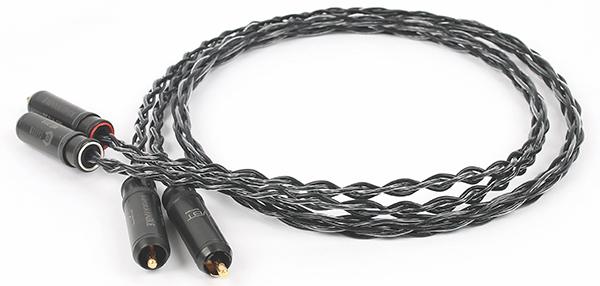

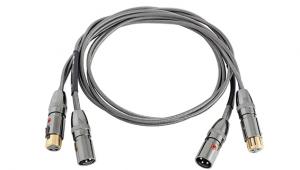
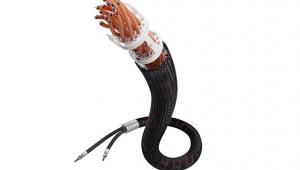
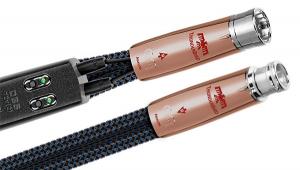
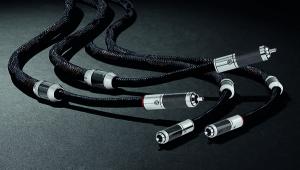
If Kimber Kable could be said to have a core philosophy then the sage advice ‘if it isn’t broken, don’t fix it’ would come very near the top. Of course, Kimber does have its own longstanding USP in the form of its ‘VariStrand’ conductors, braided geometry and use of both PE and PTFE dielectrics, depending on a cable’s position in the range. Copper is still the material of choice in this Carbon interconnect, each conductor comprising seven strands of four different diameters. These strands are clamped within a ‘carbon-infused polymer’ that forms an electrostatic screen, while a Teflon sleeve provides a final insulating layer with superior dielectric properties. Four of these conductors, for left and right channels, are woven into Kimber’s familiar braid.
Plait for performance
Using several conductors for each side of the cable offers a sensible compromise between cable capacitance, shielding and linear resistance. The latter will be determined by the conductivity and gauge of the metal (four 19.5-gauge OF copper conductors per side in this instance) and amounts to a low 45mohm/m loop. Alongside, the Carbon’s 86pF/m parallel capacitance lies midway between that of the VariStrand/braided Kimber KC-1 interconnect I tested in 1992 and the Hero in 1998. Well, I did say that Kimber had been ‘doing its thing’ for a very long time...
However, following in the footsteps of Kimber’s Axios headphone cable, this latest interconnect also has the two conductor pairs in both left and right channel legs braided together. This, in addition to the ‘carbon polymer’ infill within each conductor core, has pushed the overall series inductance down to a low 0.28µH/m. The result is that Kimber’s Carbon interconnect looks to be a very ‘unfussy’ customer and likely to perform very consistently, over moderate lengths, in a wide variety of hi-fi systems.
Pricing depends on your choice of termination. Fitted with XLRs or WBT-0114 Cu (copper) RCAs, as pictured and tested here, a 1m stereo pair costs £652, or £884 for a 2m set. Opting for WBT-0114 Ag (silver) RCAs takes the price to £757 for a 1m set and £989 for 2m.
 Carbon capture
I had the opportunity to compare Kimber’s Carbon with some spectacularly high-end interconnects from Crystal Cable and Transparent, and did this self-effacing interloper come up short? No it didn’t, even when laced between the dCS Varèse streamer/DAC [HFN Feb ’25] and Constellation Revelation 2 preamplifier [HFN Jan ’25] that front the system in our Listening Room [HFN Yearbook ’25].
There’s a sense of balance, of quietness, subtlety and smooth detail with this cable that harks right back to Kimber’s classics like the late-’80s 4TC speaker cable. The brass-rich overtones of Too Many Zooz’ ‘Warriors’ [Subway Gawdz; CD res.] soared, rich in timbre and boosted by the band’s typically potent bass line. The instruments were reproduced with bite and weight but also with a harmony that invited turning up to ‘11’ without fear of fatigue. Hand-in-hand with this relaxed outpouring of musical detail comes an equally unforced impression of acoustic space, exemplified by the opening timpani of Copland’s Fanfare... with Eiji Oue marshalling the Minnesota Orchestra [Reference Recordings RR-93]. Kimber’s Carbon did little to limit the potential of ‘Prof. Johnson’s most exciting sound’ or curtail the expansive scope of the concert hall. Step inside and time will simply fly by.
Hi-Fi News Verdict
Audiophiles prone to long, exploratory listening sessions will find Kimber’s Carbon interconnect to be an amiable companion on their journeys into fresh musical pastures. There’s no forensic insight here, no emphasis of bright leading edges or ‘plumping up’ of bass. Instead, Carbon seemingly brings composure, a quiet calm and dignity to performances that might just as easily get out of control. If you value natural sound, Carbon is your organic choice.Sound Quality: 89%












 SPONSORED VIDEO






| Equipment Reviews |  |
Music Reviews Awards | |
Latest News Features | |
Resources Newsletters | |
Subscriptions |
WHERE TECHNOLOGY BECOMES ENTERTAINMENT
 © 2026 Hi-Fi News
AVTech Media Ltd
All rights reserved