Archiving analogue audio
I am always looking for easier ways of archiving analogue audio recordings. Most legacy audio capture, from LP, CD, tape or video soundtrack, will involve converting the analogue signal to a digital stream and sending it to a computer running a program like the excellent, and free, Audacity.
Hardware is needed for this, of course. There are now many capture ‘dongles’, including some available from China via the Internet for around a tenner a time, which take in an HDMI signal and put out a USB stream. These dongles are ostensibly sold for use by gamers who want to boast about their gameplay. But they have a much wider range of audio and video uses because they ignore the HDCP copy protection system which is supposedly built into all HDMI hardware.
Older AV gear – and some real hi-fi – will not have an HDMI output. Fortunately there are many devices available, again beginning from around a tenner, which will convert just about any analogue signal to digits. Conversion quality will generally depend on the device price. And remember that the output can’t be better than the source!
In and out
You also get what you pay for when buying a turntable with a built-in analogue/digital converter (ADC) and USB output, or a standalone ADC with analogue line inputs and USB out.
Before the vinyl revival, after amps stopped sporting phono cartridge inputs and before the advent of turntables with onboard USB conversion, Pro-Ject launched a clever little box which took in MC or MM phono and EQ’d and ‘preamped’ to line-level while also using an ADC to output a USB stream.
I thought I was being helpful when I suggested adding a switch that could bypass the phono preamp and so let the user plug in a line-level audio feed and use the built-in ADC to output a signal over USB. However, a Technical Services Manager was so quick to shoot me down in flames that I think he may have missed my point: ‘Bypassing the “preamp” doesn’t make sense for a phono stage, because all you’d be left with is a very low signal output, which wouldn’t be much use for recordings via the USB’.
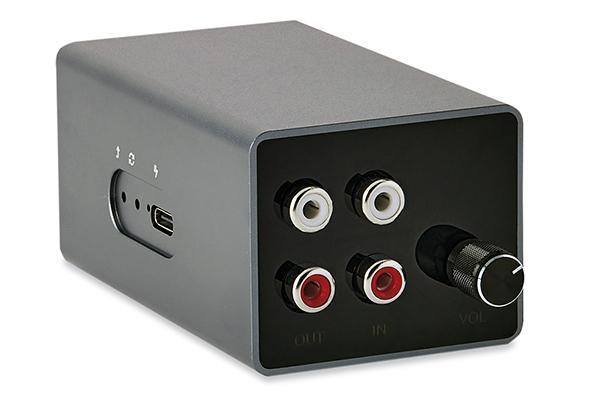
So my curiosity was roused when British company A2D2 recently announced a £159 conversion box, called Stream [pictured above], that takes in line-level analogue stereo and outputs a digital stream which can be home-networked by Wi-Fi, Bluetooth or Ethernet.
Just point a web browser at the device’s page address (http://a2d2.local/) and up comes a menu of playback options including Bluetooth for headphones or players, AirPlay, Chromecast, HEOS (Marantz/Denon), Sonos and Alexa, plus ‘Listen on this Device’ with the choice of 48kHz or 96kHz audio quality. A phone app can also be used to control it all.
Let’s play
I fed an analogue stereo line out from a hi-fi amplifier into the A2D2 Stream, and sent the digital signal over Ethernet to my home network. Using the ‘a2d2.local’ webpage, I chose ‘Play on this Device’ and clicked ‘Play’. This gave the choice of listening to the stream through speakers and/or capturing it with Audacity. As someone who never ceases to be frustrated by computer stuff that does not do what it says on the tin, I was pleasantly astonished to hear music play and see the software capturing it.
According to A2D2 the option to feed analogue line-level audio into the box and get out a USB digital stream is ‘on the roadmap’, along with FLAC encoding. The A2D2 box could then be a killer hi-fi capture device.

















 SPONSORED VIDEO






| Equipment Reviews |  |
Music Reviews Awards | |
Latest News Features | |
Resources Newsletters | |
Subscriptions |
WHERE TECHNOLOGY BECOMES ENTERTAINMENT
 © 2026 Hi-Fi News
AVTech Media Ltd
All rights reserved