Back to the future
Who needs Dolby Atmos? New models from British brand EJ Jordan remind Steve Harris that there’s a long history of loudspeakers designed to better capture that ‘concert hall’ feeling
An early idea of hi-fi was that it should be ‘a window on the concert hall’. But then, with stereo, came the hope that you could feel as if you were in the concert hall. Enter the Bose 901, launched in 1968 and in production until 2016. With eight 100mm drivers arranged in a V-shape on the back, and just one in front facing the listener, reflected sound meant the 901 filled the room like no other speaker. Was this the true sound of a concert venue, though? I don’t think so.
Lens flair
In the 1970s, Swedish designer Stig Carlsson claimed his omnidirectional Sonab designs were ‘the only speakers in the world designed for use in a regular home’. Again making use of room reflections, they effectively sounded the same from any listening position.
In the 1990s, the mushroom-shaped S series speakers from Canon revived an old concept of a driver pointing at a conical reflector, the latter being shaped to give wide rather than omnidirectional dispersion. And in the 2000s, Bang & Olufsen’s high-tech BeoLab 5 used ‘Acoustic Lens Technology’ to give a claimed flat response across a horizontal angle of 180o, again giving a wide listening area.
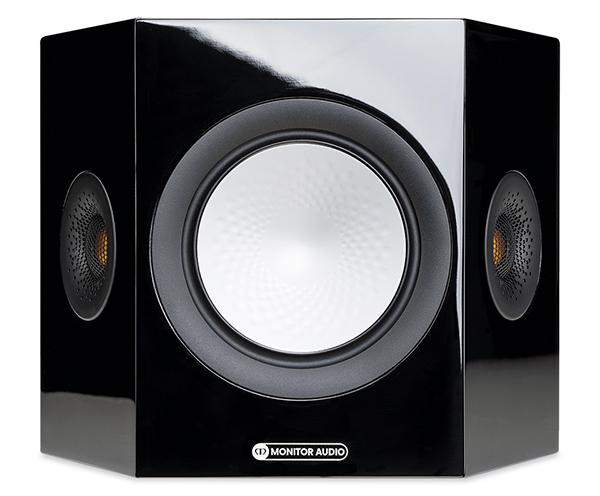
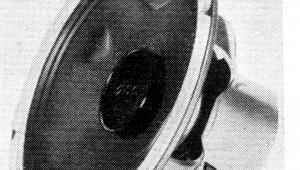
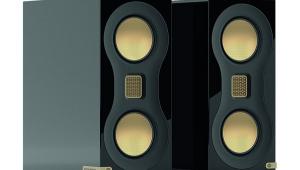
Today there are some amazing high-end omnidirectional speakers, but most hi-fi designs still have only forward-firing drivers. You’re more likely to find multi-directional models being used in home theatre systems – such as Monitor Audio’s on-wall ‘FX’ units [see pic, right], which are switchable between bipole and dipole configuration. If two opposite drivers are in-phase (both cones moving out at the same time), it’s a ‘bipole’. If the two are out-of-phase (one moves in while the other moves out), it’s a ‘dipole’.
Panel speakers are necessarily dipoles. In the case of the Quad ESL [HFN Nov ’57], the rear output was unwanted and curbed by damping material, but what was then considered a necessary evil has now become a virtue.
With little output from the sides, a dipole won’t add unduly to the early reflections from nearby side walls, which arrive too soon for the ear/brain to distinguish them from the direct sound. But sounds from the rear arrive at the listener’s ear later, to be perceived as added depth or space.
By contrast, a bipole is more omnidirectional and boosts the bass. But there’d hardly been any bipolar music speakers since the Mirage M-1 and M-3 of the late 1980s – until recently, when EJ Jordan unveiled its new flagship, named for that iconic London recording venue, the late-lamented Kingsway Hall.
When I asked director/designer Colin Shelbourn why he’d created a bipole, he explained that the Mirage designs had been an influence, also pointing to an article by Duke LeJeune, ‘The Controlled Pattern Offset Bipole Loudspeaker’. And the Kingsway is an offset design, with two of Jordan’s Eikona drivers at the front and two more mounted lower down at the back. ‘The Eikona, like any 100mm cone speaker, has an increasingly directional response above 3kHz’, says Shelbourn. ‘The rear drivers help balance this, the reflection from side walls adding more air and ambience to the sound.’
But, he claims, ‘the forward drivers maintain the focus and clean imagery of a standard, forward-facing Eikona speaker’.
There’s now no need to compensate for loss of output below the ‘baffle step’ frequency, and (because they are lower) the rear drivers also fill in the ‘floor dip’ in the lower midrange. The speakers can also be placed further apart.
Some will say this is all irrelevant in the era of Dolby Atmos, but I’m glad developers still care passionately about good old two-channel stereo, and about old recordings with fabulous acoustics. Long may they flourish.




















 SPONSORED VIDEO






| Equipment Reviews |  |
Music Reviews Awards | |
Latest News Features | |
Resources Newsletters | |
Subscriptions |
WHERE TECHNOLOGY BECOMES ENTERTAINMENT
 © 2026 Hi-Fi News
AVTech Media Ltd
All rights reserved