Herbert von Karajan Conductor in control
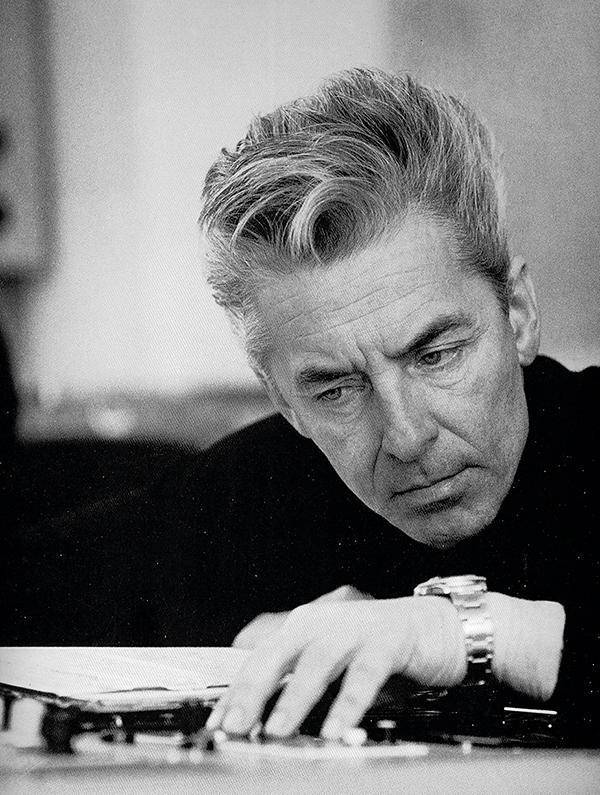
He was the first conductor to actively embrace each new phase in recording: from 78s to digital discs and then film. Christopher Breunig looks back at his orchestral work
The Austrian conductor Herbert von Karajan would become the most discussed, photographed and written about musician of his time (nowhere better than by Richard Osborne in his masterly Faber biography). He was born in Salzburg in 1908 and in 1989 suffered a fatal heart attack in the company of Sony executive Akio Morita, at Karajan’s home in Anif. Whether or not his dream of reincarnation as an eagle came true we’ll never know.
He had taken part in the Salzburg launch of compact discs with Morita in 1981, declaring the technology ‘a miracle’. With a new means of editing, digitally, ‘all else is gaslight’, he remarked.
During the war years Karajan was appearing in occupied Paris and The Netherlands. It was in the latter, in 1943, where he made recordings with the Concertgebouw – these were issued in a 1988 DG set, The First Recordings [E4776237; now download only]. But more intriguing was an experimental stereo finale of Bruckner’s Eighth Symphony, made with the Berlin Staatskapelle, issued briefly on a Koch CD.
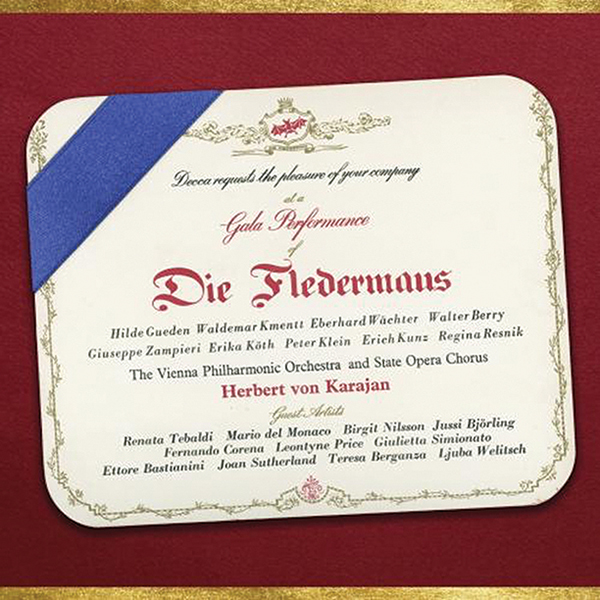
Above: The Strauss Die Fledermaus, with ‘Gala Concert’, is newly remastered for SACD and LP [Decca 4871546]
Having fallen out of favour with the Nazis, he and his wife sought refuge in Milan. Postwar, Karajan’s big break came in war-torn Vienna, short of both food and electricity, when Walter Legge sought permission for him to record with the VPO. When it came to Brahms’s Ein Deutsches Requiem, Legge was amazed when Karajan presented a list of all the most suitable 78rpm disc side-changes!
The two became musical ‘alter egos’, Karajan just the man to develop and hone Legge’s new orchestra, the Philharmonia. Apparently when rehearsing his London debut programme he tried to influence his soloist, the great Dinu Lipatti, concerning every phrase of the Schumann Concerto.
Later, he did seem to ‘collect’ young players like Christian Ferras, Géza Anda and Christoph Eschenbach, or fashionable ones like Evgeny Kissin and Lazar Berman when they came to the West. There was also the controversial Ivo Pogorelic – a collaboration that never was! Violinist Anne-Sophie Mutter, of course, was Karajan’s most notable protégée, recording Mozart concertos with him when she was only 15 years old.
A move to DG
Legge realised that he’d lose Karajan to Deutsche Grammophon when the 1963 BPO Beethoven Symphony cycle appeared. It’s been variously reissued and last came on a 6CD+ Blu-ray limited edition with original LP artwork [DG 4793442].
True, the ‘Pastoral’ was better done in the earlier 1953 EMI recording, and the Eighth most impressively in the 1984 digital version, but this would be my ‘cycle choice’ of Karajan’s four.
Done piecemeal, the previous Philharmonia set was remastered by Warner and reissued in December 2025 as 96kHz/24-bit downloads [Warner Classics 2685409605]. Also in 2025, Warner made high-res transfers of Karajan In Paris, late-’70s recordings surveying Berlioz, Bizet, Chabrier, et al with the BPO.
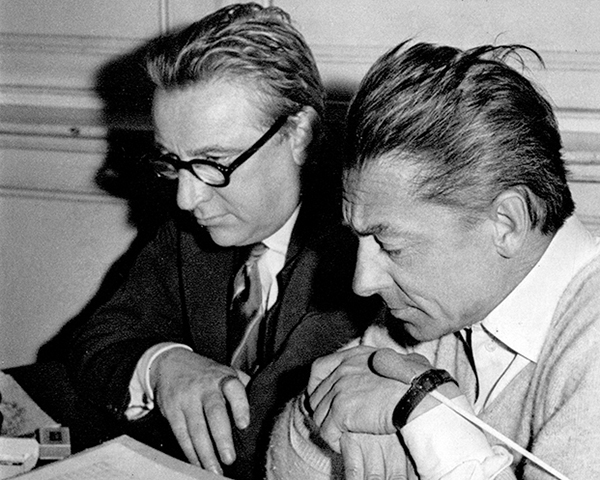
Above: ‘Musical alter egos’: Walter Legge, looking rather self-conscious [left], sitting with Karajan in 1955
With Karajan – The Legendary Decca Recordings, Decca brought new artwork (not for the better) to its 2008 9CD Erik Smith/John Culshaw VPO productions set [see Essential Recordings below]. This includes Karajan’s first Also Sprach Zarathustra which involved dubbing in the organ part from a remote military chapel – the Sofiensaal in Vienna didn’t have one. Karajan was delighted with the huge, imported church bell. Stanley Kubrick’s 1968 film 2001: A Space Odyssey had the recording for the later hugely popular ‘Sunrise’ section by arrangement, but it was not credited to Decca or to Karajan.
Turning to film
With each successive step, mono to stereo, analogue to digital, Karajan was quick (but not unique) in re-recording his repertoire. But often, the first recordings were musically more successful – Holst’s The Planets suite with the VPO, for example [Decca], or the beguiling Waldteufel ‘Skater’s Waltz’ from 1953 [EMI]. And while ‘digital’ LPs introduced new repertoire (Nielsen’s Fourth Symphony; Saint-Saens’s Third; Sibelius’s First) it was unlovable.
His completion of symphony cycles by Tchaikovsky, Schubert and Mendelssohn were perfunctory, yet the late VPO Bruckner Seventh and, with the Berlin Philharmonic, Richard Strauss’s Alpine Symphony were glorious by comparison (the latter remixed and improved for DG’s ‘Gold’ CD series). Karajan briefly worked with L’Orchestre de Paris, their collaboration resulting in a very dynamic Ravel La Valse for EMI, which you can hear on YouTube.
When Karajan took his Berlin orchestra to Japan in 1957, the TV viewing figures perhaps made him think that being on film would grant him worldwide audiences. He began with directors like Henri-Georges Clouzot – the Internet has a La Scala Verdi Requiem with a young Pavarotti, Karajan batonless – but soon he did everything himself.
The highly stylised filming which Karajan liked – his players side-lit in a black gloom, a row of double-basses, gleaming brass, timpani sticks bristling in closeup – all looks rather dated now. Sir James Galway has said that, given Karajan’s dislike for his bearded appearance, he had once to provide the sound while a stand-in flautist is seen in the film!
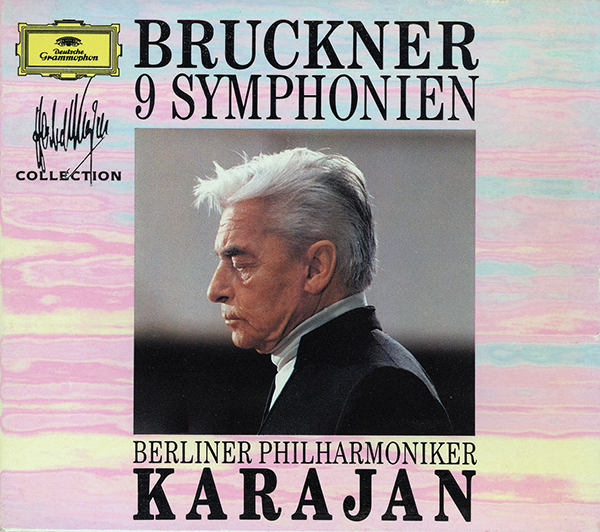
Above: Karajan’s Bruckner Symphonies are now available in a 17LP pure analogue set on 180g pressings [DG 4865436], or as CD-quality downloads [DG 429 648-2]
SACD sets
Recent years have brought numerous documentaries, even showing Karajan’s domestic life – charming images of the family trudging through snow with assorted pets following, and enjoying spaghetti (as in the BBC’s old Barbirolli Monitor portrait!). There is also a subtitled series where Pia Bernauer of the Salzburg Karajan Institute talks to musicians about working with the conductor.
In Feb ’25 and Jan ’26 the Berliner Philharmoniker label produced two expensive 24- and 20-SACD sets of live performances from 1953-69 and the 1970s [BPHR 240291 and 250571]. We’d had Testament live recordings from London visits – including his last, RFH Oct 1988, where the programme, Verklärte Nacht and Brahms’s First Symphony, was delayed by an hour through industrial action in Paris, the players on stage in casual dress. But this was Karajan on home ground.
I think the repertoire in the second box is more interesting – small-scale Bach and a Beethoven Eroica (Vol.1 has no fewer than three Ninths). Surprisingly, there’s RVW’s Tallis Fantasy too. Worth exploring if you have the odd £480 floating about…
And my top tracks for that imaginary desert island? The Waldteufel waltz and, with the VPO, the Strauss Annen-Polka [part of Decca 4780155].
Essential Recordings
New Year’s Day Concert 1987
VPO/Kathleen Battle; DG 4864284 (download)
Karajan’s only New Year’s Day concert. To greater advantage you can see the whole programme on a Japanese YouTube film.
R Strauss Don Quixote
DG 4390272 (44.1kHz/16-bit download)
With Antonio Meneses (who sadly died in 2024) this mellow account complements the earlier version with Fournier.
Shostakovich Symphony 10
DG 4790311 (44.1kHz/16-bit download)
Perhaps the live Moscow version [Melodiya, now deleted] was more intense but this 1966 Berlin is preferable to the digital remake.
The Legendary Decca Recordings
Decca 4780155 (44.1kHz/16-bit download)
Nearly 11 hours of orchestral music, wide in range – from Brahms Symphonies to Peer Gynt and Tchaikovsky ballet suites. Lots of Strauss (Richard and the Johanns), and the remarkable Planets too.
Sibelius Symphonies 4-7
DG 4577482 (44.1kHz/16-bit download)
Pre-Karajan, Sibelius’s music was rarely heard in Germany. Symphony No 4 he said was one of the pieces he found most draining to perform. There’s a live version in BPHR250571. These 1965/’67 recordings, in the Jesus-Christus Kirche and engineered by Günter Hermanns, have stood the test of time.














 SPONSORED VIDEO






| Equipment Reviews |  |
Music Reviews Awards | |
Latest News Features | |
Resources Newsletters | |
Subscriptions |
WHERE TECHNOLOGY BECOMES ENTERTAINMENT
 © 2026 Hi-Fi News
AVTech Media Ltd
All rights reserved