Found in translation
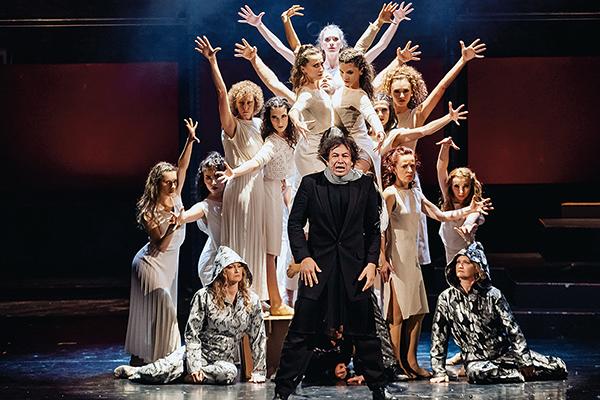
From Puccini one year to Andrew Lloyd Webber the next... Peter Quantrill encounters a rock-opera classic in an unexpected corner of Europe and gets his classical privilege ‘checked’
In June this year I spent an illuminating fortnight at the Bucharest Opera Festival. Last year’s all-Puccini celebration could hardly be emulated, so the programming of the festival turned in the opposite direction. Four staged operas, four ballets, one opera in concert, and… Jesus Christ Superstar. Put on by the Hungarian Opera from the city of Cluj.
What, you might well ask, is Andrew Lloyd Webber’s first musical doing at an opera festival? Sung by Hungarians, in English, in Romania? I’ll admit I was sceptical in advance. Not (I would like to think) because of any innate snobbery about musical theatre. Shows from Oh, Kay! to Les Mis to Hamilton don’t need my seal of approval (they get it anyway). Then there are the cinematic equivalents, from Les Parapluies de Cherbourg to La La Land. Pompous judgment on them dates as badly as Joseph Kerman’s infamous ‘shabby little shocker’ put-down of Tosca.
Proof positive
Over the years, I remained immune to Andrew Lloyd Webber. Partly it was from an uneasy sense of getting second-hand goods. Partly because both he and his style seemed long ago to become a parody of themselves. Jesus Christ Superstar, however – or JCS – is the work of someone with plenty to prove. He and Tim Rice had been working together for five years, but they were still in their early 20s, and they had yet to make a real splash.
Returning to the piece, after I last saw it more than 30 years ago, was an object lesson in prejudice-busting. Is it really a musical anyway? Is it a ‘rock opera’, or a concept album stuck on stage? In the context of operas by Donizetti and Puccini, JCS felt true to itself – and to its time. No wonder the elderly Shostakovich admired it when he saw the first London production in 1971 on his last UK visit – as unlikely as that may appear. Perhaps he enjoyed the Prokofievian accents to Webber’s orchestration: a duet for coiling flutes, crunchy bitonal clashes for the mob.
Licence to thrill
If the blend of rock band and orchestra seems dated to us now, Webber got there first. And plenty of classical composers followed in his wake, such as Alfred Schnittke. In any case, the performance I witnessed in Bucharest was fired with a conviction that can’t so easily be reproduced when the show is done for the 300th time as part of a ten-year run. The Hungarian company in Cluj had a licence to give 20 performances, and this was one of the last of them.
Talking afterwards with some of the performers – such as the Pilate, sung by Balint Szep, whose English was clear as a bell – I discovered that the piece is in their bloodstream, and has been since they were children. They know every word, even the ones they aren’t singing. You can’t buy that kind of commitment. The role of Mary was sung by Yolanda Covacinschi, whose Doretta in La Rondine had captivated me as part of the 2024 festival of Puccini. For her, too, JCS felt like a homecoming: the music she had sung to herself in the mirror as a girl.
Sometimes the clunky gear changes between musical numbers made me wonder if we were missing dialogue: this rock opera is through-composed only up to a point. Sharpened points of rock-orchestral dissonance had me thinking of Journey To The Centre Of The Earth – then I did my homework and realised that JCS precedes Rick Wakeman’s landmark album by three years…
Absence of irony
The charges of blasphemy against it now also seem rather quaint, when The Book Of Mormon has been packing out theatres since 2011. Maybe it’s not just our reactionary times that make JCS ripe for revival beyond Romania, but also a touching absence of irony that crosses boundaries of genre and language.
















 SPONSORED VIDEO






| Equipment Reviews |  |
Music Reviews Awards | |
Latest News Features | |
Resources Newsletters | |
Subscriptions |
WHERE TECHNOLOGY BECOMES ENTERTAINMENT
 © 2026 Hi-Fi News
AVTech Media Ltd
All rights reserved