Devialet Phantom Ultimate streaming loudspeaker
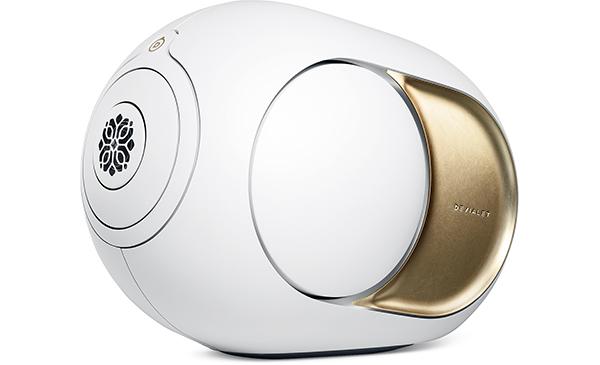

Although the Paris-based audio brand, Devialet, debuted with its groundbreaking D Premier integrated amplifier in 2010 [HFN Apr ’10], it’s arguable that its most well-known release has been the Phantom [HFN Feb ’15]. Launched in 2015, this almost spherical-shaped active, wireless speaker leveraged the brand’s electronics knowhow and eye for a smart aesthetic to shake up the compact hi-fi market. Upgraded models have appeared in the decade since, but only now does the manufacturer feel confident in launching a new ‘Ultimate’ edition.
Just as the recent Phantom II generation offered two options, named for their claimed SPL output, the new model is sold in ‘98dB’ and ‘108dB’ guises, the former 4x smaller than the latter. Naturally, for HFN’s world exclusive review and lab test, we opted for the more potent Phantom Ultimate 108dB, which is yours for £2800 in Light Pearl or Deep Forest colourway, or £3300 in the gold-leaf adorned Opéra de Paris iteration seen here. There’s a saving to be made with the Phantom Ultimate 98dB – Light Pearl and Deep Forest models are £1400, the Opéra de Paris option a touch more expensive at £1650.
Grid games
For the Ultimate series, Devialet has re-examined every facet of the Phantom’s software and hardware design including, of course, the drivers. The Ultimate 108dB features a ‘new-gen’ 25mm alloy tweeter, 110mm ring midrange and 200mm dome woofers, the latter now fashioned from ABS instead of aluminium. The 98dB’s 100mm bass drivers are still alloy, incidentally.

Editor PM discusses these new woofers, plus the Phantom Ultimate’s technical story – which includes Devialet’s Analog Digital Hybrid (ADH) amplification and Speaker Active Matching (SAM) DSP, and the speaker’s spherical design (named ACE, for Active Cospherical Engine) – in his boxout on p63.
This comprehensive re-engineering of the new Phantom is not especially obvious from the outside, as the speaker’s bloodline is retained in the curves of its 246x255x342mm (whd) cabinet and those side-facing bass drivers. But there are external changes here and there. Firstly, the woofers no longer feature a central dustcap, its removal claimed by Devialet to both smarten up the speaker’s look and improve driver rigidity. The tweeter’s ‘grid’ protector has also been redesigned, its Chladni wave pattern altered to improve the Phantom Ultimate’s ‘acoustic transparency’ above 2kHz.
Pair Pressure
On top of the cabinet there are now discreet, soft-touch controls for volume, play/pause/skip track functions, and Bluetooth (v5.3) selection – an optional physical ‘puck-shaped’ remote, colour matched to your choice of speaker and similar to that of Devialet’s Astra integrated amplifier [HFN Aug ’25], is priced £189.
You can, of course, buy a single Phantom Ultimate for a high-performance ‘all-in-one’ to grace a living room, kitchen or office. But the speaker is also designed to be run in pairs – the audiophile default – even though the option to purchase ‘stereo’ on Devialet’s website doesn’t come with any cost-saving: two Ultimate 108dBs, in a standard colourway, is still £5600.
Initial setup, using the brand’s control app [see boxout] becomes a little more complex, as each speaker must be ‘discovered’ separately, and assigned left or right status, before you can establish them as a single system. After that, though, the two units act as one, and will ‘share’ wired sources (a TV connected to one, a CD player to the other, for example) over a bespoke 96kHz/24-bit Wi-Fi network. This needs no configuration on the part of the user.
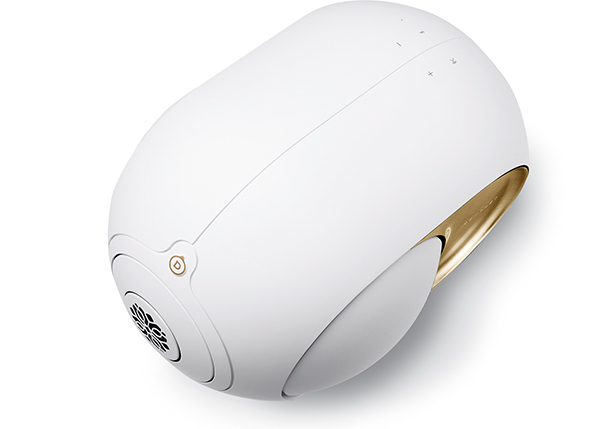
The slickest way to play music through the Phantom Ultimate is via streaming, either from an online service, UPnP server, over Bluetooth, or through Roon, Google Cast, etc. While Devialet’s implementation of Qobuz Connect is still in the works, I found playing music through Roon, instead, to be glitch-free. Choices are limited for external sources. Beyond an Ethernet socket, the only other available wired connection is optical. Devialet’s manual suggests this is good for a TV, but an HDMI ARC connection would be the more ‘modern’ choice here. Probably there’s just enough real estate to accommodate the supplied mains lead, shaped to continue the cabinet curve once installed, wired Ethernet and/or optical cable.
Rooted in Style
There’s built-in Wi-Fi for systems without a hardwired network connection, which is likely how many Phantom Ultimate owners will use it. Over a network, the speaker’s DOS3 processing system, also seen on the Astra amplifier, supports PCM audio inputs up to 192kHz/24-bit. However, with all internal audio processing set at 96kHz, native-rate files will incur the least overhead.
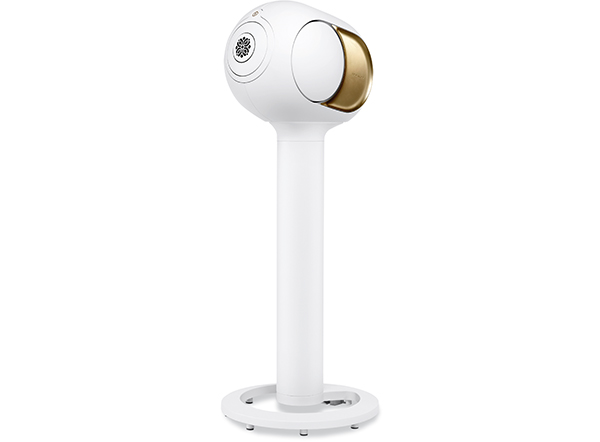
When it comes to installation, I would certainly recommend Devialet’s optional, customised stands. The ‘Tree’ option [pictured below], which are priced £379 each, elevates the Phantom Ultimate by 66cm, and is a perfect aesthetic match for the speaker, and channels mains, Ethernet and optical cables through its ‘trunk’. An alternative, for placement on a table-top, are the 34cm-tall, wooden-legged, Treetops, priced £299 each.
 Wake-up call
While the Phantom Ultimates cannot quite match the ‘big’ sound of a set of towering floorstanders, they do pull off the hi-fi trick of sounding much grander than they look. In the large HFN Listening Room, Devialet’s compact 108dB models – mounted on the Tree stands – seemed to fit right in, such was the depth and drive of their bass, their ability to play loud, and their coherent stereo imaging.
In terms of voicing, and despite their bass presence, the speakers can lean a little on the incisive, if not bright side. Using the ‘Monitoring’ mode designed for critical listening, the sound is clear, forward and focused, with plenty of midband energy. Never a speaker to sound ‘sleepy’, the Phantom Ultimates got into a brilliant, bouncy groove with Sabrina Carpenter’s ‘Espresso’ [Short N’ Sweet (Deluxe); Island Records; 44.1kHz/24-bit], with its club-friendly rhythm and ’80s-style synths, and absolutely nailed the hazy, set-back, processed presentation of her vocals.
As the output is marshalled by Devialet’s DSP, the focused and controlled aspect of the Phantom Ultimate’s performance shouldn’t surprise. This air of precision also extends to its highly effective – albeit not massively extended – soundstaging. With the two units set 3.5m apart, the playful mix of David Essex’s ‘Rock On’, from the album of the same name [Columbia], was on show, with vocals jumping around the stage. Similarly, the echoey intro to ‘Warriors’ by Too Many Zooz [Subway Gawdz; 44.1kHz/24-bit] came with a tangible sense of depth and space.
Push It Real Good
The volume control on Devialet’s app is shown as a dial you ‘turn’ with a fingertip – easy to accidentally set to a level that will have you jumping from your seat. Even sat 4m from the Phantom Ultimates, a halfway setting proved more than adequate.
These speakers ‘open up’ appreciably when their onboard amplification is given a good push. Quiet, background listening is perfectly satisfying, the Phantom Ultimates still conveying the detail and loose-limbed, jam vibe of Don McLean’s ‘Everybody Loves You Baby’ [American Pie, Capitol; 192kHz/24-bit], but these love to play loud – as that ‘108dB’ name suggests. Push the volume and the speakers stay clean and sweet, with instrumental tones well defined. McLean’s ‘The Grave’ particularly enjoyed a full-bore presentation, its quiet sections, with just the singer and acoustic guitar, being smooth and detailed, but followed by moments of astonishing transient attack. Make no mistake, this speaker is quick on its feet…
Whipping up a storm
Feed the Phantom Ultimates high-quality recordings and you’ll find they have lots to give in terms of resolution and effortless listening. Mathilde Storm’s beautifully recorded ballad ‘Cries Like A Baby’ [Propeller Recordings] opened with weighty guitar chords and a pin-point, lifelike rendition of her vocals, before some superbly integrated bass enlarged the performance, followed by lush samples and keyboards. ‘Love Has No Pride’, by Bonnie Raitt [Give It Up, Warner 8122-78378-2], erupted from the Ultimates’ enclosures with a deep, undulating bassline that was superbly balanced by the insight into her heartfelt vocal, and the clear-as-day delivery of the backing instruments.
On first listen, the bass output here will grab your attention. There’s no doubting the LFE reach as Devialet’s SAM technology works in the background to coordinate those two 200mm drivers in a fashion that would be impossible with a conventional passive solution. While this remarkable extension is combined with detail and fluency there are clearly practical limits to its bass amplitude [see PM's Lab Report]. So there was a slight softening to the deepest, loudest bass notes in Paul van Dyk’s ‘Artefact’ [Vandit Records; 44.1kHz/24-bit], which is where a ‘bass-head’ might yearn for a dedicated sub, but this is a trifling niggle considering the all-round sonic appeal of these speakers.
As said, I used the ‘Monitoring’ mode for most of my listening. The app’s EQ tools are useful for adjusting the Phantom Ultimate’s sound to personal taste but remember to pay attention to Devialet’s presets. ‘Music’ mode invokes a ‘Loudness’ DSP by default, while the brand’s Active Volume Levelling is automatically switched on in ‘Movie’ mode. Also seen on Devialet’s Dione soundbar, this works to normalise dynamics – preventing, for instance, movie explosions from drowning out accompanying dialogue.
Snap happy
Clearly, this particular mode should not be used for music listening, particularly as the speakers aren’t lacking in vim and vigour. They leaned into the fireworks of Led Zeppelin’s ‘Ramble On’ [Led Zeppelin II; Atlantic 96kHz/24-bit], Jimmy Page’s guitar riffs slicing through the air, while on the percussion solo during ‘Moby Dick’ there was snap and weight to every kick drum. The varied resonances of the different drumheads were easy to hear, and the precise positioning of every part of the kit across the stereo spread made it easy to visualise John Bonham thwacking away.

It’s with dramatic, well-produced music like this that the Phantom Ultimates seal the deal. With the big, resonant surf guitar vibe of ‘Blue Hotel’ from Chris Isaak’s self-titled album [Warner Bros 925 536-2], the performance felt totally removed from the compact cabinets – and that impression is rammed home when you remember there’s no amp sitting between them either.
Could I happily live with Devialet’s Phantom Ultimates? After listening sessions taking in everything from rock and pop to film scores and classical, the answer is an unequivocal yes. These are a triumph of engineering, style, usability and performance. And the price, compared with separate amplifier, speakers and cabling, seems magnanimous. Phantastic…
Hi-Fi News Verdict
Great balls of fire? Golden globes? Joking aside, Devialet’s Phantom Ultimate 108dB is an astonishing wireless/streaming loudspeaker that should appeal to both casual and audiophile music lovers alike. Stylish on the outside, acoustically and technologically smart within, when run as a stereo pair the system punches well above its weight with a full-range, richly detailed performance.
Sound Quality: 89%
 | |||||||||||

|
|
| |||||||||











 SPONSORED VIDEO






| Equipment Reviews | |
Music Reviews Awards | |
Latest News Features | |
Resources Newsletters | |
Subscriptions |
WHERE TECHNOLOGY BECOMES ENTERTAINMENT
 © 2026 Hi-Fi News
AVTech Media Ltd
All rights reserved