Burson Conductor Voyager DAC/headphone amp
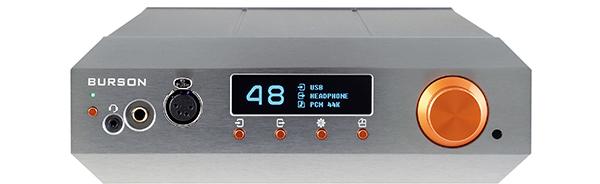

Though perhaps not so well-known in some hi-fi circles, Australian brand Burson Audio has built itself quite a following among head-fi’ers – those devotees of headphone listening – thanks to an impressive range of amplifiers dedicated to that cause. Its models range from the £849 Playmate 3 up to the Conductor Voyager we have here, at £3900 in standard guise – these all now more visible in the UK since Burson inked a distribution deal with Armour Home, the company behind brands such as Grado, Q Acoustics and QED.
The Conductor is the flagship headphone amp/preamp/DAC from Burson’s premium Voyager range, joining a separate preamplifier model plus the 200W-rated Timekeeper Voyager monoblock power amp. Burson, in business in Melbourne for two decades, is heavily based around a number of in-house developments, from discrete op-amps, used instead of the more commonly found integrated circuits, to its own power supplies.
Ready to roll
Products from Burson typically offer an upgrade pathway with the substitution of enhanced op-amps from its range, the solid-state version of ‘tube rolling’, and more advanced power supplies, again all of in-house design. Burson offers a number of guides to its technologies – and instructions on all manner of single and dual-channel op-amp upgrades for the adventurous – on its YouTube channel.
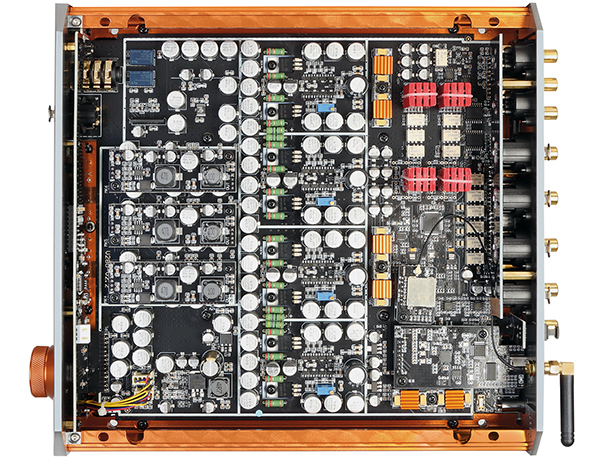
Also core to the Burson proposition is the ‘Cool Case’ in which all its products are housed. This chassis is made from 6mm aluminium panels, fitted together with invisible fixings, finned to boost heat dissipation [visible at the rear, see below], and electroplated to a grey finish. What the company calls a ‘high-performing thermal architecture’ is all about keeping the Class A circuitry of the headphone amps – and the Class AB output of the power amps – at an optimal temperature. Not only is the power circuitry fixed straight to the chassis, but even the fascia panel is part of this unified heatsink concept.
This construction gives the products a distinctive look. Combining an unusual chamfer with that grey finish and bright copper-coloured controls certainly makes the Conductor Voyager eye-catching, even in a headphone amp market where design exuberance isn’t exactly unknown!
Fixed or variable
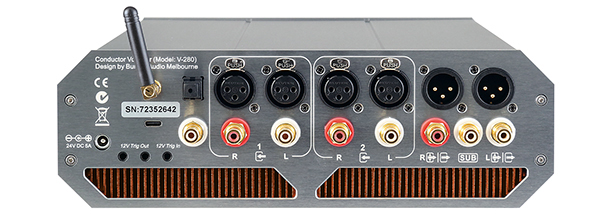
Things are more familiar when it comes to inputs and outputs, where there are two sets of analogue ins, on both unbalanced RCAs and balanced XLRs, along with matching analogue outs. These also provide the option of either fixed level working – for example to use the Conductor Voyager into a pre or integrated amplifier – or variable level to feed power amplification or active loudspeakers. There’s also a single RCA output for a subwoofer.
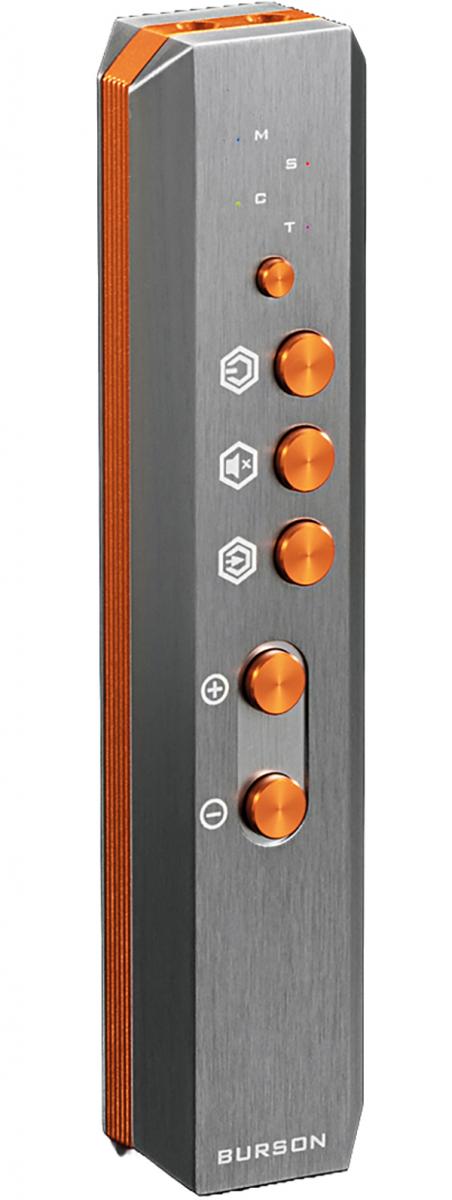
Digital inputs run to optical, coaxial, and USB-C (for computer connection), and there’s also the familiar stubby antenna for Bluetooth. Power to the Conductor Voyager comes from a 24V/5A offboard supply, included alongside a remote handset [see p59] that echoes the styling of the unit. Both USB and 12V trigger cables are also supplied, along with XLR/RCA adapters. Burson even gives you tools to get into the case, plus spare op-amps, ‘for troubleshooting’.
Handling the digital and the analogue inputs (the latter are run through a 192kHz/24-bit ADC), is the familiar ESS ES9039SPRO DAC, allowing the Conductor Voyager to decode content at up to 768kHz/32-bit PCM and DSD512 – at least via that USB-C input. Meanwhile, ‘head-fi’ enthusiasts are catered for by a choice of three headphone outputs on the front panel – balanced on 4.4mm Pentaconn and XLR connections, and a conventional 6.35mm unbalanced socket.
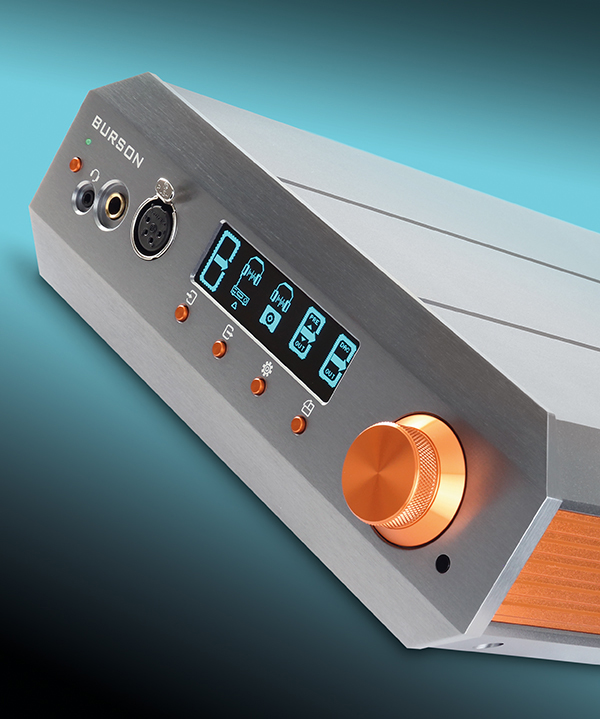
While I count myself a ‘head-fi’ fan, it never ceases to amaze me how what would seem to be a simplified version of the whole hi-fi experience – listening through headphones – has become a playground for tweakers and fiddlers. And as if all that swapping of op-amps and power supplies wasn’t enough, the Conductor Voyager offers its user a huge range of set-up options, the ins and outs made only slightly more baffling by the display’s near-hieroglyphic symbols. Yes, I’m sure these would soon become second nature, and I guess they have the benefit of being language-agnostic, but I have to admit it took me a while to get my head around them.
 Voyage of discovery
For the record, one can adjust the analogue gain level, the digital input’s PLL (phase-locked loop) bandwidth, the IIR (image rejection ratio) bandwidth, the DAC Path (from bypass to selective implementation of various settings), and three degrees of THD compensation. As ever, I tried these settings in a variety of combinations, and heard no repeatable benefits. Fortunately, the manual makes clear the default settings, which is what I stuck with. Life is too short.
I tried the Conductor Voyager in all its various use-cases, too, including as a DAC straight into my usual Naim amps, as a headphone amp with both analogue and digital inputs, and as a preamp into power amplification. And the first takeaway from all this is that the headphone section has massive output [see boxout], so it’s best to be very wary of the volume setting. You might want to stick to the ‘Low Gain’ option to keep things more controllable, whether you’re using the unbalanced 6.35mm output or the balanced options. It’s far too easy to crank up headphones when freed from concerns about disturbing the neighbours with a traditional speaker-based system.
It’s also worth noting again that the analogue inputs here pass through both ADC and DAC sections, so when using the Conductor Voyager purely as a DAC, with fixed-level output, there’s no point whatsoever in using its analogue inputs. It’s better by far to feed analogue sources straight into your amplification.
Guitar hero
What is beyond doubt, in whichever ‘mode’ you use the Conductor Voyager, is that the sound is dynamic, wide open and delivered with serious punch. Playing the easy shuffle of Eric Clapton’s ‘Get Ready’, from 1974’s 461 Ocean Boulevard album [Polydor 192kHz/24-bit], the entire track sounded fresh and under-produced – which I’m sure was the intention of its meticulous engineering! The vocals of Yvonne Elliman were beautifully delineated, especially through Austrian Audio’s ultra-precise The Composer headphones in balanced mode. These cans sound excellent with their manufacturer’s own Full Score One amp, but Burson’s unit gave them even better grip and drive.
Call the cops
The Conductor Voyager certainly rocks, as was clear with the unstoppable drive of Sting’s bass and Stuart Copeland’s tight, gutsy drumming on The Police’s all-too-short ‘Spirits In The Material World’, from Ghost In The Machine [A&M Records UICY-93192]. Quite striking is the way Copeland backs off in the verses and then breaks forward on the chorus, just as Andy Summers and Sting lock together to form another element of the rhythmic drive. It’s infectious stuff.
The Conductor Voyager’s balance was lovely and subtle with ‘Zen Is When’, from Dave Brubeck’s Jazz Impressions Of Japan [Columbia/Legacy/Sony Music 88697491952]. The arrangements may be a little stereotypical (or even cheesy), but the piano and rest of the quartet were crisp and clear. Fascinating, too, was ‘Take Five’ from the We’re All Together Again For The First Time live album [Atlantic 7567-81390-2], in which the band spins the all-too-familiar track out into a 16-minute-plus improvisation. Brubeck takes a back seat to Gerry Mulligan and Paul Desmond’s saxes, while Jack Six and Alan Dawson keep impeccable time, then step up for their solos – the piano being, for most of the track, merely part of the rhythm section. The Conductor Voyager sounds both rich and sprightly here, clearly in its element with the simple recording and fine musicianship.
Impressive, too, is the way the reverberant acoustic and playful intimacy of Lisa Pulman and Joe Stilgoe’s A Couple Of Swells set [Highfield Productions, via Tidal] was delivered, whether through amp/speakers or headphones – in this case Oppo’s planar-magnetic PM-1 [HFN Jul ’14], with its airy openness and superb bass extension. The stereo focus of both voices was superb, just as Stilgoe’s piano filled the soundstage. This is another one of those albums that captures the live rapport of its performers, and it sounded gorgeous through the Conductor Voyager and high-quality supporting components.
Hi-Fi News Verdict
It’s not hard to see why Burson has gained its reputation in the head-fi arena, but this DAC/pre/headphone amp promises much wider appeal than that, with its combination of clarity, subtlety and sheer power – perhaps too much power if you don’t use it with care! Ignore all the tweakery and faffery built-in here, stick to the excellent default settings, and you won’t go far wrong, however you choose to use it.Sound Quality: 88%
 | |||||||||||

|
|
| |||||||||











 SPONSORED VIDEO






| Equipment Reviews | |
Music Reviews Awards | |
Latest News Features | |
Resources Newsletters | |
Subscriptions |
WHERE TECHNOLOGY BECOMES ENTERTAINMENT
 © 2026 Hi-Fi News
AVTech Media Ltd
All rights reserved