Biber Rosary Sonatas
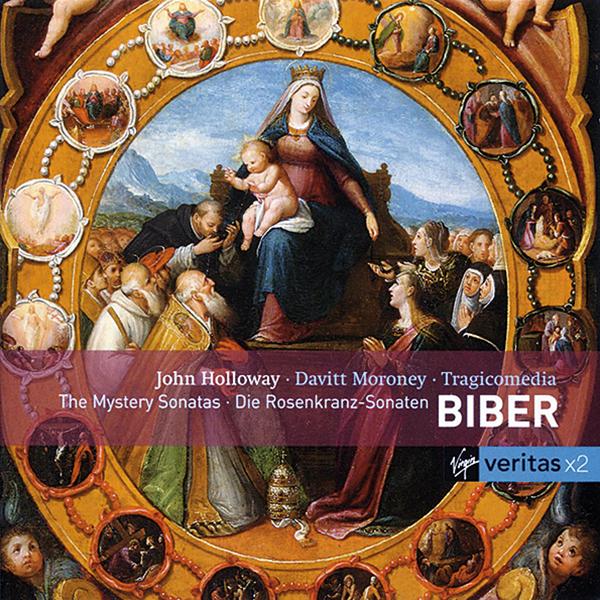
The summit of solo-violin writing before Bach, this 17th century cycle of devotional sonatas attracts highly individual responses on record, finds Peter Quantrill
Exactly how Heinrich Ignaz Franz von Biber (1644-1704) became one of the leading violinist-composers of his day is hard to say, and probably lost in time. The son of a huntsman in the service of a Bohemian noble, he took to the violin early on, and his talent must have been sufficiently developed as a teenager for him to become a pupil of Johann Heinrich Schmelzer, the leading Austrian violinist-composer of his generation.
Mystery music
Biber soon followed in his teacher’s footsteps, entering the service of Maximilian Gandolph, Prince-Archbishop of Salzburg in 1670. Gandolph revived a cult of devotion to the Virgin Mary, and around 1670 built the pilgrimage church of Maria Plain a few miles north of Salzburg. The Rosary is a sequence of prayers used in private devotion, and there are 15 Mysteries of the Rosary associated with events in the lives of Jesus and his mother Mary.
Perhaps at the behest of Gandolph, Biber composed a cycle of sonatas – for violin with continuo accompaniment – and dedicated it to his patron. The manuscript’s dedication page is lost, but a detailed engraving in front of each sonata draws the image which Biber paints in sound, from the miraculous Annunciation of Jesus’s conception to Mary, to the crowning of the Virgin in heaven.
Changing tune
Biber’s Rosary Sonatas are rarely encountered live, either whole or in part, not least because each sonata employs a different tuning system for the four strings of the violin. From the standard tuning of G-D-A-E for the opening sonata, depicting the Annunciation, the strings are retuned to A-E-A-E for No.2 (‘The Visitation’), creating bare fifths in A major. Then B-F sharp-B-D for No.3 (‘The Nativity’), and so on.
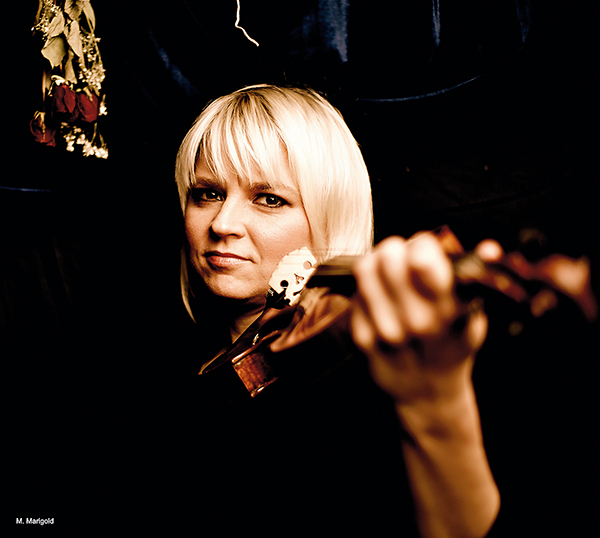
Above: Canadian violinist Julia Wedman recorded Biber’s Rosary Sonatas for her solo debut in 2011
More extreme still is the dark and dissonant tuning of A flat-E flat-G-D for ‘The Agony In The Garden’, to launch the central, ‘Sorrowful Mysteries’ panel of the triptych, and then Sonata No.11, ‘The Resurrection’, for which the middle two strings are crossed both in the peg box and behind the bridge to represent a cross. The effect of all this retuning is to alter the sound of the instrument itself, as different string tensions draw out darker and lighter tone-colours and more closed or open patterns of resonance.
Both the tuning, and the extended passages of double- and triple-stopping, effectively place Biber’s cycle out of bounds for a standard modern set-up of high-tension steel strings and long concave bow. So, while the score of the Rosary Sonatas was first published in 1905, performers only began to take a serious interest in it during the 1960s, with the early-music revival which caught on through record labels such as L’Oiseau-Lyre and the Archiv division of Deutsche Grammophon.
The pioneering version by Eduard Melkus, on DG/Archiv, holds up remarkably well, even if his vibrato, light-touch legato and analogue-studio sound unmistakably belong to their time. So, in its own way, does the next Archiv recording, from 20 years later. Reinhard Goebel’s narrow and astringent sound is less of a problem for me than his brisk dispatch, which reduces cadenza-like soliloquies to so much flashy fingerwork and extrovert flourish.
Goebel’s studio-based, virtuosic and secular-sounding approach has been developed in our own time by Amandine Beyer [Harmonia Mundi], Igor Ruhadze [Brilliant Classics] and Meret Lüthi [BR-Klassik]. Other violinists bring out more of the devotional elements which (to me) feel central to the style and purpose of Biber’s cycle. As so often in recordings of early music, the differences between them are much more radical than in (say) a Mozart aria or a Mahler adagio.
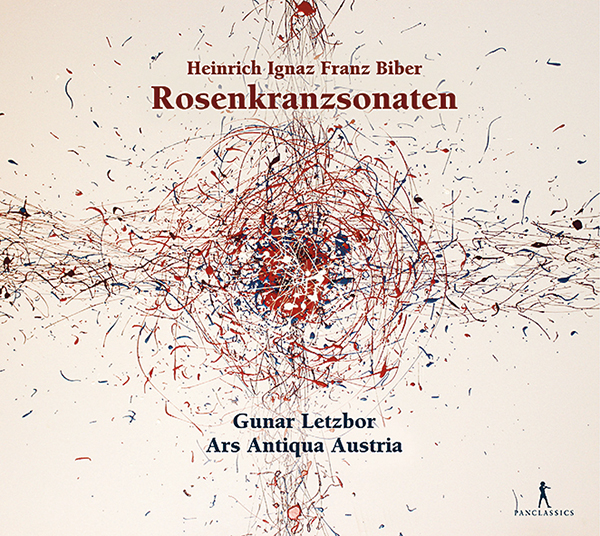
Above: Gunar Letzbor’s second recording of the cycle, captured at St. Florian Monastery in Austria in 2019, for Pan Classics
Biber opens the ‘Resurrection’ Sonata not with a blaze of glory but a slow dawn. Rachel Podger paints the Easter sunrise with warm, organ-backed tone. Meret Luthi comes in as if from a distance, evoking the scenery, physical and spiritual, with rhetorical flights of fancy and a crunchy lute. Elizabeth Wallfisch enters quite alone, and finds questions and hesitations in her phrases, as if Mary Magdalene were wandering through the garden.
All these approaches are persuasive on their own terms. Yet it is the Austrian violinist Gunar Letzbor who speaks to me most directly about the Easter mystery. He is slow but not too reverent, inflecting one phrase as a country dance, the next as a contemplative prayer, an Italianate cadenza of flourishes and echoes, a solid Austrian hymn. And all of this in a mere three-minute adagio.
In crisp, sparkling sound on Sono Luminis’s recording, Julia Wedman is also placed at a little distance from the microphone. This distance serves to bring the listener closer, into the acoustic and the presence of the musicians in a real and devotional context, rather than the music emerging from the black space of a recording studio.
Pain and gain
On BIS Records, Ariadne Daskalakis takes more radical and personal liberties with Biber’s rhythms, but the controlled lack of ambience works against her. In the allegro of No.1, John Holloway’s Virgin recording could again be playing a different piece from Daskalakis or Goebel – the mood is quiet and withdrawn, and the side-chapel perspective won’t please listeners who want to get up close and personal with bow and rosin.
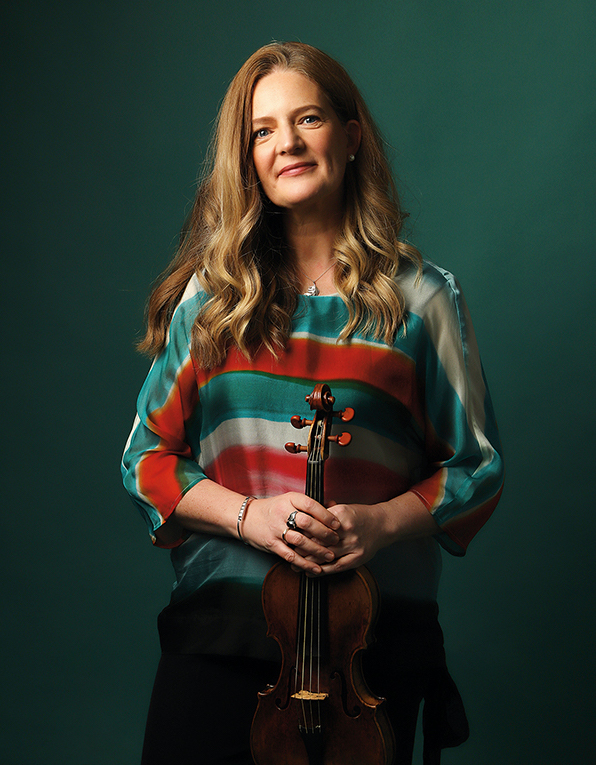
Above: ‘It’s a physical and mental challenge just to play the notes in the correct order’, says violinist Rachel Podger of Biber’s Resurrection sonata
As Podger recounts in her own booklet essay, the violin ‘suffers’ while playing these sonatas. So does the violinist. In Biber’s Resurrection sonata, ‘It’s a physical and mental challenge just to play the notes in the correct order. Hence the message of the Resurrection is fully expressed: normality does not exist anymore!’. Likewise, Letzbor testifies to a deep investment in this music through his writing as well as his playing. ‘These Sonatas really do need to be interpreted, and with a great emotional and spiritual strength that should be felt and heard during the performance. It is only when the performer is personally involved that the mystical basis of this work is revealed.’
Maximum expression
Among the many younger soloists for whom Biber’s cycle has become almost standard repertoire, thanks to the pioneering efforts of Goebel and Holloway, and then Podger and Letzbor, the Spanish violinist Lina Tur Bonet stands out to me. She and her engineering team use an array of recording perspectives and continuo accompaniments to draw the maximum possible variety of expression from each sonata, while the line of her own playing is satisfyingly full and centred.
Essential Recordings
Gunar Letzbor
Arcana A902 (2CDs)
A 1996 recording, made in an Austrian church, and backed by a six-strong continuo group and gratifyingly chunky chamber organ.
Rachel Podger
Channel Classics CCSSA37315 (2CDs)
Recorded in 2015 at St-Jude-on-the-Hill, with long experience of Podger and her colleagues touring the sonatas in performance.
Lina Tur Bonet
Pan Classics PC10329 (2CDs)
Another 2015 recording. Bonet contributes her own insightful reflections on Biber’s musical spirituality in a booklet essay.
Julia Wedman
Sono Luminis DSL92127 (2CDs)
Wedman’s remarkable debut solo album, from 2011, after playing in Tafelmusik and other Canadian early-music ensembles.
Reinhard Goebel
DG/Archiv 4316562 (2CDs)
This 1990 set reinvented Biber’s cycle for the modern age and attracted many imitators – but few with Goebel’s bracing freshness.
John Holloway
Virgin 5620622 (2CDs)
From 1990, and overshadowed at the time by Goebel’s extroversion, but standing the test of time as a compelling and devotional account.
















 SPONSORED VIDEO






| Equipment Reviews |  |
Music Reviews Awards | |
Latest News Features | |
Resources Newsletters | |
Subscriptions |
WHERE TECHNOLOGY BECOMES ENTERTAINMENT
 © 2026 Hi-Fi News
AVTech Media Ltd
All rights reserved