AirTight ATM-1e tube amplifier
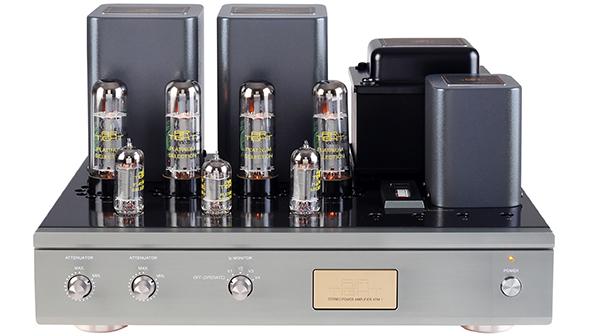

A wish fulfilled? I have already admitted in an ‘Off The Leash’ column [HFN May ’24] that, among the products I’ve never owned, I ‘lusted after’ an AirTight amplifier. So this review was accompanied by more than the usual sense of expectation, this legendary amplifier already relaunched last year as the 2024 Edition, but now officially called the ATM-1e (£8295). This is the third incarnation of the artisanal Japanese brand’s cornerstone stereo ‘power amp’, though as it’s equipped with separate left-and-right gain controls, it’s best described as a very minimalist integrated model.
All ATM-1 versions [see boxout] have possessed this crucial feature, lifting them above the level of a basic power amplifier and allowing the purist to use a fixed output source without an intermediate preamplifier. Also, while the new ATM-1e might have lost the option of running two signal inputs, that’s not necessarily a deal-breaker even if the buyer plans to eschew a separate, active preamplifier. As a workaround for multiple sources in such situations, I maintain a couple of Akai DS-5 passive tape deck selectors which up the input count by four. More appropriately for this review, I also fired up the now-legendary AirTight ATL-10A Line Controller, the company’s passive preamp with remote volume control. Note to AirTight: please bring it back!
Tube tuning
One other feature separates the ATM-1e from many basic stereo amplifiers, and that’s the fine-tune tube bias facility. A rotary on the front panel selects each EL34, the ‘off’ position being the operational mode for playback, and each tube is accompanied by a set screw that the user adjusts while monitoring the new ‘edgewise’ meter. The correct operating area is clearly marked, and you simply dial in the bias until the needle rests within it.
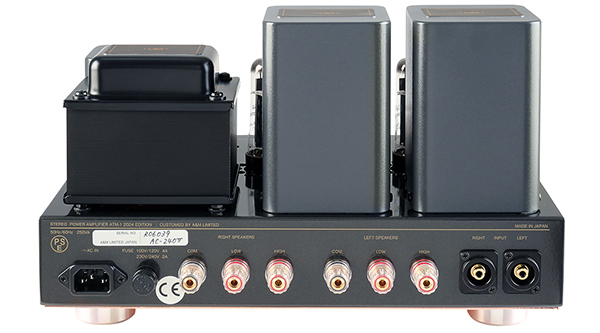
Yutaka Miura, AirTight’s MD, told HFN that while the new model ‘has a visual appearance reminiscent of the original ATM-1’, it’s a complete redesign aiming for ‘the best combination of circuit, construction, parts selection, and sonic performance. The ATM-1 and ATM-1s were developed by Mr. Ishiguro and my father, Atsushi Miura [AirTight’s co-founders] while the ATM-1e was developed by Kiyoshi Hamada, Yoshihiro Hayashiguchi and myself’. For the new amp Tamura output transformers were specified and are terminated on the rear in two sets of 4mm cable binding posts, labelled ‘High’ and ‘Low’ for nominal 8ohm and 4ohm loads, respectively.
When upgrading the ATM-1s to become the ATM-1e, the team pursued an improved signal-to-noise ratio, wider bandwidth, a higher damping factor, easier-to-adjust tube bias, and greater reliability. But it remains a classic Leak-Mullard type push-pull/ultralinear amplifier and inspired, in part, by the original Marantz Model 9. It’s also a reminder that the EL34 was once the industry’s go-to valve, before the rash of KT90, ’100, ’120, ’150s, etc, took over.
Gentle giant
Unsurprisingly, the ATM-1e shares the same 2x35W power rating from its pairs of EL34s as many classic tube amps – arguably the ‘sweet spot’ for valve amplifiers. However, because clipping is gentle rather than abrupt, the latter a characteristic of many solid-state amps, the ATM-1e sounds louder than you’d expect, as a blast through my Wilson Audio The WATT/Puppys [HFN Sep ’24] clearly demonstrated.
Although many amplifiers were fitted with EL34s in the past, Miura-san says there are ‘surprisingly few’ high-end products currently using them. ‘We think this has something to do with the fact that EL34 push-pull amplifiers were once so common and thought to be “nothing special” for a while. We feel that the EL34 has excellent characteristics that build a solid sound structure with “penetrating power”.’
This affinity for the EL34 is the basis of the development concept for the ATM-1e as ‘redefining the EL34 push-pull amplifier in the AirTight style’, a process begun in 2015. Says Miura-san, ‘The world of audio has changed significantly since 2006 when the ATM-1s was launched. AirTight’s traditional policy was “enjoying music” so we felt the need to redefine the EL34 as we aimed for a wide soundfield and a full-bodied, dignified sound with the new edition’.
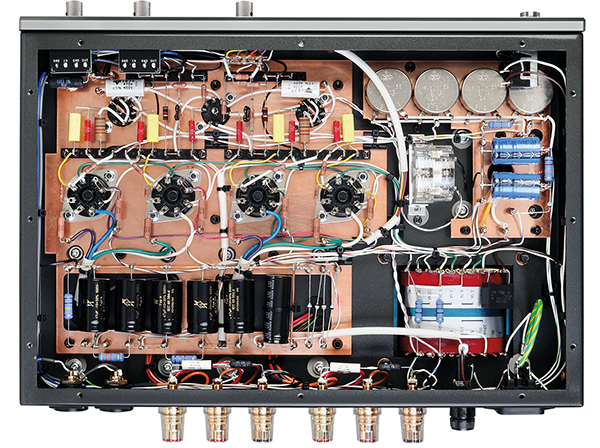
Exquisite construction and finish are qualities that render me enamoured of AirTight. The chassis structure here is a monocoque type, while the power supply section features substantial choke regulation. The circuit board is fashioned on a copper plate [see p68], and the company hand-builds each amplifier, as I witnessed when visiting its facility in Osaka [HFN Aug ’13]. Although the ATM-1e is sufficiently compact at 365x225x305mm (whd), it still weighs a chunky 21.5kg, reflecting the substantial nature of the unit – even if that sounds rather like tyre-kicking.
 Tighten up
So self-explanatory is the ATM-1e that you can have it up and running without ever looking at the owner’s manual. Aside from adjusting the two volume controls (which also allow you to fine-tune the balance if needed), and periodically checking the bias, there’s nothing else to do other than connect speakers to the multi-way binding posts and insert the signal cables into the RCA sockets. Note that AirTight will change the phono sockets to (unbalanced) XLRs and the 8ohm speaker terminals can be configured for 16ohm loudspeaker loads.
There is one caveat to remember, also noted by PM: while the ATM-1e warms up relatively quickly and has no extended switch-on mute period à la Audio Research and others, it needs a solid half-hour to really sing. I can’t say my ears are so sensitive as to have detected the increase in level of 0.3dB measured by PM [see PM's Lab Report], but I could hear improvements in every parameter, the amplifier ‘opening up’ as it settled down. I seem to recall this as a typical characteristic of the EL34 tube, so AirTight is blameless of making you wait.
Old meets new
Having recently spent time with a few vintage amps employing EL34s, purely by coincidence, I was primed for a blast from the past rather than a sonic affinity with amps running beefier KT120s or KT150s. Would this wonderful amp, its forebear born at the exact midpoint in hi-fi history, remind me of the Dynaco Stereo 70 or perhaps my beloved Radfords? The answer is ‘Yes’… and ‘No’, because AirTight has delivered what it promised, which is a method of respecting the classic sound of the ‘Golden Age’ while also managing the expectations of today.
Despite starting out with The Beatles’ remastered mono LPs for a whiff of the era when EL34s ruled, I was soon enlightened by the realisation that this was no exercise in mere nostalgia. Yes, the sound ‘bloomed’ in a way necessary to reconstruct the sensation when mono Beatles LPs were first played in 1963-1968 (at least, for those with hi-fi systems and not Dansettes). But this discernible ‘warmth’ is no play on words vis-à-vis valves. The ATM-1e sounds positively human.
On ‘You’ve Got To Hide Your Love Away’ from Help [Parlophone PMC1255], John Lennon’s voice emerged richer than what might be expected of, say, hyper-clinical solid-state amps. It was utterly grain-free yet equally the vocals were so convincingly textured that it almost sounded like a different – and indeed better – recording or pressing than what I was conditioned to hear after a lifetime of owning an original LP.
Bassey bass
In contrast to Lennon’s voice, the absolute clarity of Shirley Bassey’s pipes was rendered just as vividly, even though there were no laryngeal textures per se to reproduce. What distracted me from Bassey’s singing, however, were the massive orchestral arrangements. The remastered James Bond theme Diamonds Are Forever in the Dame Shirley Bassey – The Singer CD set [Strawberry Records QCR3JAM31] showed how deep and wide was the soundstage Miura-san and his team had hoped to construct.
Within this soundstage, and for that matter within the mono central image of The Beatles’ tracks, were low-level details retrieved so comprehensively and with such easy discernibility that I could have sworn I was hearing nuances which had previously escaped me. This attested to a transparency which wouldn’t shame a high-power solid-state amplifier of impeccable pedigree. As valve-like as the ATM-1e is in its virtues, it does not pander to the peccadillos of the past, endearing though they are to tube devotees.
Bang the drum
Ultimately, what convinced me that the AirTight ATM-1e is more than the sum of its parts was monumental bass from an all-but-forgotten demo-worthy CD, Clannad’s 1989 compilation Pastpresent [BMG PD74074]. Naturally, the gorgeous vocals showed off the ATM-1e’s super-sweet, sibilance-free top-end. But I was not prepared for the room-filling mass of the opening of ‘White Fool’, almost Kodō-like in its grandeur. Then I remembered: AirTight is Japanese. Who better to deal with the drums of giants?
Hi-Fi News Verdict
AirTight’s ATM-1e ticks every box defining a stereo tube power amplifier of true usability and practicality, with a price reflected in superb perceived value. If there truly is a category for ‘entry-level high-end’, this fits the bill. It’s an artisanal amp offering exceptional musicality, more than sufficient power and – if this matters to you as it does to me – shameless pride of ownership. Pride may be a sin, but if so, then sin on, sinners.
Sound Quality: 89%
 | |||||||||||

|
|
| |||||||||















 SPONSORED VIDEO






| Equipment Reviews | |
Music Reviews Awards | |
Latest News Features | |
Resources Newsletters | |
Subscriptions |
WHERE TECHNOLOGY BECOMES ENTERTAINMENT
 © 2026 Hi-Fi News
AVTech Media Ltd
All rights reserved