Acoustic Energy Corinium loudspeaker
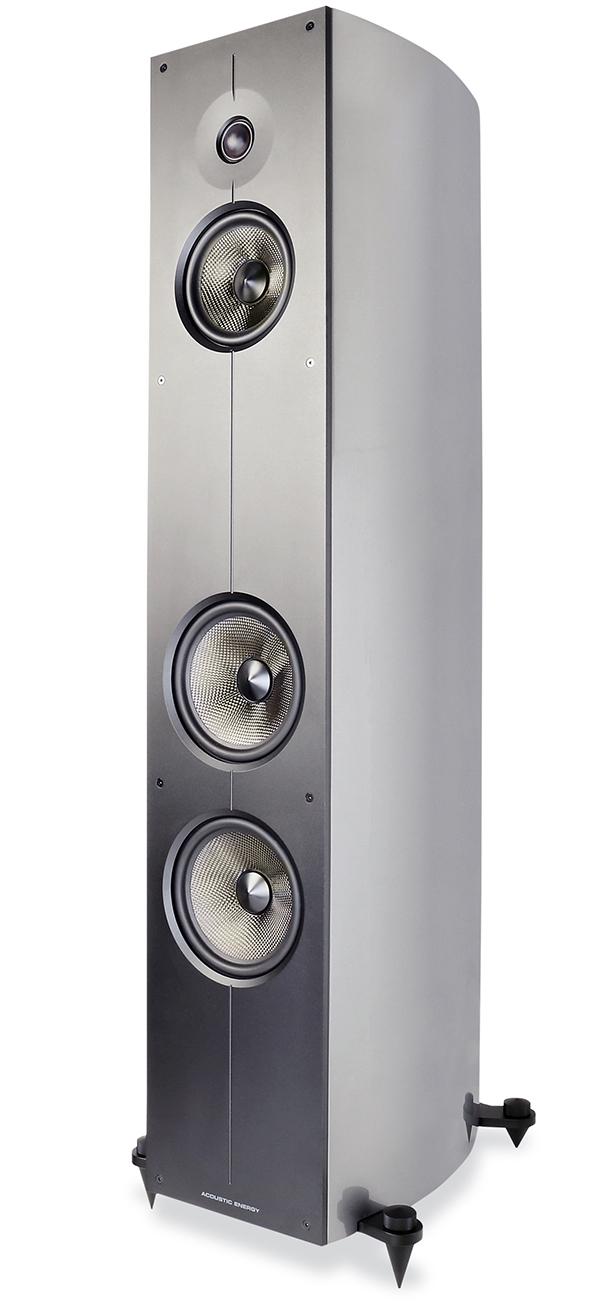

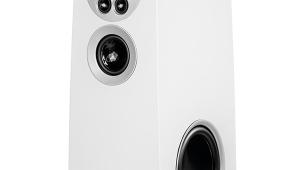
Acoustic Energy's flagship Corinium floorstander stands out from the rest of the manufacturer's range, and not simply in the matter of its pricing. In place of AE's familiar numerical system (AE500, AE300, etc), there's that one-of-a-kind title – Corinium being the Roman name for Cirencester, Gloucestershire, where the brand is based. There are new colourways too, plus a freshly curved cabinet design. And if that wasn't enough, AE claims the loudspeaker was three years in development.The result is a three-way, four-driver floorstander intended to act as a calling card for the company. The Corinium slots in at the top of AE's existing range, its pricing of £6000 for a Matt Black, Matt White or Tectona Wood finish almost double that of the next model down, the AE520. Opt for British Racing Green or the new Midnight Silver finish of our review sample and the price rises to £7000.
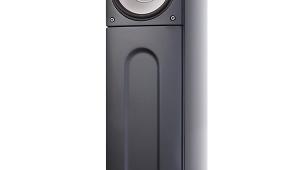
Despite this lofty positioning, the Corinium is not dramatically bigger or more imposing than AE's other floorstanders. It's 30mm shorter than the AE520, measuring 1100mm once installed on its spiked feet. Plus, while the cabinet reaches 235mm at its widest, versus the AE520's 185mm, it tapers greatly to the rear, giving it a more svelte overall appearance.
Spine design
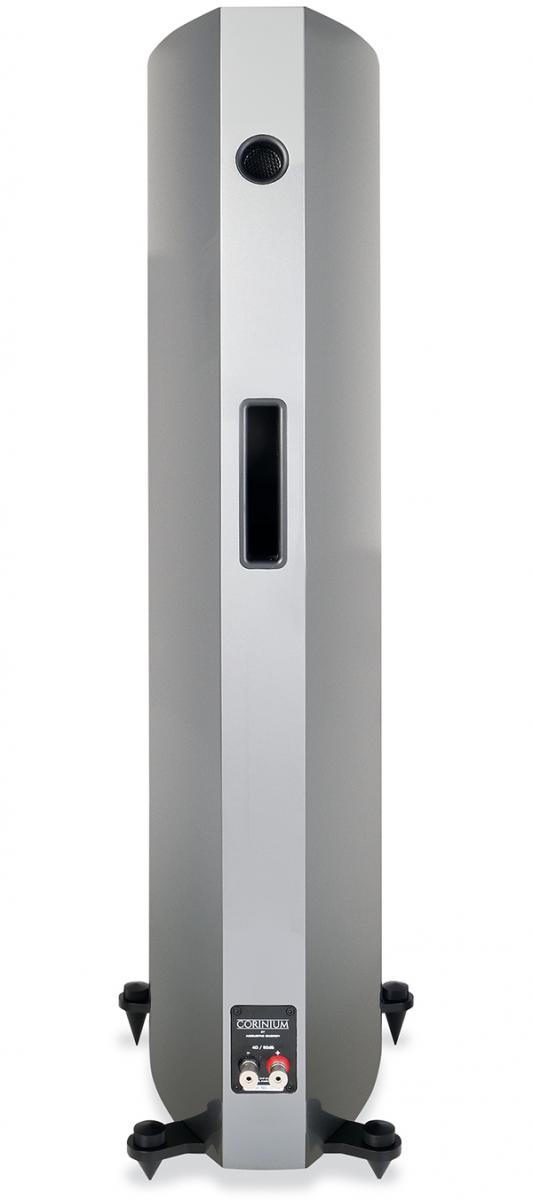
This tapering of the cabinet to a 45mm-wide 'spine' is about more than aesthetics, of course. Internally it reduces the opportunity for standing waves, while AE's MD Mat Spandl says the curved surfaces also improve the Corinium's interaction with the listening room by limiting reflections off the cabinet itself. Different spike lengths for the front and back outrigger feet also result in the enclosure having a 4o backwards tilt, for the purposes of time alignment.
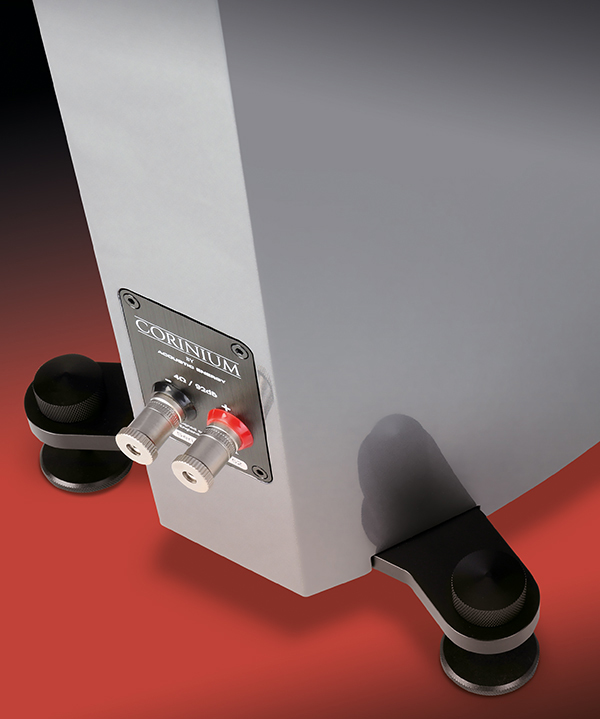
For the cabinet side walls, AE utilises the 'Resonance Suppression Composite' (RSC) design seen on its 500 series. Here, inner and outer layers of MDF sandwich an in-fill of bitumen to improve mass and damping. The thickness of these walls varies between 22mm and 45mm. Meanwhile, the Corinium's 25mm-thick MDF baffle is topped by a 6mm solid aluminium plate.
Tetoron tuning
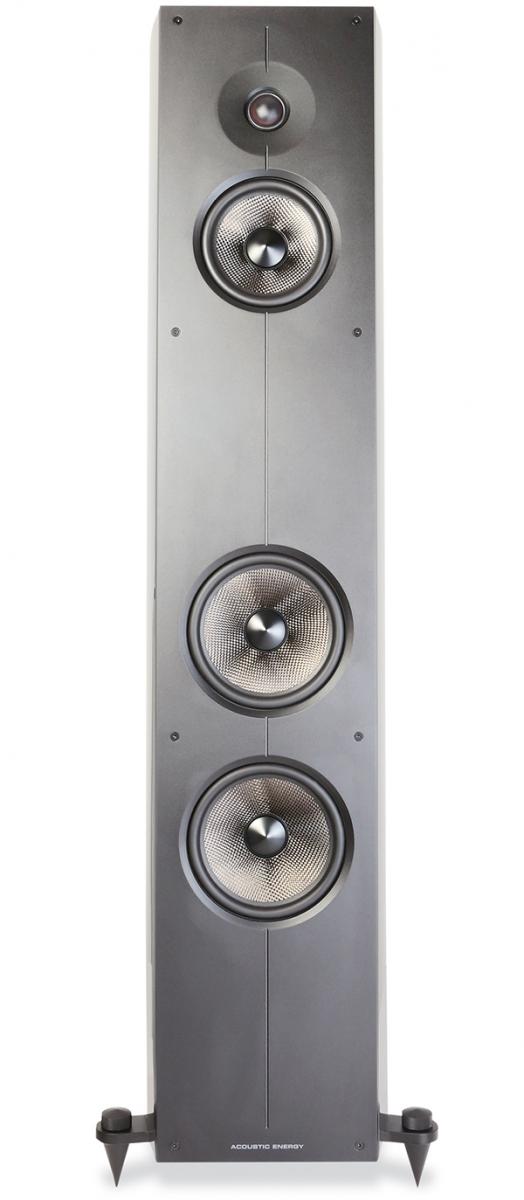
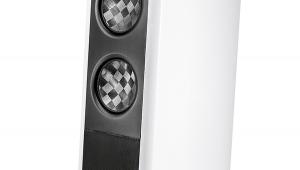
Mounted directly into this aluminium front – to limit vibrations from the speaker's mid and bass drivers, which are set into the MDF panel – is a 29mm dome tweeter. This is a new unit developed specifically for the Corinium, and made from Tetoron, a synthetic polyester chosen for its light-but-stiff properties. AE says it also experimented with silk domes for its flagship, as it sought improvements over the carbon-fibre tweeters of its 500 series.
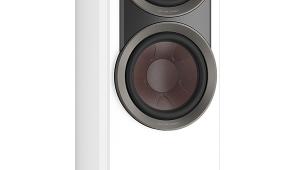
Carbon-fibre does feature in the Corinium's 120mm midrange and 140mm bass drivers, however. The former is closely related to the units on the 500 series, but the company has adapted the cone profile in order to provide better control of break-up modes. The two bass drivers, with their 'low-hysteresis' motors, are entirely new.
As PM explains [see boxout] these woofers are positioned low down on the Corinium's baffle to benefit from a degree of boundary gain – although manufacturers including Estelon [HFN Mar '25] and MartinLogan [HFN Jul '23] pursue this idea more aggressively. Further optimisation of the speaker's bass output is through reflex-loading. For this slender model, AE has rotated its typical slot port by 90o while a second, smaller opening on the back of the Corinium acts as a vent for the chamber behind the mid and tweeter units, to reduce pressure build up and maintain a 'fast, open sound'. The bass drivers work in tandem below 260Hz, and the 29mm dome tweeter comes in above 3.4kHz, via a three-way crossover utilising air-core inductors and polypropylene capacitors. For the Corinium, AE has thickened the copper tracks on its crossover PCB, while OFC cabling from US marque Wireworld links the network to a pair of 4mm binding posts.
Above these on the terminal plate is the legend '4ohm/92dB', suggesting that AE has designed the Corinium to be sensitive, albeit making demands on your amp [see PM's Lab Report]. Its recommendation is to use amps 'rated at 100W or more into 8ohm'. As for placement, 1-2m from side walls and at least 50cm from the rear wall is suggested, angling the enclosures outwards so they are pointed slightly behind the listening position.
 House music
Following these recommendations in the HFN Listening Room [HFN Yearbook '25] – and partnering the speakers with pre/power amps from Onkyo to CH Precision [HFN Mar '26] – it was clear AE's flagship does not veer far from the brand's 'house sound'. Experimenting with degrees of toe-in/out influences the Corinium's perceived brightness (the speaker potentially sounding a little 'lost' in larger spaces), but this doesn't alter what might be called its classic 'British tuning'. A little gentle at the top and lacking extravagance in the bass, the Corinium is seemingly focused on delivering natural, revealing mid-tones. The quality of its vocal and instrumental reproduction is a standout trait – Robert Plant's 'If I Were A Carpenter' [Fate Of Nations, 2009 remaster; Es Paranza download] offered high strings as smooth as butter, while the former Led Zeppelin frontman's vocals, heavily reverbed on this 1993 cover version, oozed character. The equally distinctive singing voice of Billie Eilish, on 'Ocean Eyes' [Don't Smile At Me, Interscope; 44.1kHz/24-bit], was cleanly delivered, sounding integrated with the track rather than gaining an exaggerated presence. This is a measured, balanced, unfatiguing sound that might lack immediate appeal if demo'd alongside speakers voiced to be more attention-grabbing – but it soon wins you over.
There's no sign of the Corinium's cohesion falling apart at high volumes either. Indeed, it sounded at its best – in our large listening space, at least – given a generous shove from the partnering amp. Bass weight improved, bringing the large-sounding kick drums on the Billie Eilish track into better focus, and there was more of a sense of urgency overall.
Cavernous drums were again on show, accompanied by a smooth decay, in the Los Angeles Philharmonic/Zubin Mehta performance of Edgard Varèse's 'Ionisation' [Decca; CD res]. The heft and resonance of the myriad percussion instruments easily made the Coriniums feel larger than they look. This, and the power and scale brought to low trombones in Danny Elfman's Batman theme [Warner Bros. 925 977-2], would be enough to convince many listeners of the speaker's bass performance.
Bass boundaries
That said, the low-end extension has its limits, reminding me of the company's recent AE1 40th Anniversary standmount [HFN Jan '26]. The electronic bass elements at the beginning of Exodus's 'Black 13' [Blood In Blood Out; Nuclear Blast NB 3300-2] had good initial attack, but their full 'depth-charge' effect was blunted as the twin woofers demurred. Yet while this isn't a speaker for those whose listening habits favour plenty of deep, synthesised bass, it's not hard to find material where its attributes – including that expressive midrange and glare-free treble – rise impressively to the occasion. The lead guitar lines in Gary Moore's 'Still Got The Blues', from the album of the same name [Virgin CDV 2612] were brilliantly defined. The Belfast-born guitarist took time to find his tone on this album, pairing his 1950s Gibson Les Paul with a dedicated Marshall Guvnor distortion pedal, and the result is fat, sustained highs with high-gain bite. It all flooded out of AE's flagship.
Playing it wide
Harder rock music was also well handled. The Cult's 'Love Removal Machine', from Electric [Beggars Banquet 258-223], offered powerful drums and fast runs of robust bass, plus guitar riffs the Corinium kept on the right side of caustic. From the same group's earlier Love album [Beggars Banquet BBL 65CD], the opening bars to 'She Sells Sanctuary' were sent far and wide, processed guitar chords wobbling around the edges of the listening room. This is another feather in the Corinium's cap – a wide, deep soundstage and excellent imaging ability. Similarly, returning to Edgard Varèse's piece, the scale and precision of the performance had my eyes often darting left and right, as the sound of hand-cranked sirens and castanets appeared far beyond the edge of the speakers. AE's new flagship might be patient in its approach, its sound measured and refined, but by simply letting the music take over it has no trouble holding your attention.
Hi-Fi News Verdict
Clearly engineered with care, Acoustic Energy’s range-topping Corinium floorstander is something of a slow-burner, eschewing obvious ‘sonic fireworks’ in favour of a coherent, balanced, unfatiguing sound on a grand scale. Well suited to long listening sessions in more typically proportioned rooms, and particularly impressive with orchestral and acoustic pieces, this will find plenty of admirers.Sound Quality: 84%
 | |||||||||||

|
|
| |||||||||











 SPONSORED VIDEO






| Equipment Reviews | |
Music Reviews Awards | |
Latest News Features | |
Resources Newsletters | |
Subscriptions |
WHERE TECHNOLOGY BECOMES ENTERTAINMENT
 © 2026 Hi-Fi News
AVTech Media Ltd
All rights reserved