Acoustic Energy AE1 40th loudspeaker
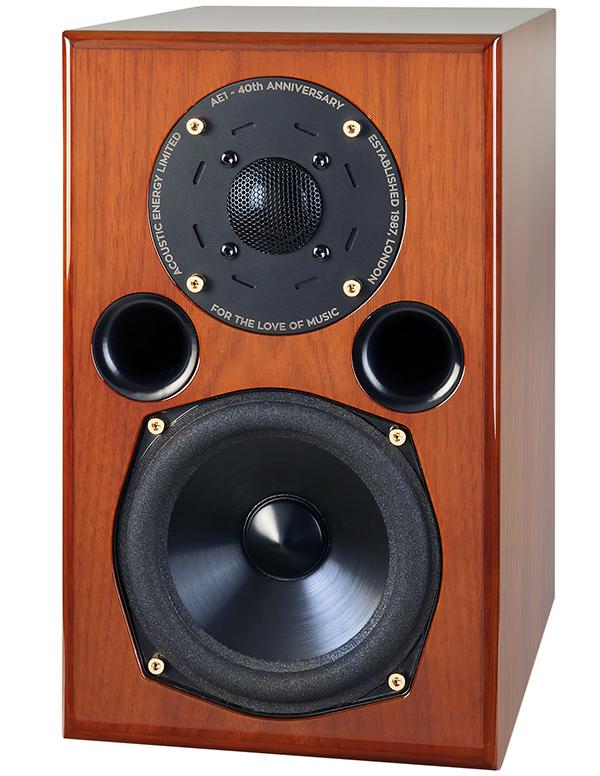

If you’re looking at the legend on the tweeter surround of Acoustic Energy’s new loudspeaker and wondering how a brand that was established in 1987 can launch a 40th Anniversary Edition model in 2025, the answer is simple. When Acoustic Energy founder Phil Jones began work on his original AE1 design [HFN Jan ’89], seeking an ‘accurate monitor’ for his recording studio, he certainly wasn’t intending to launch a consumer audio company. But the speaker, a compact two-way that was groundbreaking in its use of metal diaphragms for both bass/mid and treble drive units, caught the eye and ear of audiophiles. And now it’s back. Well, sort of.
The AE1 40th Anniversary, selling for £1499 in High Gloss Walnut or High Gloss Black finishes, is both a resurrection of the original and an all-new design. Driver sizes, crossover design and cabinet construction have been upgraded [see boxout]. Additionally, says AE’s MD, Mat Spandl, ‘because all the original parts have been out of production for some time (the last iteration, the AE1 Classic LE, launched in 2016), we had to start from scratch’.
Space suit
The new speaker slots into the company’s lineup alongside its flagship Corinium floorstander, and 500, 300 and 100 Series models. There’s also the AE1 Active, launched in 2017 to celebrate Acoustic Energy’s 30th anniversary, and the AE SUB, a sealed box subwoofer with down-firing 300mm woofer. Pricing peaks at £6999 for the four-driver Corinium in a special British Racing Green, and down to £279 for the AE1002 standmount/bookshelf speaker. There’s a clear focus on value for money.
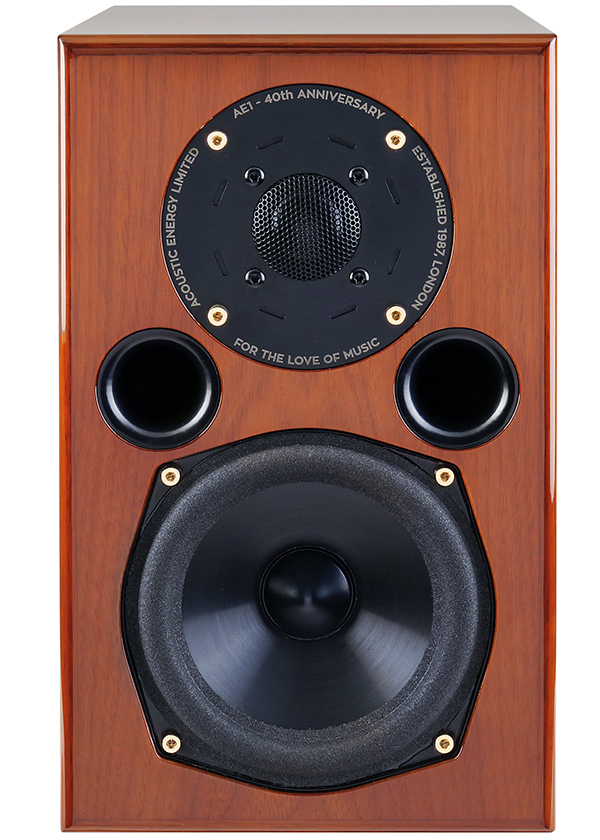
While Acoustic Energy has in the past altered the styling of the AE1, this 40th Anniversary special is nigh-on identical to the original, right down to the exposed screwheads on the driver fixings and the protective tweeter grille. One difference? The supplied black fabric grilles now attach magnetically, rather than via press-in studs.
The dimensions of the braced, constrained-layer cabinet certainly meet Acoustic Energy’s ‘small speaker’ description. At 295x180x240mm (hwd), the AE1 40th should be easy to slip into any system. Also, because its two reflex ports face front, and the rear binding posts are recessed, it might also appeal to space-starved buyers seeking speakers that can be installed close to a wall.
Ring the changes
Build quality is admirable, with the cabinets sporting nicely radiused edges and a slick gloss finish. The 29mm anodised aluminium dome tweeter is mostly hidden by its mesh grille but get up close to the 125mm bass/mid and its spun aluminium construction is apparent. This driver still has a straight-sided cone profile, but an aluminium shorting ring has been added to its motor assembly – a ‘modern improvement’ the brand says helps limit distortion caused by any ‘motional variation’ in the inductance of its aluminium voice coil.
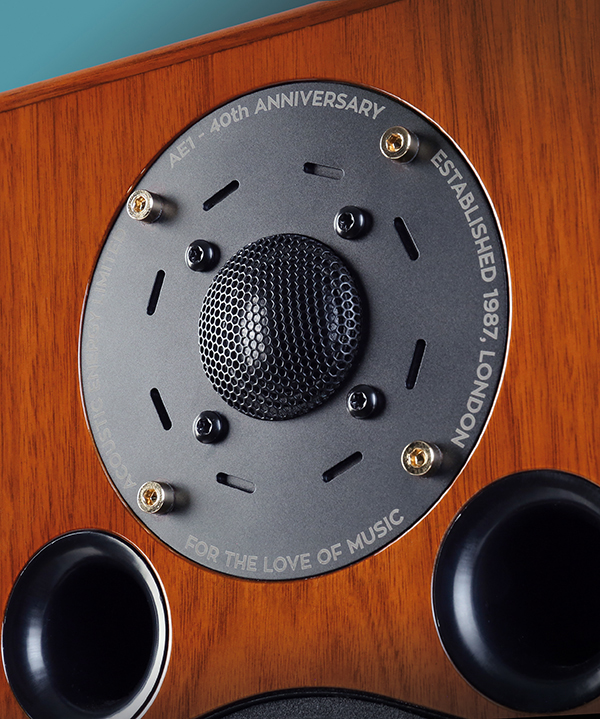
The use of alloy drivers here makes the AE1 40th an outlier for the brand. All its other speakers (excluding the AE1 Active) feature carbon fibre or paper cone woofers, and carbon fibre or fabric dome tweeters. Moreover, Acoustic Energy has moved to slot-loading its bass reflex cabinets. That said, this 40th Anniversary model has apparently been given a more ‘modern’ voicing, more suited to a domestic rather than studio environment, by refinements to its (2.8kHz) crossover.
Acoustic Energy doesn’t sell partnering stands for the AE1 40th – or any of its standmount models, for that matter – so our pair was installed on 25in FS-700 stands from Bowers & Wilkins. This worked in elevating the tweeter to around ear height. Placement recommendations in the manual are for the speakers to be at least 1m from side walls, between 50cm and 1.5m from the rear wall, and angled inward toward the listening position. There’s also good detail about experimenting with placement tweaks, and the pros and cons of boundary reinforcement.
 Rich rewards
In the HFN Listening Room [HFN Yearbook ’25], our initial thought was that this compact speaker might be found wanting. Not so, however – the AE1 40th is ready for more than just small-room/nearfield monitor duty, possessing the projection and output potential to work in larger spaces. It was almost disconcerting how these loudspeakers rendered a cohesive stereo image positioned some 4m apart, and how they happily responded to being driven hard by the reference Constellation Revelation 2 amps [HFN Jan ’25]. At the same time, keep the listening levels low and their sonic traits still shine through.
Without doubt, the AE1 40th gives you a lot for its asking price (which, accounting for inflation, undercuts the original by a good deal). Low-end extension is naturally limited, but the midrange is both characterful and articulate, and with a slight hint of lushness. The new Tabea Zimmermann/Ensemble Resonanz recording of George Enescu’s String Octet in C Major [Harmonia Mundi; 96kHz/24-bit] was awash with rich string textures, woven together but always discernible.
Meanwhile, Anna Urpina’s violin on ‘Lasciatemi Qui Solo’ [Le Chant Des Muses, Eudora Records; 192kHz/24-bit] punched through that bit more, as this recording, with its harpsichord and theorbo, is altogether brighter and sparkier. The AE1 40th didn’t overstress the high treble, nor veer into sibilance with soprano Maria Hinojosa. Enter the cello of Nicola Brovelli, and the full range of music information here – captured in DSD in Girona’s Sala Montsalvatge – was striking.
AE’s speaker didn’t falter either with Thomas Newman’s pulsating orchestral/electro score for the sci-fi flick Passengers [Sony Classical; 48kHz/24-bit]. There are traces of Newman’s various James Bond scores in ‘You Brought Me Back’, which matches blares of brass with cinematic drums and stop-start dynamics. The crisp, driving sound coming from the diminutive AE1 40ths was downright thrilling.
So, what’s the catch? Well, with Newman’s soundtrack it wasn’t too hard to hear where the bass/mid unit and port tuning runs out of scope, even while timpani drums and double basses had plenty of meat on the bone. The manufacturer rates the LF response of the AE1 40th down to 50Hz (re. –6dB), and it sounds like it [see PM's Lab Report]. And while I found boundary reinforcement could give them a leg up (at the expense of overall balance) when used in my own listening room with Hegel’s new H150 integrated amp, it didn’t hide the port ‘chuffing’ heard on a couple of demonstration tracks. Of course, audiophiles with a real penchant for, say, drum ’n’ bass music and Hans Zimmer can always consider adding the £699 AE SUB.
Five alive
With most other material, the speaker is fast, rhythmic and focused in the bass range, making for a lively, enjoyable listen. Margo Price’s ‘Don’t Let The Bastards Get You Down’ [Hard Headed Woman, Loma Vista Recordings; 96kHz/24-bit], co-written with Kris Kristofferson and full of country-and-western twang and grit, gets all its drive from a simple bassline, which the AE1 40th integrated superbly with the rest. ‘Opalite’, from Taylor Swift’s The Life Of A Showgirl [self-released; 48kHz/24-bit] was even bigger and bouncier, all ABBA-style melodies and slicker-than-black-ice production. This loudspeaker is a pop lover’s dream.
Harder to pull off is the playing of bass guitar maestro Marcus Miller, who delivers a gorgeous cover of The Jackson 5’s ‘I’ll Be There’ using just four strings on his Renaissance album [Dreyfus Jazz; FDM 46050 36982 2]. The Acoustic Energy speakers did fine work with the bends and harmonics, conveying the snap and bite of his technique.
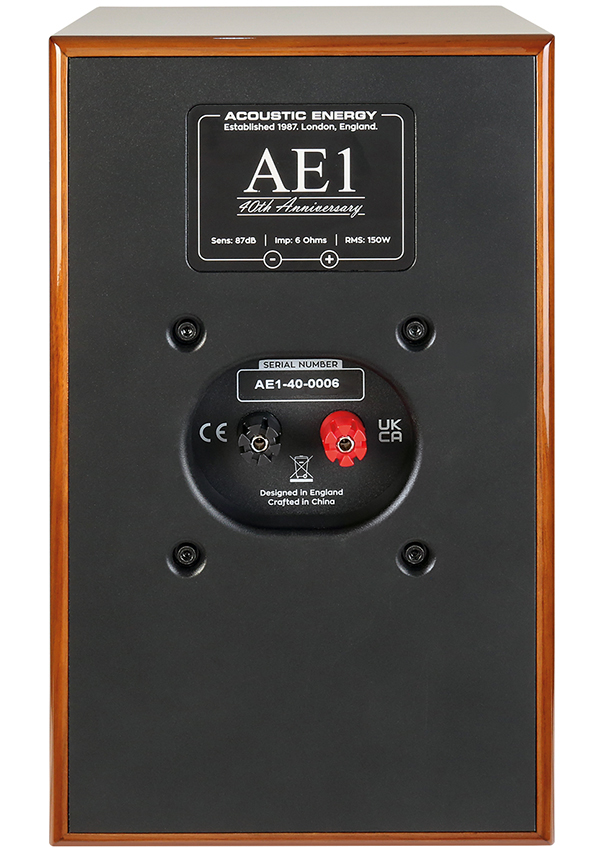
Above: Standard 4mm/cable binding posts are inset to keep the back panel flush with rear wall
This evocation of instrumental tones and character is what seals the AE1 40th’s superstar status. The piano sound in Alice In Chains’ ‘Black Gives Way To Blue’, from the album of the same name [Parlophone 50999 308266 2 5], was superb, as distinctive as the squeals and flutters of Toots Thielemans’ harmonica on ‘Sophisticated Lady’ [Only Trust Your Heart; Concord Jazz]. Meanwhile, the classical guitar that opens Megadeth’s ‘Conquer Or Die’ [Dystopia; Tradecraft] had both smoothness and bite, before distorted guitars crashed into action. The sheer tightness and grip in the midband that the reborn Acoustic Energy AE1s delivered here was something special.
Hi-Fi News Verdict Instead of a nostalgic homage to a fan-favourite standmount, Acoustic Energy’s AE1 40th Anniversary is a subtle upgrade on the original design. Sensibly priced and compact, yet able to fill a room, this two-way should appeal to all but the most bass-hardened hi-fi enthusiasts with a performance that marries speed and articulation with soundstage precision. Fit and finish are firmly on the money too.Sound Quality: 87%
 | |||||||||||

|
|
| |||||||||










 SPONSORED VIDEO






| Equipment Reviews | |
Music Reviews Awards | |
Latest News Features | |
Resources Newsletters | |
Subscriptions |
WHERE TECHNOLOGY BECOMES ENTERTAINMENT
 © 2026 Hi-Fi News
AVTech Media Ltd
All rights reserved