Topping D900 desktop USB DAC PSRM DAC
At the heart of the D900 there’s what Topping refers to as its ‘Pure Switching Reference Module’ (PSRM), an array of 32 resistor/current sources not unlike that seen in the dCS RingDAC [HFN Feb ’25] and Mola-Mola Tambaqui [HFN Nov ’19], among others. It’s typical to address this type of array with a noise-shaped 5-bit PWM datastream (5-bits are sufficient to describe one of 32 possible pulse widths), but Topping claims, instead, to implement a true one-bit DAC. It even uses a data bridge and SRC to convert all incoming streams to DSD256, although the DAC itself is not a true PDM (Pulse Density Modulation) scheme like the TDA1547 bit-converter championed by Philips as part of its DAC7 chipset in the 1990s. That classic DAC created analogue bit pulses, the density of which within a given sample period defined the signal amplitude.
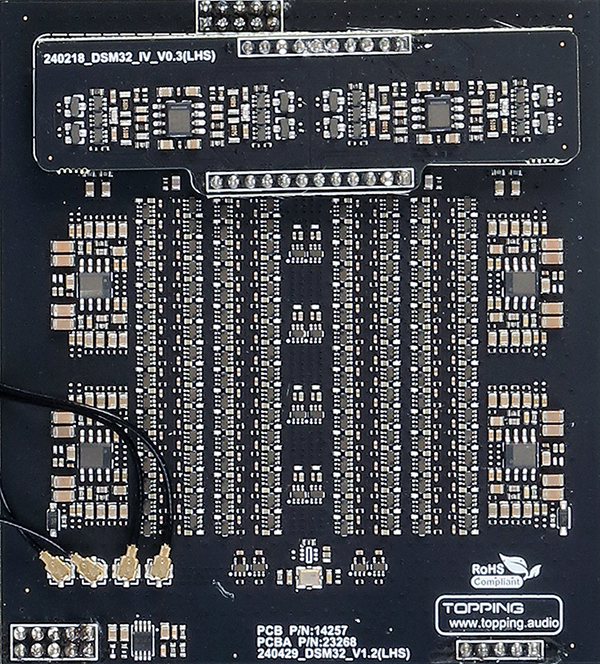
Arguably, the 32 resistors in Topping’s PSRM DAC are something of a red herring, reflecting the elegance of an engineering mind rather than a mathematical necessity. This looks to be a 32-stage FIR DAC, sometimes called a ‘moving-average’ DAC, but 28 or 36 resistors would do the same job. The DAC is fed a DSD256 stream and, like a FIFO (First-in, First-Out) buffer, drops one bit and adds the next per clock cycle while summing each 32-bit block in turn. Importantly, every iteration ‘sees’ the same signal so small differences in chip resistance do not materially affect the running average. Nevertheless, the rise and fall times of the data ‘edges’ will not be perfectly identical, possibly causing noise modulation depending on the numbers of consecutive 0s and 1s. But look closely at the module [inset picture] and we see that there are 64, not 32, resistors per channel. Noise modulation is an odd-order effect, so Topping is running its DAC in differential mode (2x32 resistors) to counter this and also further reduce both noise and (odd-order) distortion.
Following the array, Topping also implements its own I-to-V stage [the narrow and slightly wonky daughter board fitted at the top of our picture]. And one further nugget... In practice the moving-average FIR (Finite Impulse Response) is swamped by Topping’s choice of digital filter which, in this instance, shows significant pre and post-ringing. It is the latter, not the moving-average FIR, that defines the final response(s) and stopband rejection with different incoming sample rates [see PM's Lab Report]. PM
 | |||||||||||

|
|
| |||||||||












 SPONSORED VIDEO






| Equipment Reviews | |
Music Reviews Awards | |
Latest News Features | |
Resources Newsletters | |
Subscriptions |
WHERE TECHNOLOGY BECOMES ENTERTAINMENT
 © 2026 Hi-Fi News
AVTech Media Ltd
All rights reserved